Barbara Kopple's Harlan County USA is often introduced through its obvious credentials: a 1976 documentary, an Academy Award winner, a record of the Brookside coal miners' strike in southeastern Kentucky.[1][2][3] Those facts are true, but they do not yet explain why the film still feels so charged. Its deeper achievement is generic. It takes a labor dispute that could have become a case study, a courtroom of claims, or a heroic protest scrapbook, and turns it into a pressure system. Songs, picket lines, women's meetings, company housing, mine interiors, black lung testimony, funerals, guns, and title-card economics all become parts of one field.
That is why a movement-and-genre reading suits the film. Harlan County USA belongs to the post-1960s American documentary moment when small crews, portable cameras, direct sound, and political commitment could meet subjects at close range. TCM describes the film as intimate and passionate, while AFI's production history notes that Kopple and her crew spent eighteen months in Kentucky and cut roughly fifty hours of material into a 103-minute feature.[1][2] The film's force comes from that scale mismatch. The finished movie is tight, but it carries the density of long residence.
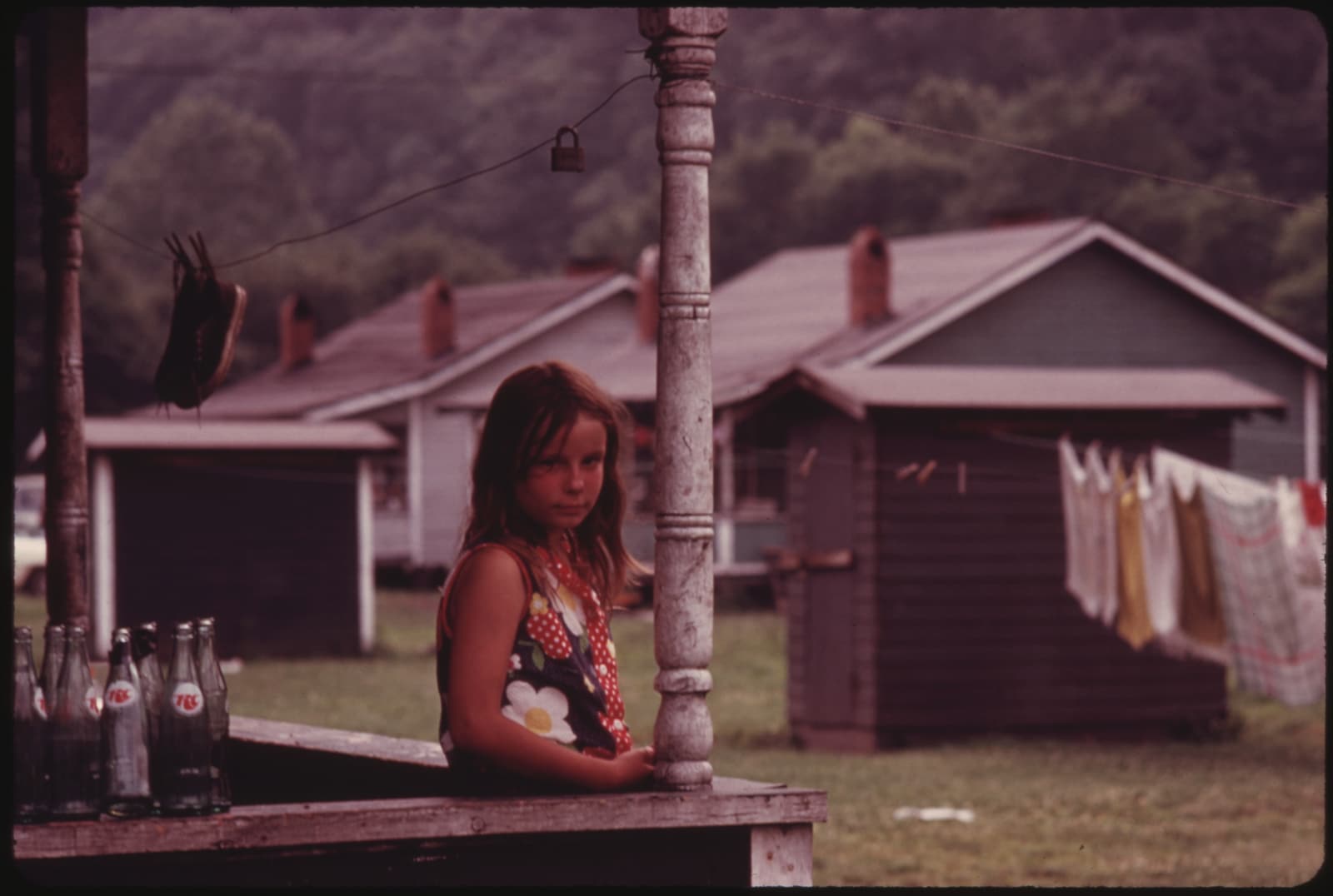
Image context: the cover photograph was taken by Jack Corn in June 1974 during the Brookside strike. It shows a miner's daughter on the porch of a company-rented house, with the archive caption noting eviction threats during the conflict.[6] That makes it a precise companion image for the film's method: the strike is not reduced to the mine gate. It spreads into domestic space, family vulnerability, and the visible conditions under which solidarity has to keep being made.
Labor Documentary As Lived Proximity
AFI's history gives the strike's legal and economic spine in compressed form: miners at Brookside voted in 1973 to join the United Mine Workers of America, and Duke Power's Eastover Mining Company refused to sign the contract.[2] Britannica gives the human version of the same sequence, describing a bloody thirteen-month struggle by miners and their families before the contract was signed.[3] Kopple's film is powerful because it refuses to choose between those registers. It needs the facts of ownership and bargaining, but it also needs the sound of people deciding what those facts will cost them.
The film's opening problem is therefore not simply "what happened?" It is "what does a strike feel like when the contract delay becomes daily life?" In a weaker labor documentary, ordinary intervals might be treated as connective tissue between events. Kopple treats them as evidence. Waiting, singing, arguing, driving, standing outside a mine gate, sitting through meetings, and watching company forces move nearby all become part of the drama. The film makes pressure cumulative rather than episodic.
That choice matters because the Brookside conflict was never only a workplace dispute. Britannica's account notes that the completed film includes archival labor footage, protest songs, scenes inside the mine, a funeral for a young miner shot on the picket line, and meetings of miners' wives, widows, mothers, and daughters.[3] That range is not scattershot. It is the genre argument. Labor documentary becomes serious when it understands that work is not bounded by the worksite. Wages, danger, housing, family care, union democracy, medical vulnerability, and public reputation all move together.
The Women's Meetings Change The Film's Center
One reason Harlan County USA has not aged into a simple union document is that the film keeps shifting where authority lives. The men are fighting for a contract and safer work, but the women repeatedly become the film's practical and moral engine.[3] They organize, argue, block, shame, sustain, and absorb retaliation. Kopple does not frame them as background wives lending emotional color to male labor history. She shows them as political actors whose knowledge comes from household economics and from the direct danger of living under company power.
This is where the archival porch photograph sharpens the movie's stakes.[6] A company house is not neutral shelter when the company is also the force across the bargaining table. A child on a porch, laundry in the yard, an outhouse in the background, and an eviction threat in the caption all tell the same story: the strike has entered the domestic frame before the film has to dramatize anything. Kopple's movie keeps returning to that kind of entanglement. The public picket line and the private home are not separate worlds. They are two ends of the same pressure.
The result is a documentary that treats speech as action. Meetings are not dull procedural scenes on the way to more cinematic conflict. They are where political identity is forged. A person stands up, tests a phrase, is interrupted, is answered, and gradually a group learns what it can say in common. That is as important to the film's movement as any confrontation with strikebreakers or police, because the documentary is watching a community make itself legible under stress.
Songs Are Evidence, Not Decoration
TCM's production note stresses the soundtrack's importance, especially Hazel Dickens's voice and Florence Reece's "Which Side Are You On?" while also crediting original music by Dickens and Merle Travis.[1] The International Documentary Association's retrospective similarly treats bluegrass union songs as the film's backbone.[4] That music is not a prestige garnish laid over raw footage. It is part of the documentary's evidence system. Songs carry memory, anger, injury, and allegiance across generations of coalfield struggle. They let the film move between immediate Brookside events and older histories without flattening either one into lecture.
This is especially important for a movie about organized labor because so much of the conflict turns on who gets to describe reality. Company language can make the strike sound like a contract inconvenience, a disruption, or a local management problem. The songs answer in a different register. They preserve lived testimony in repeatable form. They make hardship public, portable, and hard to neutralize.
Kopple's formal intelligence lies in knowing when music should lead and when it should withdraw. The film does not need to sentimentalize the miners because the circumstances are already severe. Instead, music gives the documentary a collective memory larger than any single character. It also keeps the film from becoming merely observational. Harlan County USA observes closely, but it is not neutral. Britannica notes Kopple's own political stance, and TCM frames the conflict as miners trying to unionize against violent company resistance.[1][3] The music makes that stance audible without replacing the hard work of watching.
Danger Enters The Camera's Space
The film's proximity has a cost. AFI records Kopple saying that she, the crew, and the miners had to arm themselves against company gunmen during the time they spent in Brookside.[2] Britannica recounts a moment when a gunman hired by Duke drove past a picket line, fired on strikers, and aimed toward Kopple and her cameras.[3] Those details can sound like production legend, but in the film they clarify something more important: the camera is inside the field of force it is documenting.
That position changes the documentary's ethics. Kopple is not filming danger as spectacle from a secure distance. Nor is she pretending that the camera has no effect. The film's presence becomes part of the strike's public visibility. AFI notes that the movie later opened through union discounts and fundraising events, and the International Documentary Association's later retrospective treats the film as a durable landmark in documentary and labor-film culture.[2][4] The documentary did not end at the last shot. It became part of labor memory, film culture, and preservation history.
The form is therefore less like detached reportage than embedded public witness. That does not mean every claim inside the strike is beyond scrutiny. It means the film acknowledges that some conflicts cannot be filmed from nowhere. To stand close enough to see power working is already to have chosen a place from which to see.
Why The Genre Still Matters
BFI's film page gives the minimal catalog facts: Harlan County USA, 1976, Barbara Kopple, documentary.[5] The plainness of that listing is useful because the film's afterlife has made it canonical enough to risk abstraction. It should not become only a "great documentary" title. Its greatness lies in a set of practical choices that remain instructive.
First, the film treats collective life as cinematic. It does not wait for one protagonist to simplify the conflict. Second, it treats music, meetings, and domestic space as structural material, not as atmosphere. Third, it refuses the false boundary between labor politics and family life. Fourth, it shows that access is not just a logistical achievement. Access becomes meaningful only when the film has the patience to understand what ordinary time is doing to people.
That is why Harlan County USA still cuts through contemporary documentary habits. A lot of nonfiction cinema now excels at archival assembly, expert narration, and polished argument. Kopple's film reminds us of another path: stay with a community long enough that the argument emerges through repeated pressures rather than explanation alone. The picket line matters, but so does the porch. The contract matters, but so does the song. The mine matters, but so does the meeting where someone discovers that fear can be answered in public.
In that sense, the film is not only a document of Brookside. It is a model for labor documentary as a genre of relation. It shows work as a social system, power as something that travels through homes and bodies, and cinema as a tool that can make those travels visible without pretending to stand outside them. The coalfield does not become symbolism. It remains a place, with people in it, under pressure. Kopple's achievement is to make that pressure readable without draining it of life.[1][2][3]
Sources
- Turner Classic Movies, Jeff Stafford, "Harlan County, U.S.A. - Harlan County, USA" article.
- AFI Catalog, "Harlan County, U. S. A." entry, with production history, title-card details, credits, and release notes.
- Encyclopaedia Britannica, "Barbara Kopple" biography, including the Harlan County U.S.A. section.
- International Documentary Association, "Barbara Kopple's Harlan County, U.S.A. (1976)" retrospective.
- BFI, "Harlan County, USA (1976)" film page.
- Wikimedia Commons, Jack Corn / NARA, "One of the daughters of Jerry Rainey..." June 1974 DOCUMERICA photograph from the Brookside strike.