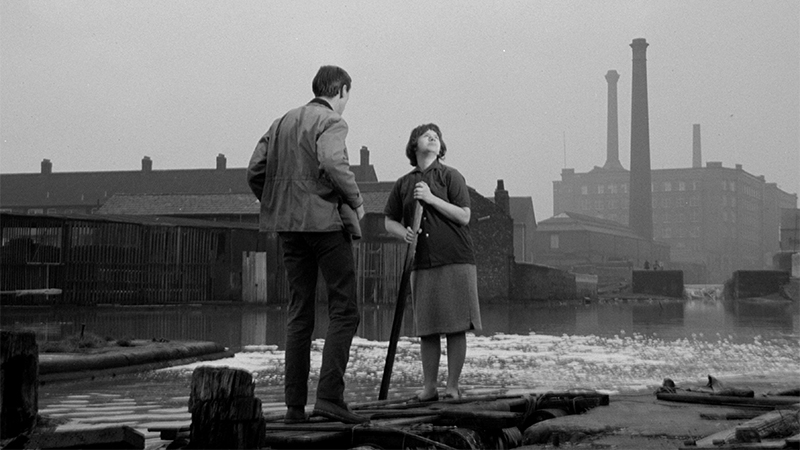
Spoiler note: this essay discusses the household's breakup and the final scene.
Geoffrey offers to marry Jo, and she refuses. In another film, that might settle whether these two people have a future together. In A Taste of Honey, it leaves the more interesting question open: what have they already made by living together? A pregnant teenager and a gay student can share a home, prepare for a baby, and need each other's company without becoming a romantic couple.[3][7]
Tony Richardson's 1961 film, adapted with Shelagh Delaney from her play, stars Rita Tushingham as Jo and Murray Melvin as Geoffrey. Their friendship develops amid the rented rooms and industrial streets of the Manchester area.[1] Its tenderness has a practical test: whether the person who provides care gets to stay.
A room someone else can rearrange
Jo has learned that home is provisional. The film opens with her mother, Helen, getting them out of their lodgings without paying the rent.[7] When Helen finds a prospective husband in Peter, her daughter's place in the arrangement becomes negotiable. Steve Vineberg's account of the film draws out the conflict during their seaside outing: Jo insists on coming along, then makes the adults' afternoon sufficiently uncomfortable that Peter wants her sent home.[5]
Jo's abrasiveness matters. She cannot secure her mother's attention simply by being lovable, and she declines to make abandonment convenient. The quarrel lets Tushingham play a difficult daughter whose difficulty has a history. We can understand why Peter loses patience while seeing what his impatience costs her.
Dora Bryan's Helen also brings appetite and comedy to the screen. Her wish for another life is intelligible. The injury comes from making Jo absorb its consequences. Affection can survive between them while the arrangements for living together repeatedly fail.
The city gives them breathing space
Richardson and cinematographer Walter Lassally take the play beyond its interiors. Colin MacCabe emphasizes the canals and streets, including the shot of Jo watching Jimmy, the sailor she loves, depart aboard his ship.[2] Distance becomes something the image can measure. Jo can still see him when she can no longer keep him near.
The setting has material variety, too. Criterion producer Elizabeth Pauker records that Lassally used three film stocks, selected for their different grain and relationship to the art direction, while shooting in Salford and Blackpool.[4] The roughness of these surfaces was a photographic choice. Walls, water, and faces belong to a world with texture, rather than a neutral background for social problems.
Open space also permits exhilaration. Near Stockport Viaduct, Jo announces her singularity to Geoffrey, spreading her arms against the sky. Thirza Wakefield's BFI essay places this moment alongside Jo's dancing and playful posing.[3] Tushingham's body briefly occupies more space than any cramped room allows. A film about insecure housing still finds room for showing off.
The offer she can refuse
Geoffrey's proposal gives their improvised household a familiar possible name. Jo's answer is startlingly severe: “You're nothing to me; I'm everything to myself.” Wakefield quotes the exchange as part of her discussion of working-class women's demands for lives of their own.[3]
The line wounds because Geoffrey matters. Her dependence on him does not cancel her wish to decide what that dependence means. Marriage would make their situation easier to explain to other people; it would also ask Jo to accept a description of herself that she resists.
Her refusal tests our sympathy. Valuing Geoffrey's kindness need not mean Jo owes him a marriage. Respecting her independence need not make her answer kind.
Kindness has an unequal price
Geoffrey's attention extends to preparations for motherhood. Glenn Erickson's review discusses the doll supplied through the health service and Jo's angry response to it, as well as Geoffrey's patient attempts to help.[6] An object intended to make childcare comprehensible instead exposes how frightening the expected role feels. He stays with the problem after the reassurance fails.
There is a limitation in the film's generosity toward him. Vineberg observes that we never see Geoffrey with a male partner and argues that the character is romanticized.[5] His capacity to care receives far more space than his own desires. That imbalance complicates the household's warmth: the film lets us know what Jo receives from him more fully than what he might want beyond her.
A celebration cannot keep him there
Helen's return displaces Geoffrey; she even tells him to take away the cot he has made for the baby.[7] At the end, he lingers near the children and bonfire, looking toward Jo before leaving.[5] Guy Fawkes Night supplies a public celebration while the private arrangement comes apart; the final image of Jo with a sparkler leaves her future unsettled.[6]
The street remains alive. That is what makes the ending hurt. Nothing in the surrounding festivity stops because someone has lost his place in a home.
For me, the household's breakup changes the question raised by the proposal. Jo and Geoffrey have already demonstrated that care can exist without a couple. What they have been unable to establish is a secure place for it. When the mother returns, the friend who has been doing so much of the family's work can still be treated as a visitor whose stay is over.
Sources
- BFI, A Taste of Honey — film details, cast, credits, and synopsis for Tony Richardson's 1961 adaptation.
- Colin MacCabe, “A Taste of Honey: Northern Accents,” The Criterion Collection, August 23, 2016 — adaptation, location photography, Jimmy's departure, and the accompanying film still.
- Thirza Wakefield, “Night animals: the women of Woodfall,” BFI, May 25, 2018 — Jo's refusal of marriage, playfulness, and declaration at Stockport Viaduct.
- Elizabeth Pauker, “10 Things I Learned: A Taste of Honey,” The Criterion Collection, August 26, 2016 — production research, especially Lassally's locations and use of three film stocks.
- Steve Vineberg, “Recovering a Lost Treasure: The Criterion Blu-ray Release of Tony Richardson's A Taste of Honey (1961),” Critics at Large, April 22, 2017 — the seaside outing, Helen's return, Geoffrey's departure, and the limits of his characterization.
- Glenn Erickson, “A Taste of Honey,” Trailers from Hell, August 15, 2016 — written review discussing preparations for motherhood, Geoffrey's care, and the unresolved Guy Fawkes Night ending.
- Peter Viney, “A Taste of Honey (1961)” — film retrospective documenting the opening departure, Geoffrey and Jo's shared home, and Helen's rejection of his cot.