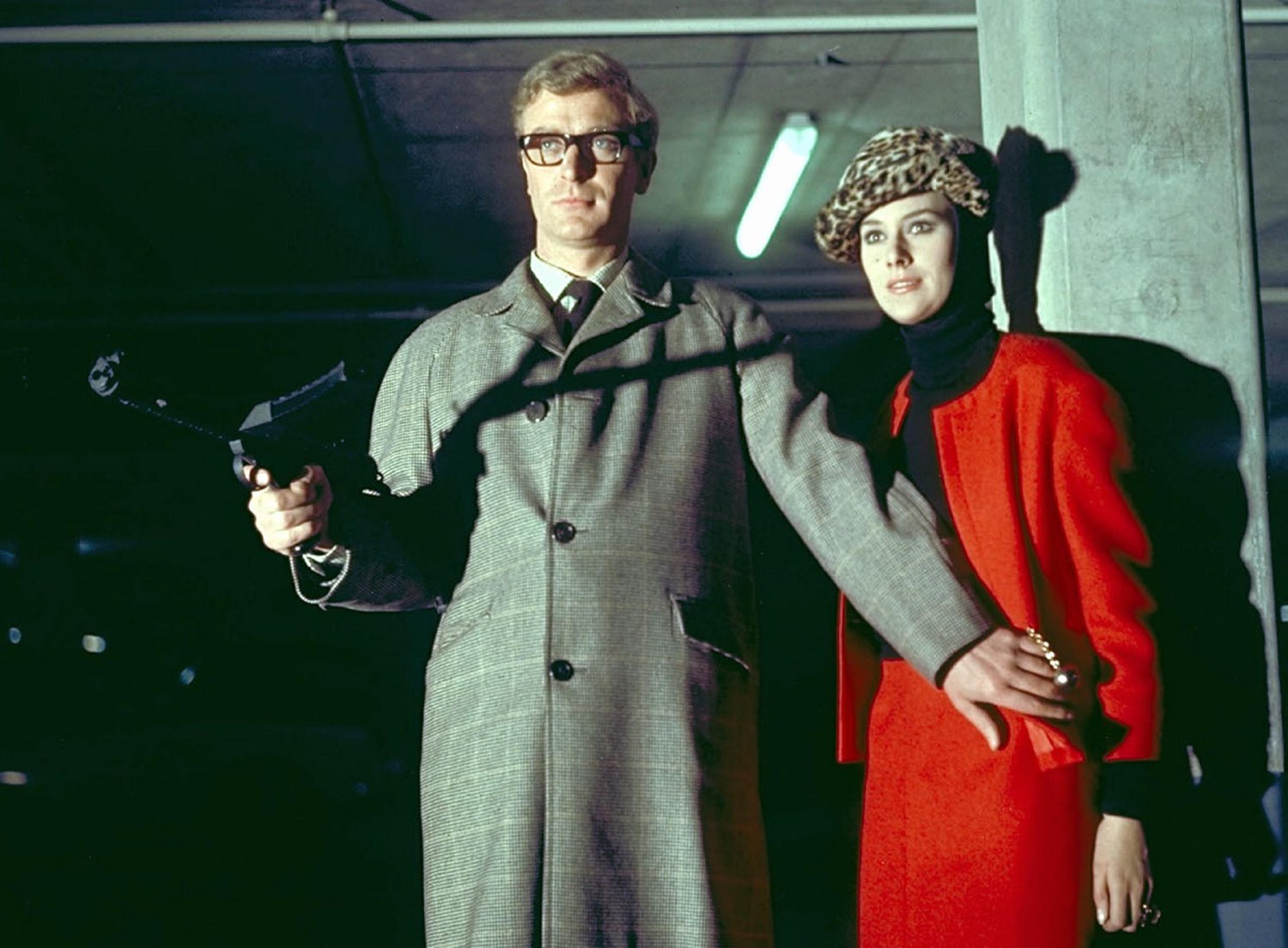
In The Ipcress File (1965), a wide screen offers Harry Palmer remarkably little room to feel comfortable. Sidney J. Furie and cinematographer Otto Heller push faces into unexpected parts of the composition and make colour and angles compete for attention. The BFI describes a London-bound spy whose surroundings are as shabby as his employers are untrustworthy.[1] Width becomes another way of putting pressure on Michael Caine.
That expansive image began with a particularly economical piece of film. The Ipcress File used Techniscope, a system that exposed a frame only two perforations high.[3] Its proposition was practical: give filmmakers a wide composition while moving half as much negative through the camera. The cinema audience would receive a familiar kind of print. The unfamiliar work happened earlier.
A shorter step through the camera
Perforations are the regularly spaced holes along the film's edges. In conventional four-perforation 35mm photography, the mechanism advances the strip by four holes for each new frame. Techniscope shortened that step to two. It retained the width but reduced the frame's height, producing a wide image directly with ordinary spherical lenses.[2][3]
The saving was measurable. Kodak describes two-perforation photography as using 50 percent less stock and processing than four-perforation capture; a 400-foot magazine runs for roughly nine minutes.[4] For a crew, that means more uninterrupted camera time between reloads. Whether those minutes become a longer performance, another attempt, or simply fewer interruptions depends on the production.
It does not mean a film costs half as much to make. The actors, locations, lighting, costumes, transport, and days on the schedule do not shrink with the negative. The saving belongs to a particular part of the budget, and realizing it requires equipment and finishing arrangements that accommodate the format.
Spherical lenses mattered too. The Pixel Farm's guide to restoration formats notes their availability and potential advantages in speed and close focusing compared with anamorphic equivalents.[3] A producer could economize on film while a cinematographer gained useful lens choices. Those are related benefits, but neither guarantees a compelling picture.
The laboratory supplied the squeeze
Techniscope separated the shape photographed from the shape distributed. Frederick Foster's contemporary explanation in American Cinematographer describes optical printing that enlarged the short negative image vertically by a factor of two. The resulting four-perforation print carried a squeezed image for anamorphic projection.[2] The theater's lens restored its proportions on screen.
The practical consequence was significant: the production could use a different camera format without asking every exhibitor to adopt a two-perforation projector. Compatibility was achieved in the laboratory. The release print concealed the unusual route by which the image had arrived.
That route also reached the cutting bench. Foster quotes editor Frank Keller explaining that narrow frame lines made conventional negative splices liable to show. Alternating scenes between A and B negative rolls avoided that problem, but required spare frames around cuts. Keller reported difficulties inserting a reaction shot or making a very short jump cut.[2]
This is the less glamorous side of a format innovation. A saving made while the camera runs can create a constraint when the editor wants to remove a moment. The film strip remains a physical object throughout the process; its geometry can affect the timing of a glance as well as the bill for raw stock.
Economy does not dictate the image
The Ipcress File makes a useful test case because its visual ambition is so conspicuous. Edward Milward-Oliver's BFI production account places the first day's shooting in a vacant building near Victoria Station in September 1964. The building served as both location and production offices, while Ken Adam devised the film's economical production design.[5] Resourcefulness belonged to the production as a whole.
Yet economy does not explain the peculiar unease of its compositions. The BFI's account of Heller and Furie's angular framing identifies deliberate choices about where bodies and colours sit.[1] The format supplied a rectangle. The filmmakers made that rectangle inhospitable.
In the BFI's photograph, Caine's outstretched arm crosses Sue Lloyd's vivid red coat; a concrete column cuts off the space behind her. The photograph does not establish the projected aspect ratio. But its compressed bodies and hard surfaces make a useful companion to a film in which space repeatedly feels controlled by somebody else.[5]
A smaller negative leaves a visible bargain
There was a cost in image texture. The Pixel Farm notes that two-perforation material generally looks grainier than full-height four-perforation anamorphic photography because of its smaller exposure area. It also identifies gate hairs as a restoration problem: debris that might fall outside another format's final crop can intrude into this tightly used frame.[3]
The bargain can become an aesthetic preference. In Kodak's February 2026 account of Rabbit Trap, cinematographer Andreas Johannessen describes choosing two-perforation 35mm partly for its texture and the softness it could bring to landscapes. That production processed and scanned its film at Cinelab before a digital finish.[4] The short camera frame survived, while the later stages differed from the historical Techniscope printing chain.
Techniscope's enduring idea is therefore a division of labour. The camera conserves material; the finishing process prepares the image for its audience. Between those stages, filmmakers decide how much texture, flexibility, and complication they can use. A wide screen begins as an allocation of a very small surface—and becomes expressive only when somebody decides what belongs inside it.
Sources
- British Film Institute, “The Ipcress File (1965)” — credits, Harry Palmer's milieu, and Furie and Heller's framing.
- Frederick Foster, “Techniscope—What It Is and How It Works,” American Cinematographer, reproduced by the American WideScreen Museum — camera modification, optical enlargement, and Frank Keller's account of negative cutting.
- Adam Hawkes, “Identifying Film Formats,” The Pixel Farm, June 26, 2024 — the “35mm 2 perf / Techniscope” section, including lenses, grain, restoration issues, and The Ipcress File.
- Kodak, “DP Andreas Johannessen FNF harnessed KODAK 2-perf 35mm to deliver a haunting atmosphere for Bryn Chainey's supernatural drama ‘Rabbit Trap’,” February 16, 2026 — consumption, magazine duration, cinematographer interview, and finishing workflow.
- Edward Milward-Oliver, “Moviegraphic: The Ipcress File,” BFI, March 17, 2015 — the accompanying production account and the film photograph reproduced here.