Spoiler note: this essay discusses the film's premise, recurring images, and ending logic, though A Page of Madness is less twist-driven than perception-driven.
Teinosuke Kinugasa's A Page of Madness (1926) begins with a storm and never quite lets the viewer find dry ground. Rain, bars, corridors, faces, masks, dancers, spinning light, and shattered bits of domestic memory arrive in a rush. A conventional summary is possible: a former sailor takes work as a custodian in the asylum where his wife is confined, hoping to remain near her and perhaps repair the damage he helped cause.[2][3][4] But the film's force comes from how strongly it resists the comfort of summary. It makes plot feel like something the viewer has to assemble under pressure.
That pressure is historical as well as formal. Routledge describes the film as a black-and-white silent Japanese work celebrated for experimental cinematic form, made with links to the Shinkankakuha, or New Impressionist School, and with Yasunari Kawabata involved in the story's development.[1] Japan Society similarly frames it as a late Taisho independent film tied to avant-garde modernism, one that omits intertitles and uses rapid montage and oblique storytelling to enter its characters' uninhibited emotions.[3] Those facts matter because the movie is not simply "weird" in a timeless way. It belongs to a moment when cinema was arguing with literature, theater, imported European modernism, Japanese exhibition practice, and its own still-forming grammar.[1][2][3]
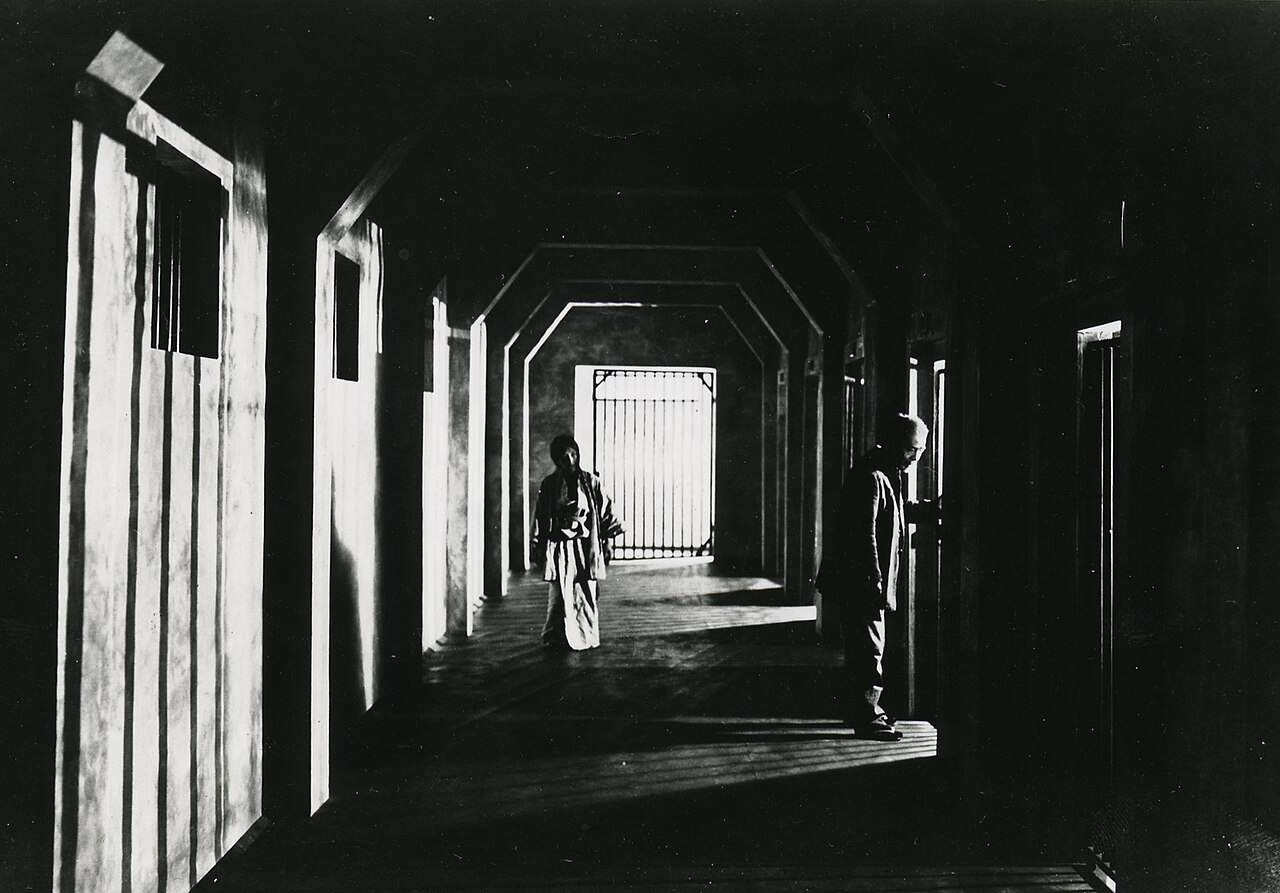
The asylum is a machine for separating people
The film's most stable fact is architectural. Almost everything important happens under the pressure of the asylum: hallways, cells, barred openings, offices, gates, and rooms where looking is never neutral.[2][4] This is why the custodian's job is such a sharp dramatic device. He is close to his wife but not truly with her. He can sweep, watch, plead, remember, imagine, and sometimes cross a threshold, yet the institution keeps turning proximity into separation.
TCM's Chris Fujiwara, drawing on Aaron Gerow's work, notes that the asylum architecture and the narrative construction impose a "logic of separation."[2] That phrase catches the movie's deepest rhythm. The husband and wife are separated by illness, guilt, social order, medical authority, and physical barriers. Their daughter is separated from the full truth by the threat that knowledge of her mother's confinement could damage her marriage prospects.[2] Even the viewer is separated from ordinary narrative confidence because the movie denies intertitles and keeps shifting from exterior action to interior pressure.[2][3]
The corridors therefore do more than provide spooky atmosphere. They organize the film's ethics. A barred door is not only a horror image; it is a question about who gets to define sanity, family responsibility, and release. When the custodian tries to turn care into rescue, the film refuses to make the act simple. He may be devoted. He may also be trying to hide an uncomfortable social fact. His desire to liberate his wife is tangled with shame, control, and the need to protect his daughter's future.[2][4] The asylum makes those motives visible by forcing every gesture through a door.
Montage turns sympathy into disorientation
The film's famous experimental style does not sit on top of the story. It is the story's method. BFI's centenary note describes a sad story told through bold experimental form, with horror and bereavement carried less by narrative clarity than by rapid cuts, fast camera movement, and non-linear storytelling.[4] That is a useful map, but the experience is less tidy than the list of techniques. The viewer is not asked to identify a device and move on. The viewer is made to feel what happens when techniques compete for control of reality.
Rapid cutting breaks the stable relation between body and place. Superimpositions let one mental state leak into another. Distortions and visual patterns make the asylum feel less like a single building than a pulse that changes shape according to fear, memory, or fantasy.[2][4] The result is not pure subjectivity. It is more unsettling than that. The movie keeps sliding between what might be happening, what might be remembered, what might be feared, and what might be staged for us as a visual equivalent of emotional pressure.
This is where A Page of Madness separates itself from a later, simpler idea of "dream logic." The film still has family stakes, institutional routines, and recognizable melodrama.[2][5] Its radicalism comes from scrambling access to those stakes. We know enough to care, but not enough to relax. The former sailor's guilt is readable; the wife's suffering is visible; the daughter's marriage anxiety is socially specific. Yet the film's images repeatedly interrupt any stable moral arrangement. The more the viewer tries to orient the story, the more the editing exposes orientation itself as fragile.
No intertitles does not mean no language
Modern viewers often treat the lack of intertitles as the film's great declaration of silence. It is, but only partly. TCM emphasizes an important exhibition context: A Page of Madness was originally shown in a Japanese silent-film culture where benshi narrators were expected, and those performers could explain plot, supply background, and voice characters' feelings.[2] Japan Society's note on the film's omission of intertitles is accurate, but the absence did not necessarily leave 1926 viewers alone in the same way it leaves many viewers alone today.[3]
That changes how the film should be read. The lack of written titles is not simply a modernist dare in which story disappears. It is also a wager on live mediation, performance, and the visual track's ability to carry sensation even when narration might help carry plot.[2][5] Gerow's excerpt is especially valuable here because it warns that our encounter with the film is troubled by textual instability: the surviving version is shorter than the 1926 censorship records indicate, and the current print may have been deliberately cut after release or around the 1970s revival.[5]
In other words, the difficulty of A Page of Madness is not one thing. It comes from artistic choice, exhibition practice, missing or altered material, and the distance between contemporary spectators and the conditions of Japanese silent cinema.[2][5] That complexity actually strengthens the film as an object of close reading. Its brokenness is not a defect to explain away. It is part of what the surviving film now means. We watch a work about unstable perception through a print whose own history has become unstable.
Horror arrives as a failure of borders
The film is often classified as avant-garde drama or early psychological horror, and both labels are useful as long as neither one tames it.[1][4] The horror is not only that people are confined in an asylum. It is that boundaries stop doing what boundaries promise. Inside and outside blur. Memory and present action blur. Care and coercion blur. The custodian's identity as husband, worker, rescuer, and possible source of harm keeps shifting according to the image pressure around him.[2][4]
This is why the dancer and mask imagery feels so central even when it does not advance plot in the usual way. Performance becomes one of the film's languages for mental fracture. Faces are covered, repeated, exaggerated, or thrown into unstable relation with bodies. A person in this movie is rarely just a psychological interior waiting to be explained. A person is a surface under stress: watched by others, edited by the film, divided by architecture, and rewritten by memory.
The asylum's barred light makes that division physical. The most haunting images are not the most spectacular ones but the ones that make perception feel trapped in a pattern. A corridor recedes, but it does not liberate. A door opens, but not into clarity. A face becomes expressive, then unreadable. Kinugasa's close reading of space is therefore harsher than simple expressionist decoration. The film makes visual style behave like an institution: it sorts, separates, repeats, and sometimes overwhelms.
Nearly a century later, A Page of Madness still feels abrasive because it refuses to choose between human story and formal assault.[1][2][4] The former sailor's guilt gives the film its emotional thread. The asylum gives it a social structure. Montage gives it a nervous system. The missing or altered print history gives it an afterlife in which uncertainty is not merely inside the images but around the object itself.[5] The film's achievement is that all these instabilities rhyme. It does not merely show madness as subject matter. It makes orientation, spectatorship, and memory feel precarious enough that the viewer has to work through the asylum too.
Sources
- Routledge Encyclopedia of Modernism, "A Page of Madness (1926)" - film overview, Shinkankakuha context, and authorship note.
- Chris Fujiwara, "Page of Madness aka Kurutta Ippeiji - A Page of Madness," Turner Classic Movies, 2011 - production, reception, benshi context, and formal analysis.
- Japan Society, "A Page of Madness / Grass Labyrinth" - program note on Taisho modernism, missing intertitles, montage, and 1971 rediscovery.
- Pamela Hutchinson, "10 great films of 1926," BFI, 2026 - centenary note on A Page of Madness, rapid cuts, non-linear storytelling, horror, and bereavement.
- Aaron Gerow, excerpt from A Page of Madness: Cinema and Modernity in 1920s Japan - print history, censorship records, and surviving-version caveats.
- Wikimedia Commons, "File:A Page of Madness - 1926.jpg" - Kinugasa Productions scene still used as the article image.