Forough Farrokhzad's The House Is Black lasts only about twenty-two minutes, but it has the density of a much larger film.[1][4] Its subject is life in a leper colony; its method is harder to summarize. Farrokhzad films faces, bandages, classroom exercises, meals, prayer, play, work, medical treatment, and ordinary movement, then binds them with voiceover that draws on scripture and poetry.[1] The result is not a report that has been decorated with lyricism. It is a film in which lyric form becomes the only honest way to hold competing facts at once: physical suffering, social exclusion, religious language, human dignity, and the dangerous comfort of spectatorship.
That danger is the center of the film. A viewer can approach The House Is Black expecting either a humanitarian document or an avant-garde poem. Farrokhzad refuses to let either expectation remain clean. Janus's film note describes the work as a portrait of inhabitants who live, worship, learn, play, and celebrate inside a self-contained community cut off from the wider world.[1] That phrase matters because the colony is not treated merely as a container for disease. It is a social world. Children recite lessons. Adults gather. Faces meet the camera. Bodies bear marks that cannot be sentimentalized away, yet the film never lets those marks become the whole person.
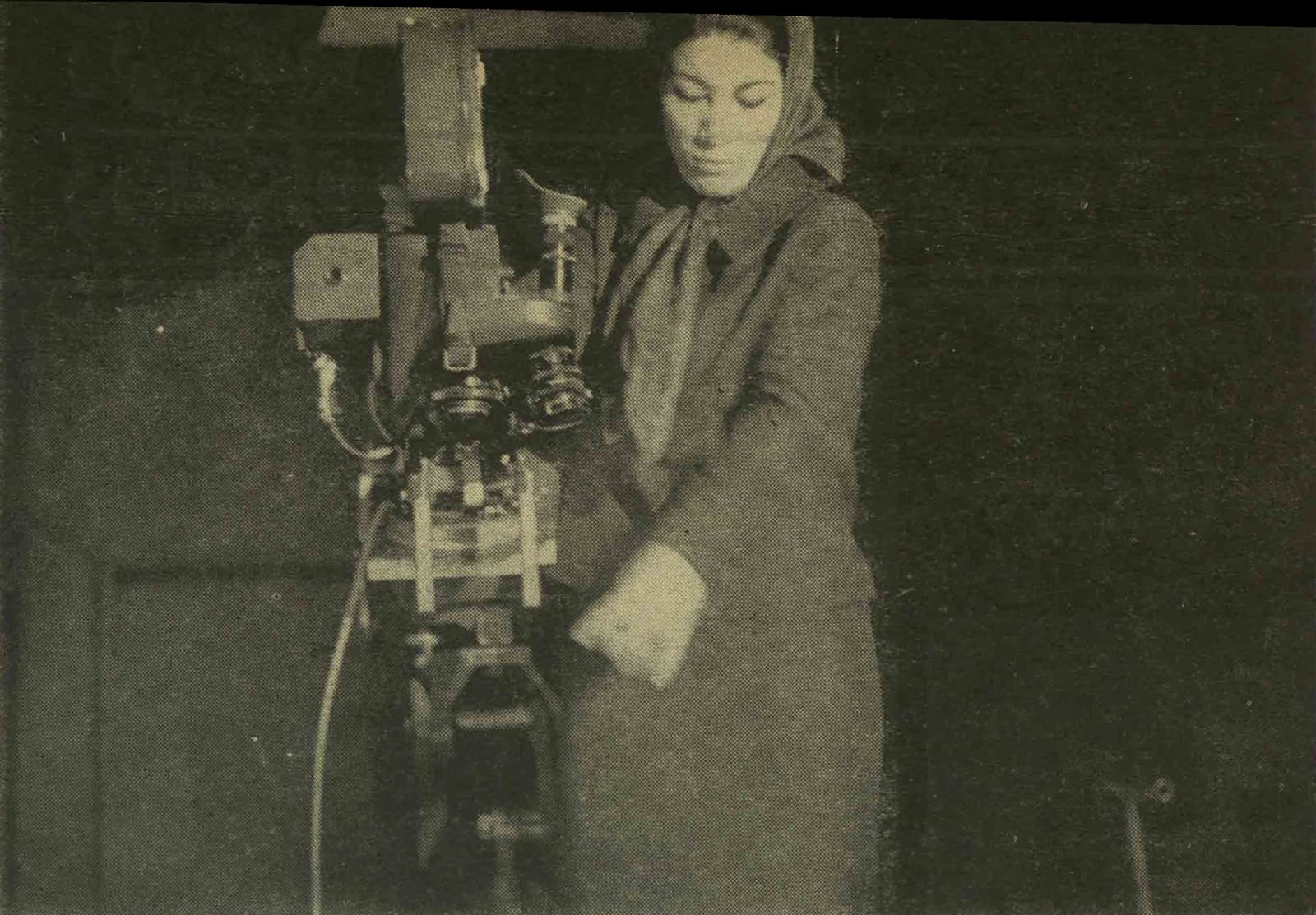
Image context: the cover uses a real archival photograph, published in the Iranian magazine Sepid-o-Siah and preserved on Wikimedia Commons, showing Farrokhzad at work during the making of the film.[5] A production image is the right visual anchor because this close reading is about method: the discipline behind a film that keeps asking what it means to look directly without turning another person's condition into possession.
The film's first argument is distance
The most radical thing about The House Is Black is not that it looks at visible illness. It is that it keeps changing the moral distance of the look.[1][2] Farrokhzad does not hide damaged skin, altered features, or medical routines. She also does not arrange them as shock material. The camera is direct, but it is rarely triumphant about its own courage. A face appears, a hand moves, a child answers, an adult continues a task, and the frame has to accept that the person on screen exceeds the viewer's first reaction.
This is why the film's close-ups do not behave like conventional documentary evidence. They are not simply proof that suffering exists. They are encounters that make the viewer aware of the habits used to manage suffering from a distance: pity, religious explanation, clinical classification, aesthetic admiration, and the wish to move on. Maryam Ghorban Karimi's study is useful here because it treats the film's visual composition and editing as inseparable from Farrokhzad's poetry, arguing that the images move beyond first impressions through montage and arrangement.[2] That is exactly what the close-ups do. They do not let the viewer stop at the first impression of disfigurement. They demand a second act of seeing.
The film's title helps set that trap. "The house" can sound like a place already condemned: black, enclosed, other. But the film keeps finding light inside the enclosure, not as uplift imposed from outside but as a visual fact of people continuing to live. Janus stresses that Farrokhzad finds grace where few would think to look, and the wording is apt if grace is understood as attention rather than consolation.[1] The film is not saying that beauty redeems disease. It is saying that a camera that only sees disease has failed.
Voiceover does not explain the images; it pressures them
The narration is sometimes described as poetic, but that word can make the technique sound soft. In practice, the voiceover is severe. It places religious, philosophical, and poetic language against images that resist easy moral accounting.[1][3] The effect is not illustration. The words do not arrive to explain what the viewer has just seen. They make the seeing more unstable.
Kamran Talattof's Cinema Iranica essay places the film inside a larger Iranian tradition of poetic moving images and notes how Farrokhzad "married pictures and poems" in this short documentary.[3] The marriage is tense. A line can make the colony feel cosmic, as though the film were asking questions about creation, judgment, darkness, and mercy. Then the cut returns us to a hand, a classroom, a bandaged face, or a body at work. The scale collapses from metaphysical to physical and back again.
That oscillation is the film's moral engine. If the voiceover were only humanist, it might soften the images into compassion. If the images were only observational, they might become ethnographic display. Together they make a harsher demand. The viewer has to think about how societies make some lives remote, how religious language can console and distance at the same time, and how poetry can either aestheticize pain or force attention toward it.
Farrokhzad's great formal intelligence lies in never allowing one register to win. The medical image is not the final truth. The prayer is not the final truth. The child's recitation is not the final truth. The montage moves because each register corrects the others. A body is a body, a citizen is a citizen, a sufferer is a person with habits and relations, and a beautiful image remains ethically incomplete unless it can survive contact with the person it frames.[1][2][3]
The schoolroom turns stigma into a lesson about language
The schoolroom scenes are among the film's most piercing because they change the implied audience. For a moment, the film is not addressing us first. It is watching children learn how a world speaks. That matters in a film about stigma. Leprosy has already named the colony from outside; the children are inside a second naming system, repeating, answering, being taught, and being seen.
This is where Farrokhzad's montage becomes especially exact.[2][3] The schoolroom does not cancel the medical scenes. It reframes them. The viewer is forced to hold illness and education in the same mental space, which means the colony can no longer be reduced to a place where history has stopped. It has futures, routines, mistakes, impatience, and instruction. The children are not symbols of innocence placed there to soften the film. They are participants in a social world that the film insists on treating as active.
The same logic governs the film's treatment of prayer and ritual. Worship in The House Is Black is not background atmosphere. It is one of the ways the community organizes time, speech, and endurance.[1] But Farrokhzad's editing keeps ritual from becoming a simple explanation. Prayer coexists with bandages. Faith coexists with exclusion. Gratitude coexists with visible neglect. The film understands that language can help people live inside suffering while also making it easier for others to leave suffering structurally unchanged.
The colony is specific, but the film's afterlife is cinematic
The film's historical importance can be stated quickly: Cinema Iranica's reception history notes that The House Is Black won a Grand Jury Prize at Oberhausen in 1963 and has been cited as seminal by later filmmakers and critics.[4] Janus calls it a key forerunner of the Iranian New Wave.[1] Talattof goes further, arguing that Farrokhzad's work influenced major male filmmakers associated with Iranian cinema's later poetic modernism.[3] Those claims explain the film's afterlife, but they do not fully explain its force.
Its force comes from the fact that it still looks formally unresolved in the best sense. It does not settle into advocacy film, devotional film, medical film, or experimental poem. It keeps the seams of those categories visible. That is why the restored and repertory life of the film matters: the 2019 Venice Classics listing identifies the restoration with Fondazione Cineteca di Bologna and Ecran Noir Productions, giving the film a continuing material path back to viewers.[6] Restoration is not just preservation of a famous title. It keeps available a short work whose form still challenges how documentary authority is supposed to sound and look.
Farrokhzad made only this one film, which can tempt viewers to treat it as a miraculous exception.[1][2] It is better to treat it as a completed argument. The House Is Black shows what happens when a poet trusts cinema enough not to turn images into captions for ideas. Faces remain faces. Rooms remain rooms. Illness remains visible. But montage changes the ethical weather around them. The film does not rescue its subjects from the colony, and it does not rescue the viewer from discomfort. Its achievement is more difficult: it makes looking itself answerable.
That is why the film's brevity feels almost accusatory. In twenty-two minutes, Farrokhzad builds a form that many longer documentaries never reach.[1][4] She gives the viewer enough time to see and not enough time to feel innocent about seeing. The house is black, but the film is not dark in any simple sense. It is alert, rhythmic, unsparing, and full of human continuance. Its poetry is not an escape from documentary fact. It is the pressure that keeps fact from becoming a dead category.[2][3]
Sources
- Janus Films, "The House Is Black" film page, with synopsis, credits, runtime, format, and New Wave context.
- Maryam Ghorban Karimi, "The House is Black: A Timeless Visual Essay," University of St Andrews Research Portal, 2010.
- Kamran Talattof, "Poetic Pictures: The Feminization of Iranian Cinema," Cinema Iranica, updated 2026.
- Anne Démy-Geroe, "The International Reception of Iranian Cinema," Cinema Iranica, updated 2026.
- Wikimedia Commons, archival magazine photograph of Forough Farrokhzad working on The House Is Black, published in Sepid-o-Siah.
- La Biennale di Venezia, "Khaneh siah ast (The House Is Black)" Venice Classics 2019 page, with restoration credits.