
Criterion's "Three Reasons: Jules and Jim" is useful because it does not approach François Truffaut's film as a respectable classic that needs to be carefully unpacked for modern viewers.[1] It approaches the movie as something still electrically fast. That is the right starting point. Jules and Jim is often reduced to a summary about two friends and the woman who disrupts them, but the movie's lasting force is less its triangle on paper than its tempo on screen.[2][3][4] Years pass in gusts. Voiceover skims over biography that another director would dramatize scene by scene. Still photographs, wipes, quick pans, and abrupt emotional turns make the film feel as if it is perpetually outrunning its own explanatory machinery.[1][3][5]
That is why the film remains fresher than many later prestige romances.[3][4][6] Janus describes it as an exuberant yet poignant work about freedom, loyalty, and the fortitude of love, while BFI's film and streaming pages stress both its joyous-tragic sweep and its formal freshness.[2][3][4] Those summaries matter because the movie never allows freedom to become simple innocence. The desire it creates comes from motion. The characters seem to inhabit a world where feeling can keep changing shape before society, marriage, war, or habit can pin it down.
BFI's locations essay is especially helpful here because it reminds us how many of the film's most durable images are images of movement through actual spaces.[5] The houses, bridges, stairways, and riversides are not scenic backdrop. They are the corridors through which the film's emotional weather keeps passing.[5] My inference from the clip and the written sources together is that Jules and Jim stays modern because Truffaut turned romantic instability into a visual principle. The movie does not merely tell us that love is difficult. It makes difficulty travel through speed, ellipsis, and changes of surface.
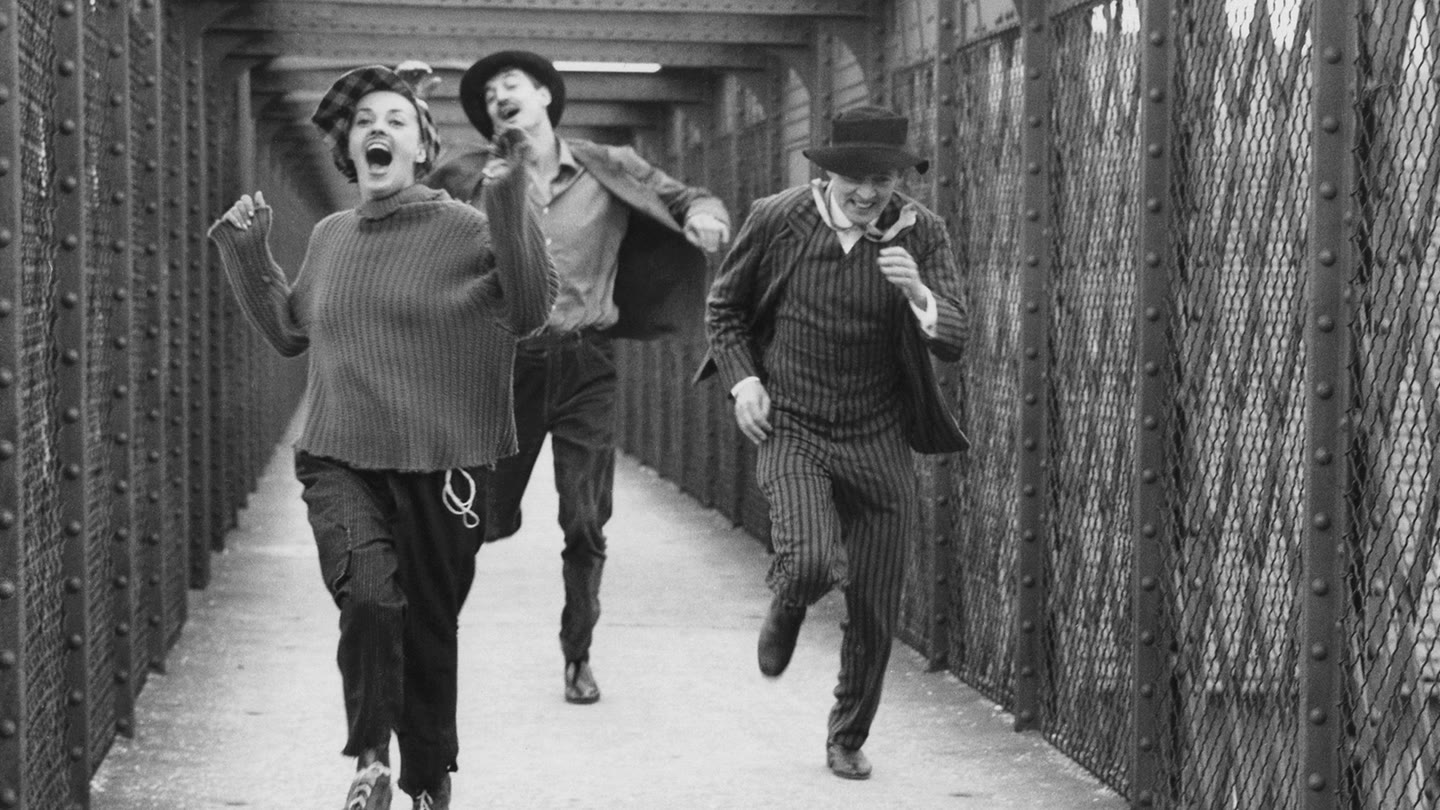
Image context: the cover uses a real Janus still of the trio running over the bridge. That choice matters because the article is not arguing that the film is memorable only for Catherine as an idea or for New Wave style as an abstract package. It is arguing that the movie's emotional structure becomes readable when the three bodies briefly move in one direction and the camera turns shared motion into a fragile kind of harmony.[2][5]
In the opening stretch, the clip makes speed itself feel like the film's first subject
The strongest thing about the video is how quickly it reminds you that Jules and Jim does not introduce itself like a patient literary adaptation.[1] Before the tragedy consolidates, before jealousy thickens, before the war and the domestic aftermath settle in, the movie moves with the buoyancy of a found object being tossed from hand to hand.[1][4] Catherine appears not as a solemn mystery to be decoded but as a force entering a system already in motion.
That matters because Truffaut's use of voiceover is often discussed as if it were merely efficient storytelling.[3][4] It is more destabilizing than that. The narration does not calm the film down. It gives the film wind at its back. Time is leapt over rather than lived through in a continuous dramatic present, and that makes every emotional turn feel simultaneously light and consequential.[1][3][4] You are not invited to settle into one stable version of these people. You are pushed along with them.
BFI's roundup on cinematic menages a trois makes an adjacent point when it says the film still feels remarkably fresh because it is packed with New Wave devices such as freeze-frames, wipes, and stills.[6] Those are not decorative signatures. They are how the movie thinks. The clip works as annotation because it treats this formal restlessness as central rather than incidental. Jules and Jim is not a classic romance with some stylish flourishes attached. It is a romance whose style keeps refusing emotional fixity.
In the middle, hats, disguises, and the bridge run turn freedom into an image problem
The clip's middle movement keeps circling Catherine's changing appearance and the film's most famous burst of collective motion: the three figures racing over the bridge.[1][5] That sequence has become one of the iconic publicity images of the French New Wave, and BFI's locations essay notes that it was shot on the Passerelle de Valmy, a footbridge over the rail lines out of Gare de Lyon.[5] The image endures not because it freezes youthful freedom into a slogan, but because it shows how brief that freedom is. For a few seconds, the triangle is not a problem of possession, betrayal, or memory. It is just three people moving at one speed.
Yet Truffaut never lets the image stay that innocent.[3][5][6] The video is good on this point because it keeps returning to faces, costumes, hats, and performance. Catherine is not photographed as an essence. She is photographed as variation. The famous smile matters because it never quite settles into one meaning: invitation, mockery, courage, impulsiveness, or warning.
This is why the movie's freedom feels real instead of merely fashionable.[2][4][6] Freedom here is not an achieved state. It is an unstable image relation. The characters try on poses, inhabit temporary arrangements, and sprint through spaces that seem briefly to promise a life outside ordinary sequence.[5] The clip compresses that beautifully. It makes the bridge run, the dress-up energy, and the quick changes of mood feel like aspects of the same formal idea.
By the final stretch, the clip shows that all this velocity is racing toward pain rather than away from it
What keeps Jules and Jim from becoming a simple celebration of charm is the sadness that keeps catching up with its speed.[2][3][4] Near the end of the clip, the emotional temperature changes sharply. The buoyancy is still there in memory, but the emphasis shifts toward damage, exhaustion, and the recognition that joy has generated consequences that cannot be edited away.[1] The final image of Jim speaking about having created pain instead of joy lands so hard because the film has spent so much time teaching us to associate motion with possibility.[1]
Janus and the BFI pages are careful in the way they summarize the movie. They do not sell it as a manifesto for liberated romance. They emphasize poignancy, audacity, and the way joy and tragedy are fused from the beginning.[2][3][4] That is more exact. The film loves spontaneity, but it also knows that spontaneity becomes history the moment it is lived. The clip earns its keep by preserving that double truth. It does not flatten the movie into New Wave chic, and it does not flatten Catherine into a destructive muse. It shows how the film's exhilaration and its cruelty are carried in the same current.
That is why the bridge image remains the right emblem after the video ends.[5] It is joyous, but only provisionally. It gives us a fleeting visual solution that the story cannot maintain. For one instant, the trio become rhythm instead of argument. The rest of the film is what happens when time resumes and rhythm has to answer to choice, memory, and hurt.
The real achievement of Jules and Jim is that it never treats this collapse as a betrayal of the earlier liveliness.[1][3][4][6] The liveliness is precisely what makes the collapse painful. Truffaut understood that a film can move lightly without being emotionally light. Criterion's short video captures that with unusual economy. It leaves you with the sense that the movie's speed is not a youthful accessory that history has politely preserved. It is the form of the heartbreak itself.
Sources
- CRITERION, "Three Reasons: Jules and Jim," YouTube video.
- Janus Films, "Jules and Jim film page."
- BFI, "Jules et Jim (1962)" film page.
- BFI Player, "Watch Jules et Jim online" - synopsis and program page.
- Adam Scovell, "Jules et Jim: how the bridge and other locations from Francois Truffaut's classic look today," BFI.
- BFI, "10 great films about menage-a-trois relationships."