Francois Truffaut's The 400 Blows is often treated as a liberation story because it belongs to the first burst of the French New Wave and because its hero, Antoine Doinel, keeps moving: out of class, through Paris, away from home, into petty crime, out of a reform school, toward the sea. The British Film Institute calls the 1959 debut a banner film for nouvelle vague lyric realism, made with a free-wheeling energy around Jean-Pierre Leaud's rebel-schoolboy surrogate for Truffaut.[1] That description is true, but it can make the film sound more buoyant than it feels.
The movie's deeper force is that it makes escape visible without making escape simple. Antoine's movement is thrilling because the camera can finally breathe when he runs, wanders, rides, steals a little time, or looks back. It is also frightening because every release deposits him into another frame built by adults: classroom, apartment, police station, van, observation center. The famous final freeze-frame does not solve that pattern. It suspends it. The face at the sea is not a happy ending. It is a question the film refuses to answer for him.[1][3]
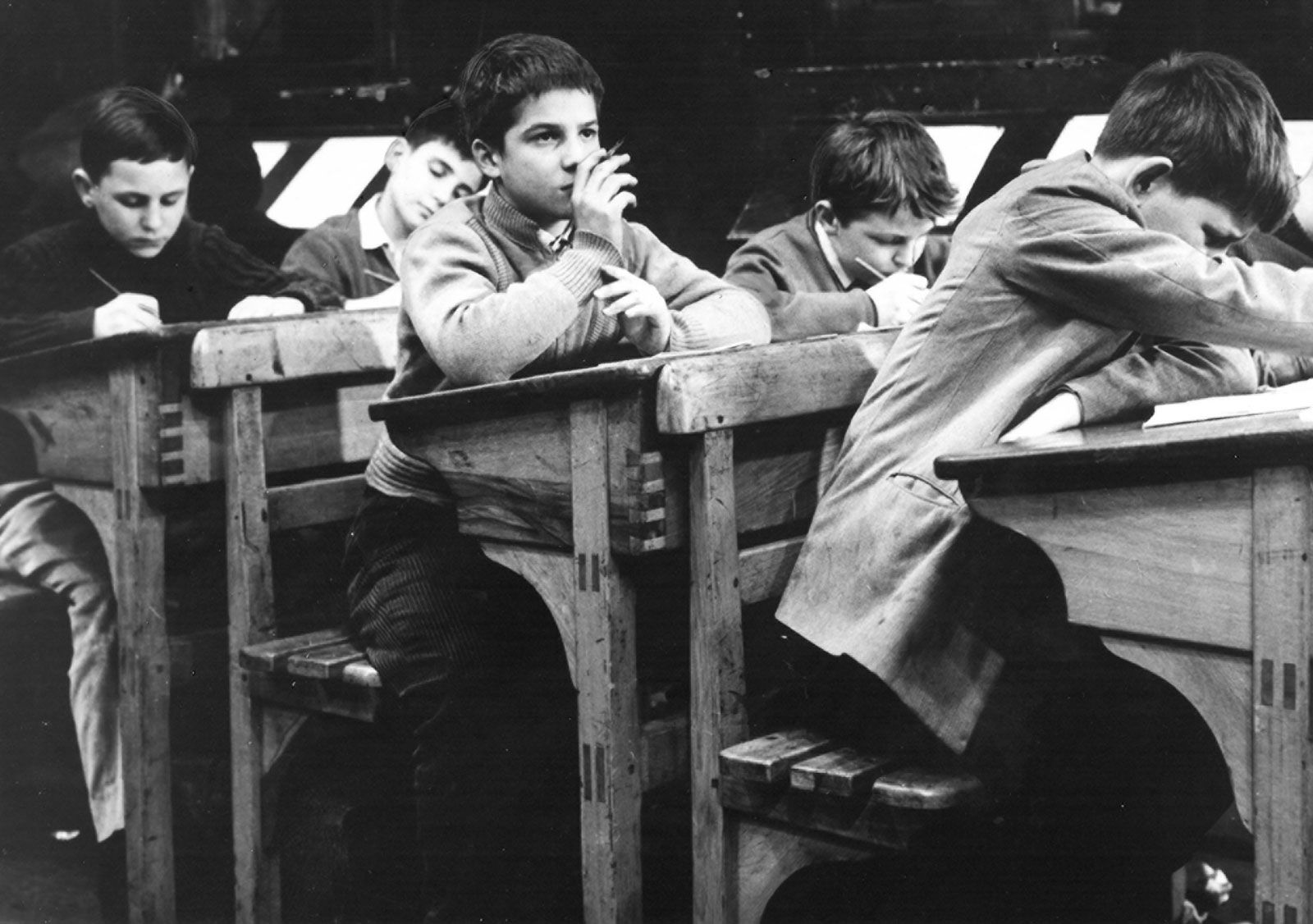
School Is The First Camera
The classroom scenes are not just social background. They teach the viewer how Antoine will be read by authority for the rest of the film. He is seen from the front, named, corrected, punished, and turned into an example before anyone has understood the small injuries collecting around him. TCM's account of the film notes that Truffaut drew on his own troubled childhood to portray a boy whose resilience is tested by unloving parents and clueless teachers.[2] The important word is not only "troubled." It is "tested." Antoine is treated as if childhood were an exam he keeps failing.
Truffaut's staging makes discipline look procedural. Desks line up like evidence. Boys pass notes and perform tiny rebellions, but the room absorbs them as violations of order. The teacher can notice behavior, not pressure. He can identify disruption, not cause. That is why Antoine's lie about his mother dying is shocking without feeling random. It is a child's desperate invention inside a system where ordinary truth has stopped working.
The film's sympathy is precise because it does not make Antoine innocent in a sentimental way. He lies. He steals. He acts out. He can be careless with other people. But Truffaut's point is that adult systems convert those acts into a fixed identity too quickly. "Bad boy" becomes a role handed to him from the outside, and once the label exists, every gesture begins to confirm it.
Paris Gives Him Air, Not Safety
When Antoine and Rene move through Paris, the movie changes temperature. TCM emphasizes Henri Decae's fast working method, natural light, real locations, and fluid exterior tracking shots as central to the film's freedom and spontaneity.[2] Those streets matter because they briefly release Antoine from rooms where every action is already legible as misconduct.
But the Paris of The 400 Blows is not a postcard refuge. It is a city of partial freedoms. The boys skip school, steal a poster, look at movies, improvise shelter, and test how far friendship can stretch. These scenes have comic lift because Truffaut knows the energy of delinquency from the inside. Yet the city never becomes a stable home. It is full of doorways, shopfronts, corridors, and borrowed spaces. Antoine can move through it, but he cannot settle there.
That distinction keeps the film from becoming a simple anti-school fantasy. Cinema may be a sanctuary, as one of the BFI poll comments puts it, but sanctuary is not rescue.[1] The movie theater gives Antoine an image-world larger than his apartment and classroom; it does not give him an adult who can stay. Paris lets him disappear for a while; it does not make disappearance a life.
The Apartment Is Too Small For Everyone's Lies
The Doinel apartment is one of the film's cruelest spaces because it is not monstrous. It is cramped, ordinary, and emotionally underpowered. Antoine's mother and stepfather are not painted as gothic villains. They are vain, tired, distracted, irritated, intermittently warm, and unable to make love feel dependable. That ordinariness matters. The film's pain comes from neglect that can pass as normal household weather.
Antoine's place in the home is always provisional. He sleeps awkwardly, watches adults negotiate around him, and learns that family language is unstable. A pleasant evening can follow an accusation. A parent can protect him in one scene and abandon him emotionally in another. The result is not a single traumatic break but a rhythm of uncertainty.
Senses of Cinema argues that the Doinel cycle should not be mistaken for basic feel-good cinema, because Truffaut's understanding of love includes cruelty, jealousy, indifference, and darker emotional crosscurrents.[3] That observation fits the first film exactly. The 400 Blows is tender toward Antoine, but it is never naive about tenderness. The people who should hold him also misrecognize him. The rooms that should shelter him prepare him for confinement.
Confinement Turns Biography Into Procedure
The police and observation-center passages are devastating because they make Antoine's life administrative. A child becomes a file, a transported body, a case to be managed. The film's semi-autobiographical roots, noted by BFI, TCM, and Quad Cinema, matter here not because they invite a one-to-one decoding of Truffaut's childhood, but because they give institutional scenes the texture of remembered procedure.[1][2][4] The movie knows how humiliation works when it is done calmly.
The interview sequence is especially sharp. Antoine's answers can sound flat, funny, evasive, or terribly exposed depending on how much trust the viewer has learned to give him. The setup asks for explanation, but what comes out is not a clean psychological key. It is a child's account of a life that adults have already organized into categories. His speech reveals damage, but it also reveals the limits of explanation itself. Telling the truth to a system does not mean the system will hear it as truth.
That is why Truffaut's style is more rigorous than the film's loose reputation suggests. The New Wave freshness is not only in location shooting or youthful energy. It is in the refusal to let form become social certainty. Handheld-feeling movement and open streets coexist with frames of confinement. Lyricism and paperwork occupy the same movie.
The Run To The Sea Does Not End The Story
The final run is one of cinema's great releases because the film has earned every step. Antoine escapes during a soccer game, runs down roads, reaches the beach, touches the water, turns back, and is caught by the camera. BFI identifies the freeze-frame as the film's most celebrated stylistic innovation, fixing Antoine's expression after his break for liberty and leaving his future uncertain.[1] Senses of Cinema goes further, describing the run, the beach, the waves, and the freeze as a sequence that forces the viewer into moral contemplation rather than closure.[3]
The sea is crucial because it is both destination and limit. Antoine has been running toward an image of elsewhere, and when he reaches it, there is nowhere obvious to go. Water wipes away footprints, but it does not provide a plan. The frame closes in on him just as the world seems to open. That contradiction is the film's final intelligence.
The freeze-frame is sometimes remembered as pure emblem: New Wave modernity, youth in revolt, cinema discovering its own freedom. It is all of those things. But inside the drama, it is also an ethical stop sign. The film refuses to turn Antoine's face into an answer. He looks at us, and the look returns responsibility to the viewer. What has this child escaped? What is still holding him? What would care require if it arrived too late for the institutions that claimed to provide it?
A Coming-Of-Age Film That Distrusts Arrival
Quad Cinema calls The 400 Blows a new standard for autobiographical coming-of-age stories and notes that Truffaut's unveiling at Cannes moved him to the front ranks of international cinema.[4] That historical importance is secure. The more interesting reason the film still feels alive is that it distrusts the very shape of coming-of-age. Antoine does not mature into legibility for us. He does not deliver the speech that explains himself. He does not step into a future the movie has prepared.
Instead, Truffaut builds a form around misreading. School misreads behavior as essence. Family misreads need as nuisance. Police misread trouble as destiny. Even cinephile admiration can misread the film if it turns Antoine's last run into a clean myth of freedom. The movie's compassion depends on resisting those shortcuts.
That is why The 400 Blows remains sharper than nostalgia. It remembers childhood not as innocence lost, but as a condition in which adults control the frames while children improvise inside them. Antoine's escapes matter because they briefly change the frame. They do not abolish it. At the sea, the camera gives him the dignity of being looked at without being explained away. Then it stops, and the unresolved look keeps moving in us.
Sources
- British Film Institute, "The 400 Blows (1959)" - film page, Sight and Sound ranking context, New Wave framing, and final freeze-frame note.
- Margarita Landazuri, "The 400 Blows," Turner Classic Movies, June 14, 2007 - production context, Truffaut biography, real-location shooting, Decae cinematography, and cast credits.
- John Conomos, "Truffaut's The 400 Blows, or the Sea, Antoine, the Sea...," Senses of Cinema - essay on the Antoine Doinel cycle, love and cruelty, and the final sea sequence.
- Quad Cinema, "The 400 Blows" - programme note on the film's Cannes breakthrough, autobiographical coming-of-age form, and Leaud's casting as Antoine Doinel.
- Encyclopaedia Britannica image asset, "scene from Les Quatre Cents Coups" - source for the downloaded black-and-white classroom still used as the article image.