Spoiler note: this essay discusses the film's ending.
Rainer Werner Fassbinder's The Bitter Tears of Petra von Kant looks, at first, like a theatrical constraint: one apartment, one dominant room, a handful of women, almost no escape into the outside world. That summary is true and misleading. The 1972 West German film, centered on fashion designer Petra von Kant, her silent assistant Marlene, and the younger Karin Thimm, does not feel small because Fassbinder makes the bedroom behave like a complete social machine.[1][2] Love enters the room, but so do class, labor, performance, age, ownership, and the humiliating desire to be needed.
The film's pressure starts with confinement. BFI frames it as a visual and verbal extravaganza about loneliness, love, the compulsion to work, and the impossibility of honest relationships.[1] Criterion Channel places it in the moment when Fassbinder had absorbed Douglas Sirk's melodramas and moved toward a more intensely emotional register while still keeping experimental theater in the staging.[2] Those two descriptions explain why the movie feels both lush and airless. It borrows melodrama's force, but it denies melodrama's usual relief valves: streets, weather, crowds, travel, the restorative cutaway. Everything has to happen where Petra can see it, misread it, stage it, and suffer from it.
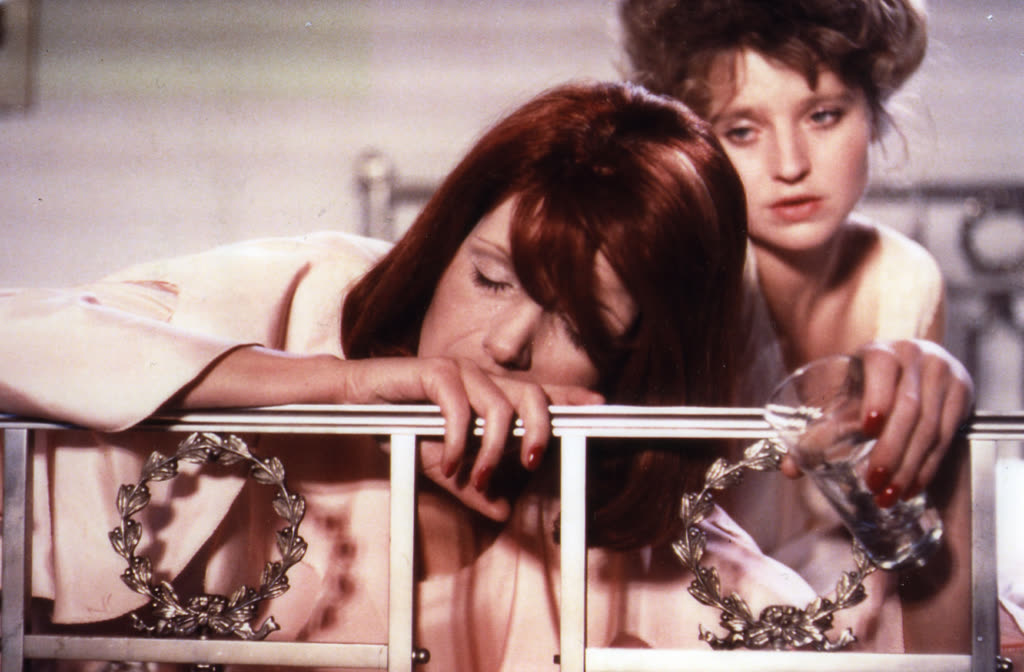
The Room Is Not Privacy
The central joke of Petra's bedroom is that it promises privacy while making privacy impossible. It is too arranged, too watched, too full of surfaces and props. BAMPFA's program note calls the film a furnished chamber piece and names the key triangle cleanly: Petra, Karin, and Marlene, the assistant who is also secretary and stylist.[3] That last role matters. Marlene is not simply a servant in the background. She is the hidden operating system of Petra's elegance. She types, serves, sketches, waits, absorbs insult, and keeps the room functioning.
That means Petra's "private" suffering is built on someone else's labor. The film keeps Marlene's work visible without giving her explanatory speeches. Her silence is not absence. It is a pressure that Petra keeps trying to convert into obedience. BFI's single-location guide makes the larger spatial point: the film is confined to Petra's apartment, yet the camera's gaze and gliding movement make the stage-derived setup fully cinematic.[4]
The bedroom therefore becomes a power machine because every object has a double use. The bed promises intimacy, but it also becomes a throne, a sickbed, a bargaining table, and finally an exposed stage. Clothes promise identity, but each wig and outfit makes Petra's self-command look more fragile. The huge wall image behind her does not supply culture as refinement; it crowds the room with mythic bodies, appetite, and possession. BFI singles out the reproduction of Nicolas Poussin's Midas and Bacchus as a production-design element that dominates the proceedings.[4] Fassbinder's staging makes decoration accusatory.
Costume as Damage Control
Petra is a fashion designer, yet the film is less interested in fashion as industry than in costume as emotional damage control. She dresses to master the scene she is already losing. With Karin, clothing becomes a seductive language: Petra can offer taste, entry, modelhood, protection, and access. But every offer contains a demand. She wants Karin to enter the image Petra has prepared for her, and Karin's power lies partly in refusing to remain there.
That is why the movie's artificiality never feels empty. It is not pretending that real feeling disappears under style. It is showing how style becomes the only language available when feeling has turned coercive. Criterion Channel's note that the film balances tormented romance with theatrical staging gets to the point: the artifice is not decoration after the fact; it is how the relationship works.[2] Petra performs confidence, generosity, injury, maternal care, erotic hunger, and aristocratic disdain, but each costume change reveals less control, not more.
Michael Ballhaus's cinematography, credited by BAMPFA, is crucial because the room keeps changing without becoming a different room.[3] Camera placement, bodies, mirrors, and blocking reassign power. Petra may dominate one composition and look trapped in the next. Karin can seem idle and still own the air. Marlene can be at the edge of the image and still define the moral temperature of the scene. The film does not need a large geography because hierarchy keeps moving inside one frame.
Melodrama Without Escape
Fassbinder's Sirk inheritance matters, but Petra von Kant is not simply a Sirk imitation in German chamber form. Sirk often used domestic interiors to expose social cruelty: mirrors, color, windows, and furniture made private pain legible as public structure. Fassbinder pushes that method toward a harsher limit. The bedroom is not a home wounded by society. It is society compressed into a bedroom.
The Sirk connection can also mislead if it makes the film sound only like a story of overwhelming feeling. Fassbinder is colder than that. The movie keeps asking whether the language of love is being used to hide contracts of domination. Petra says she wants honesty, but she wants honesty under her management. She says she wants to help Karin, but the help arrives with possessive terms attached. She says she will change with Marlene, but even contrition comes with the reflex of command.
That final movement is the film's hardest turn. If the story ended with Petra's humiliation, it would be cruel but simpler: the powerful woman has been broken by the younger woman she tried to possess. Instead, the ending returns to Marlene. Petra's apparent offer of equality arrives after years of abuse, and Marlene's departure makes the offer unreadable as easy liberation. The silent assistant refuses to complete Petra's redemption scene. The machine loses the worker who made it run.
This is why The Bitter Tears of Petra von Kant still feels sharp rather than merely camp, severe rather than merely theatrical. Its excess is diagnostic. The wigs, dresses, wall images, dolls, furniture, songs, and poses are not ornamental clutter; they are evidence. They show how power beautifies itself, how need disguises itself as generosity, and how a room can become a whole world when everyone inside it is trying to own the terms of love.
The film's enduring force lies in that compression. A less exact movie would escape the apartment to prove the stakes were larger. Fassbinder trusts the opposite route. He makes the room so specific that it stops being only Petra's room. It becomes a model of unequal intimacy: someone poses, someone watches, someone works, someone waits to be chosen, and someone finally leaves. The door matters because the film has spent two hours proving how hard it is to imagine an outside.
Sources
- BFI Player, "The Bitter Tears of Petra von Kant" - streaming page with synopsis, country, date, runtime, and thematic framing.
- The Criterion Channel, "The Bitter Tears of Petra von Kant" - film page and program description of Fassbinder's Sirk-influenced emotional register and theatrical staging.
- BAMPFA, "The Bitter Tears of Petra von Kant" - 2026 screening note with production credits, chamber-piece framing, runtime, and Janus Films source.
- Alex Barrett, "10 great films set in one location," BFI, March 31, 2017 - includes The Bitter Tears of Petra von Kant and notes its apartment confinement, camera movement, and production design.
- SFMOMA-hosted Janus Films still for "The Bitter Tears of Petra von Kant" - source image used for the article cover.