
Before Zora Neale Hurston’s folklore became a shelf of books, some of it moved through strips of 16mm film. Children spin, logging workers cross a landscape of felled trees, a woman on a porch walks into extreme close-up, and faces look back at the person looking. The surviving images do not resemble a polished documentary. They arrive as brief, silent, unevenly exposed encounters. Their roughness is not an obstacle to Hurston’s literary story. It is one of the places where that story begins.
The three-minute PBS short The Films of Zora Neale Hurston puts filmmaker Tracy Heather Strain beside excerpts from this visual archive.[1][2] It asks viewers to add “filmmaker” to the familiar sequence—novelist, folklorist, anthropologist—but its more valuable achievement is quieter. The short shows that Hurston did not treat Black Southern life as inert material waiting to be collected. Motion keeps defeating that idea. People play, work, gather, perform, and return the camera’s gaze. The archive records culture as an activity, not a specimen.
A camera inside a contested commission
Hurston reached this work through both intellectual freedom and financial constraint. She studied anthropology with Franz Boas at Barnard, graduating in 1928, at a moment when field science still prized the authority of an observer who could classify other people from a distance.[2][4] In December 1927, the wealthy patron Charlotte Osgood Mason hired Hurston to collect Black music, folklore, literature, hoodoo, and other forms of expressive life. The contract supplied money, a car, and a rare 16mm camera; it also restricted Hurston’s control over what she gathered and published.[2][4] The instrument of independence came inside a relationship of ownership.
That contradiction matters. The films should not be romanticized as a lone genius simply pointing a liberating lens. Hurston was working between Boas’s academic expectations, Mason’s primitivist ideas, the practical need to earn trust, and her own conviction that Black culture was contemporary, inventive, and internally various. Writing to Langston Hughes in 1928, she announced, “I am really getting inside of Negro art and lore.”[4] “Inside” is the operative word. She did not want only to observe a song or story from across a disciplinary border; she sang, danced, traded stories, and made herself part of the exchange.[2]
The camera extended that method without mastering it. Hurston filmed children’s games, a baptism, a church picnic, a Florida lumber camp, and Oluale Kossola, also known as Cudjo Lewis, one of the last survivors of the Clotilda.[2][4] Notes from her conversations with Lewis later became Barracoon. Material gathered elsewhere in the South fed Mules and Men, her theater, and the social language of her fiction.[2] Film, field notes, remembered speech, performance, and prose were not separate careers stacked one above another. They were different containers for encounters that could not be held by any single medium.
Provenance: fragments, not one finished film
The embedded video is a 2023 American Experience digital short, released as a companion to Strain’s documentary Zora Neale Hurston: Claiming a Space.[1][2] It is not Hurston’s original reel, unmediated. It is a modern curatorial layer: an interview, an edit, a soundtrack, and selected archival passages. Close-ups of a modern projector and a contact-sheet montage make that mediation visible. Hurston’s early footage itself was silent. Any sound that accompanies it now belongs to its later presentation, not to a synchronized recording made on location.
Even the archive’s size changes with the boundary being counted. PBS says that across multiple Southern trips Hurston amassed 85 minutes of 16mm footage that she shot and/or directed.[2] The Library of Congress describes eight early rolls associated with her, filmed in Florida between 1927 and 1929, plus seven separate rolls from a 1940 South Carolina church project whose production roles are less certain.[3] The National Film Preservation Foundation, meanwhile, has circulated a five-minute selection under the title Zora Neale Hurston’s Fieldwork Footage.[6]
Those figures are not a puzzle to solve by choosing one. They describe different objects: a broader body of material, a set of surviving early rolls, a later project, and a curated excerpt. Calling all of it “the 1928 film” would turn a layered, incomplete record into a falsely stable work. The gaps belong to its meaning. We are watching survival, attribution, preservation, and later editing as well as Hurston’s act of filming.
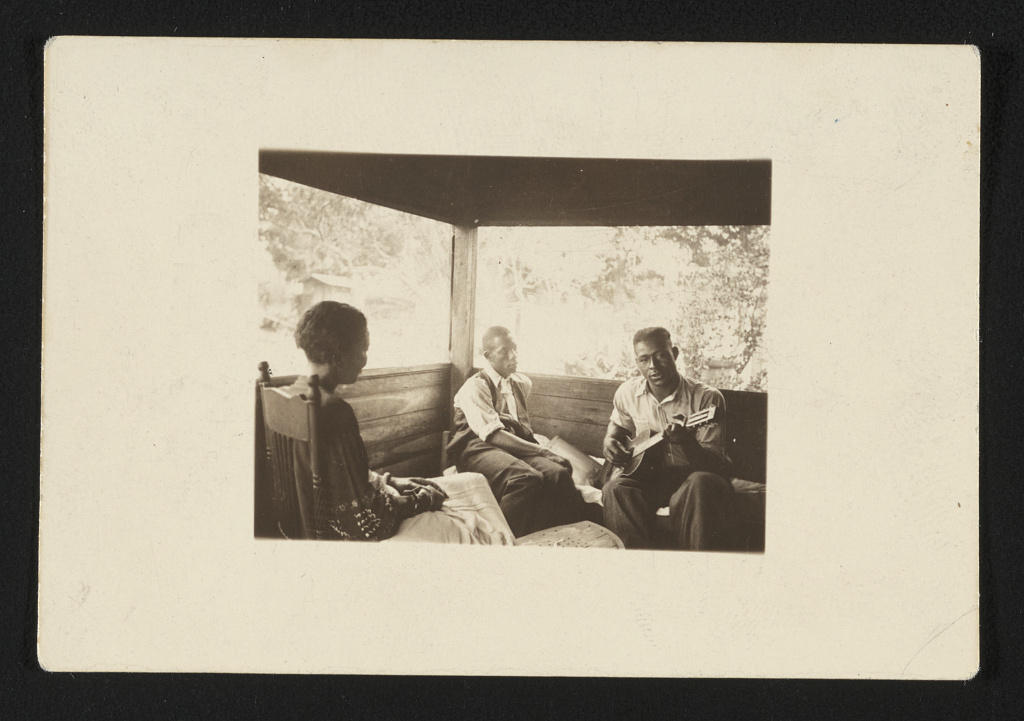
The lead photograph carries a parallel history. Alan Lomax made it in Eatonville in June 1935 during the Lomax-Hurston-Barnicle recording expedition. Hurston sits with Rochelle French and Gabriel Brown, whose guitar points toward the collective work occurring beyond the still image.[5] It is not a frame from the footage. It is a second archival witness to Hurston’s practice: listening and performance happening in company, not a solitary author extracting “material” and departing.
Watch the frame lose control
Strain’s short is most revealing when its explanatory voice meets images that refuse to behave like illustrations. It cuts from the projector’s metal mechanism to a moving view through woods, a narrow track across logged land, workers among felled timber, and a yard crowded with vehicles and stacked logs. Later passages move through outdoor cooking, a baseball game, and children raising their linked hands in a ring before the formation breaks. The clips do not merely prove that certain activities occurred; they preserve the pressure those activities placed on a camera trying to organize them.[1][4]
The porch passage makes that pressure personal. Two women sit outside; then one rises and walks straight toward the lens until her face fills the image. Near the short’s end, a child also steps in, bends toward the apparatus, and smiles in extreme close-up.[1] These approaches reverse the usual geometry of ethnography. The filmed person is not held at a scientifically useful distance. She or he changes the scale of the shot and converts observation into a visibly mutual event. The camera may initiate the look, but it does not own the encounter.
Autumn Womack’s close study of the films gives this pressure a useful name: “overexposure.” Sometimes the term is literal. Hurston’s footage is washed out or underlit, obstructed or out of focus; Black bodies and bright cards register unevenly on film stock calibrated around whiteness.[4] But overexposure is also structural. Too many gestures compete for notice. Children spin until their bodies blur. People enter and leave the visual field before a viewer can settle on a single subject. The archive offers too much to see and not enough context to make it fully knowable.[4]
That instability keeps the footage from becoming a transparent window onto “authentic” Black life. Hurston’s position inside the communities she studied gave her forms of access that white anthropologists often lacked, but access is not omniscience. The people in the images remain more than evidence for her method. Some perform for the lens; some appear absorbed in one another; some look directly back. Their relationship to the camera changes from moment to moment, and the silent fragments cannot tell us everything about consent, staging, or what happened before and after the shot. PBS does not attach a date, place, or catalog title to each excerpt, another reason to resist making the montage more definite than its curators do.[1]
The best close reading therefore follows two movements at once. Hurston’s lens counters a visual culture that routinely reduced Black Southerners to caricature, pathology, or picturesque background. Yet her imperfect film also exposes the fantasy that a better camera operator could finally possess the whole truth of a community. Womack argues that the footage’s visual grammar oscillates between what can be recognized and what escapes control.[4] Its ethical force lies partly in that escape.
The page inherits a moving crowd
This is where the film archive returns us to literature. Hurston’s prose rarely treats vernacular speech as a detachable quotation placed inside an otherwise neutral narrative. Talk happens among listeners. A boast draws a correction; a story changes the temperature of a room; gossip creates and revises a public self. In Mules and Men, the surrounding conversation became part of the book’s form. In Their Eyes Were Watching God, porch talk is not scenery around Janie’s life but one of the forces through which a community interprets it.[2]
The field footage offers a visual analogue, not a key that decodes the novels. Its crowded frames resemble Hurston’s crowded scenes because both preserve relation. A child’s movement means something within a circle of other children. A worker’s gesture belongs to a labor rhythm and a watched performance. A face directed toward the lens turns observation into an exchange. The important unit is seldom the isolated subject. It is the subject among other subjects, making and contesting meaning in real time.
Film also clarifies why Hurston needed more than transcription. A notebook can preserve words, but not the speed of a turn, the geometry of a game, or the moment a group’s attention shifts. Silent film can preserve gesture, but not the song itself or the speaker’s exact cadence. Sound recording can hold a voice while losing the room. Hurston kept moving among media because folklore exceeded each one. Her eventual literary forms did not simply reproduce field data; they rebuilt the social motion that every recording device had partly missed.
What the archive changes
Hurston’s place in literary history is still often secured by one magnificent 1937 novel. The films widen that frame. They show a writer learning not only from tales and idioms but from bodies in space, reciprocal attention, interruption, and performance. They also reveal an artist testing a modern technology whose claims to objectivity she could never take for granted.
The PBS short makes this archive newly reachable while reminding us, by its brevity, how much remains outside the embed.[1] Three minutes stand in for scattered rolls; a contemporary filmmaker speaks over a silent practice; preserved fragments point toward books, plays, recordings, and uncompleted projects. That compression should provoke curiosity rather than closure.
Watch the short once for what survived: the extraordinary fact of ordinary Black life in motion before Hurston’s camera. Then watch it again for what will not hold still—the competing gestures, the returned looks, the edits, the missing sound, the limits of the frame. Hurston’s achievement was not that she captured folklore once and for all. It was that she recognized culture as something people keep doing to, with, and around one another, faster than any single lens or sentence can contain.
Sources
- American Experience | PBS, “The Films of Zora Neale Hurston,” YouTube video.
- PBS American Experience, Zora Neale Hurston: Claiming a Space (film page, credits, transcript, and digital-short provenance).
- Library of Congress, “Motion Pictures in the Library of Congress,” Margaret Mead Collection section.
- Autumn Womack, “The Brown Bag of Miscellany: Zora Neale Hurston and the Practice of Overexposure,” The Scholar & Feminist Online.
- Library of Congress catalog, “Zora Neale Hurston, Rochelle French, and Gabriel Brown, Eatonville, Florida” (lead-image record).
- National Film Preservation Foundation, More Treasures from American Film Archives contents (five-minute fieldwork-footage selection).