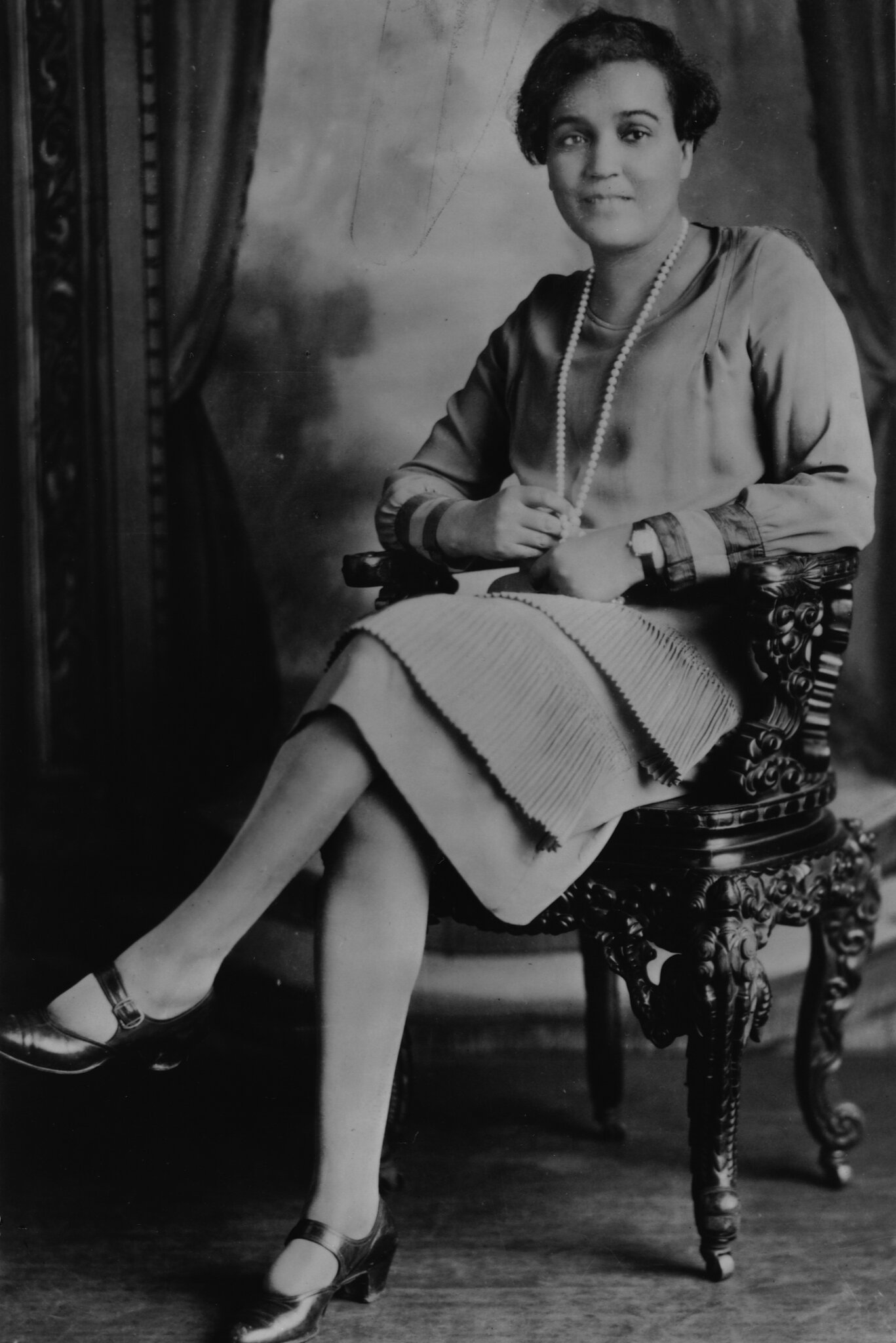
On March 21, 1924, Jessie Redmon Fauset arrived at Manhattan's Civic Club expecting a celebration of her first novel, There Is Confusion. The evening widened around her. Alain Locke and Charles S. Johnson used the occasion to bring Black writers and white publishers into one room; a century later, the dinner is often treated as a starting gun for the Harlem Renaissance. The New York Public Library's 2026 symposium on Fauset put the irony plainly: she did not quite receive the book party she had hoped for, while literary history promoted the gathering itself into the main event.[3]
That displacement has followed her. Fauset is regularly introduced as the literary editor of The Crisis who supported writers now more famous than she is. The description is deserved—her editorial work between 1919 and 1926 was formative—but it can turn a novelist into infrastructure for other people's careers. She published four novels between 1924 and 1933, along with poetry, criticism, essays, and fiction. The work deserves to supply the verbs in her profile.[3][5][6]
Read There Is Confusion beside Plum Bun, and one verb keeps changing: to want. Fauset does not present ambition as a private flame glowing safely inside a gifted person. It is inherited in families, practiced in parlors, judged by audiences, financed by committees, translated into headlines, and bargained against marriage. Her 1924 debut makes a woman's career the final payment for domestic union. Four years later, Plum Bun keeps the romance form but alters the bill: its heroine's art survives disclosure, lost privilege, and an Atlantic crossing.
The contrast is not proof of a simple personal conversion; novels are not diary entries, and each ending carries several competing pressures. It is, however, a change in design. Fauset kept romance and ambition in the same room, then changed which one had to move.
Greatness begins as an echo
There Is Confusion opens before Joanna Marshall is five. Sitting on her father's knee, she requests a tale: “Story 'bout somebody great.” Joel Marshall hears his own thwarted life answering him. Born enslaved, he had dreamed of education and public leadership, but illness in his family redirected his savings and labor into catering. He became prosperous without becoming the kind of great man he had imagined. When Joanna declares the same desire, he treats her talent as a second chance.[1]
This origin prevents ambition from belonging to Joanna alone. Her father supplies stories, lessons, money, and expectation. She inherits both his faith and his unfinished account with the world. Fauset makes the inheritance double-edged. Joanna works with extraordinary concentration, yet she also measures other people by whether they possess a “purpose.” Her seriousness produces art and a small moral impatience. Wanting greatly can enlarge her; it can also make everyone nearby look like supporting material.
The novel's most pleasurable formal sequence loosens that severity. Joanna watches children perform a street dance, carries the steps into the Marshall parlor, teaches siblings and friends, and later places the dance inside a staged benefit. The action travels from street game to home performance to public choreography. At no point does Fauset let “originality” mean solitary invention. Joanna's stage piece is memorable because it has passed through bodies, rooms, music, imitation, and return.[1]
This is Fauset's first model of artistic ambition: a gift becomes visible through a social circuit. The family room protects Black pleasure from hostile public space, but it does more than shelter. It becomes a workshop. The audience is already part of the art.
The first novel sends the dancer home
Joanna eventually gets what the child wanted. She sings, dances, tours, and earns critical recognition. Yet success does not end the novel's argument; it raises the price of its marriage plot. In Chapter XXXIV, after Joanna and the surgeon Peter Bye reunite, he says, “I'm afraid you'll have to give up your career, dear Joanna——” Joanna answers, “Of course, of course, I know it.”[1]
Fauset gives the exchange no ornamental fog. The novel has spent hundreds of pages demonstrating the work behind Joanna's achievement, then lets its public future contract in two short speeches. Peter's medical career will require struggle, money, and domestic support. Joanna's stage career is treated as the available resource from which that support can be made.
The scene should not be flattened into a verdict that Fauset simply opposes art and love. Joanna and Peter understand their reunion as refuge from the violence, exclusion, migration, and daily calculation imposed by racism; the novel takes that pressure seriously. Nor is Joanna coerced into a union she does not desire. The sharper discomfort is asymmetry. Both have talents. Both have suffered. Only one career is grammatically presented as the thing the couple already knows must go.
The narrator labors to settle the bargain, recasting Joanna's old drive as something imposed upon her and treating domesticity as a recovered freedom. Still, Joanna leaves the stage without ceasing to make art: the final chapters give her church and concert singing, a brief tour, two compositions, and harmony lessons. Creative practice persists inside the domestic future, while the commanding public ambition of her childhood shifts toward supporting Peter's career. The resolution argues for its own rightness so insistently that the asymmetry remains audible.[1]
Plum Bun makes passing a form of audience management
Plum Bun begins with another family education, but its heroine learns to treat identity as performance. Angela Murray's light-skinned mother occasionally crosses the color line for an afternoon's access or amusement, then comes home and tells her husband about the playacting. Angela converts a situational tactic into a theory of freedom. After her parents die, she leaves Philadelphia for New York, passes as white, studies art, and enters social and romantic worlds from which open Blackness would exclude her.[2]
Fauset organizes the novel through its nursery-rhyme epigraph and the section names drawn from it: home, market, the coveted plum bun, home again, market done. That structure keeps asking what Angela thinks she can purchase and what the transaction quietly removes. Passing gives her access, but it also makes every room an audience before which a sister, classmate, lover, or casual remark can expose the role.
Art initially participates in the bargain. Angela uses artistic study partly as a respectable reason to break loose. After romance has failed and estrangement has done its damage, however, the narration says her talent has become the “greatest, most real force in her life.” Work changes from alibi to center.[2]
The change is tested through Miss Powell, a visibly Black classmate. Both women win art prizes and plan to study in France. The American committee facilitating the trip returns Miss Powell's passage money because white students may object to traveling with her. Angela could continue under the identity the committee assumes. She hesitates, calculates the cost, and then encounters reporters pressing Miss Powell inside her home. In that hostile little public, Angela says, “Well, I'm coloured too.”[2]
The declaration does not magically purify the market. A newspaper recasts it as the exposure of an ambitious fraud. Angela gives up the committee's assistance, loses her job, and risks the mobility she had worked for. But Fauset does not make honesty synonymous with artistic extinction. Angela keeps the thousand-dollar prize, repairs her bond with her sister, and finds another route to Paris. Solidarity has a material cost; it does not have to consume the career that made the choice consequential.
The final visitor crosses into her working life
Paris is not a reward painted in soft focus. Angela is lonely there. She studies twice a day, haunts museums, submits to routine, and disciplines herself toward what the narration calls “her one ambition”: becoming a significant portrait painter. The romance ending eventually arrives, but its choreography has changed. Anthony crosses the Atlantic and appears in her tiny drawing room on Christmas morning. Angela does not abandon her artistic vocation to enter his future; he travels into the life her work has organized.[2]
That distinction is modest and radical at once. Plum Bun still likes coincidence, reunion, and the emotional satisfactions of romance. It does not solve the unequal structures surrounding Angela, and it does not pretend that artistic success cancels loneliness. Yet compared with Joanna's renunciation of the stage, the final geography matters. Love finds the artist abroad, already at work.
Library of America's current edition framing catches some of the formal nerve that labels such as “conventional” or “bourgeois” can hide. It describes Plum Bun as blending realism and romance while revising the tragic-mulatta story; its fairy-tale machinery is not an escape from race, gender, and class but a way to audit their promised rewards.[4] Fauset does not throw away the familiar plot. She makes it disclose who has been expected to pay for the ending.
Editing belongs beside the novels
Fauset's editorial career clarifies this fiction without reducing one form of work to the other. At The Crisis and The Brownies' Book, she was not merely identifying isolated talent. Editorship links choosing, sequencing, revising, commissioning, and imagining readers. Clemson University Press's Editing the Harlem Renaissance places a study of Fauset and The Brownies' Book inside a larger account of magazines, editorial practice, and literary production; the framing restores editing as a form that helps make a movement, not clerical labor performed after art happens.[5]
The connection to the novels is an inference, not a documented one-to-one cause. Still, the family parlor, benefit stage, art school, committee meeting, press interview, children's magazine, and literary journal all pose a related question: under what conditions can a person's gift become publicly legible? Fauset's fiction is crowded because achievement requires a crowd. Someone teaches the step, pays the fare, opens the page, controls the headline, or decides which audience counts.
That is why the familiar metaphor of Fauset as a literary midwife is both honoring and insufficient. It recognizes her care for emerging writers while assigning the finished work—and the future—to somebody else. Scholarship has had to recover the anger, feminist pressure, and racial analysis in a writer too easily caricatured as merely proper. Beth Aplin-Rollins's Cornell study, for example, reexamines Fauset's fiction, periodical work, and four novels together, challenging the narrow public personality earlier criticism constructed for her.[6]
The better profile keeps editor and novelist adjacent. Editorial work shows Fauset building audiences; the novels show her testing what audiences demand in return.
Give Fauset her verbs back
The 1924 dinner offers a miniature of the whole problem. Fauset brought a novel about Black ambition into a room, and the room became famous for launching other careers. Even her own celebration was converted into infrastructure. The 2026 Schomburg symposium returned attention to the person at the table, but the fiction had already supplied the strongest correction.[3]
In There Is Confusion, ambition is inherited, rehearsed, applauded, and finally redirected from a public stage. In Plum Bun, it is disguised, financed, exposed, and carried overseas. Neither route is clean. Together they show a writer revising the social contract around a woman's art without pretending that art can exist outside love, race, money, or an audience.
Jessie Fauset did help open doors for a generation of writers. Her novels ask the harder question that begins after the tribute: once the door opens, who owns the room, and what will the woman who entered be asked to leave behind?
Sources
- Jessie Redmon Fauset, There Is Confusion. Project Gutenberg eBook no. 78915 — primary text of the 1924 novel, including Chapters I–II, VII, XIII, XXXIV, and XXXVI used for the close readings.
- Jessie Redmon Fauset, Plum Bun: A Novel Without a Moral. Lehigh University, African American Literature Digital Anthology — full text used for the novel's section design, art-school sequence, disclosure scene, and Paris ending.
- Schomburg Center for Research in Black Culture, New York Public Library, “Symposium: The Life and Work of Jessie Redmon Fauset” (April 27, 2026) — Civic Club dinner, editorial career, novels, and current commemoration.
- Library of America, “Jessie Redmon Fauset: Plum Bun: A Novel Without a Moral” — modern edition overview of the novel's romance, realism, passing plot, and revision of inherited genre.
- Joshua M. Murray and Ross K. Tangedal, eds., Editing the Harlem Renaissance. Clemson University Press, 2021 — editorial-history framework and contents listing “Jessie Fauset and Her Readership: The Social Role of The Brownies' Book.”
- Beth Carol Aplin-Rollins, “The Muses Themselves Would Bear Witness to This: Jessie Redmon Fauset; A Biographical Portrait and Literary Analysis.” Cornell University, 1995 — research abstract covering Fauset's life, periodical writing, four novels, and critical reassessment.
- Wikimedia Commons, “Jessie Redmon Fauset (1882–1961) portrait” — provenance page for the circa-1920 archival photograph preserved by the Library of Congress and used as the article image.