In E. T. A. Hoffmann's “The Sandman,” the automaton Olympia sings, plays, and dances with mechanical precision, yet offers almost nothing back in conversation. She sits, stares, sighs, and receives Nathaniel's fantasies without resistance. In Coppélia, the 1870 ballet loosely drawn from Hoffmann's tale, the doll becomes a role that a living woman enters on purpose. Swanilda discovers the mechanism, puts on its behavior, and decides when it will appear to come alive.[1][2][3]
That is the adaptation's decisive reversal. Hoffmann makes a man mistake his own projections for a woman's mind. Coppélia makes a woman perform the mistake so knowingly that she can control the men who want to believe it. The ballet does not answer the old question—what distinguishes the human from the mechanical?—with a philosophical definition. It answers in choreography: the human is the dancer who can choose when to look like a doll.
The answer is exhilarating, but not innocent. Swanilda's comic agency depends on a theater that still displays women as objects, and the original workshop surrounds its heroine with racialized automata whose stage afterlives cannot be treated as decorative trivia.[6] Coppélia repairs Hoffmann's catastrophe by changing who controls the performance. It does not repair everyone equally.
The reader who wants no answer
Olympia is usually remembered as the story's exposed machine: the false woman whose glass eyes and wooden regularity eventually betray her. But Hoffmann places a more unsettling test before that revelation. Nathaniel first uses the language of automation against Clara, a living woman. When she refuses to admire his feverish poem, he calls her an “inanimate, accursed automaton.” Later he adores Olympia as an “admirable listener.”[1]
The contradiction is the point. Clara becomes mechanical when she answers independently; Olympia seems soulful because she does not. Nathaniel watches her through the spyglass bought from Coppola, attends her ball, and reads his writings to her for hours. Her vocabulary scarcely extends beyond “Ah, ah!”, yet he insists that in her love he can “find myself again.”[1] The phrase is almost a confession. Olympia's supposed inner life is valuable because it returns Nathaniel to himself.
Hoffmann therefore makes vision an accomplice rather than a safeguard. The spyglass brings Olympia close but does not help Nathaniel see her accurately. Her fixed look acquires whatever depth he needs. Even after acquaintances notice the precision of her playing and dancing, Nathaniel treats their unease as proof that they lack poetic feeling. He does not fall in love despite Olympia's passivity. He falls in love with the freedom her passivity gives his imagination.[1]
When the doll is torn apart, the revelation is bodily and violent: displaced eyes, contending makers, a figure reduced to components. Nathaniel's catastrophe follows from more than gullibility. He has made mutual recognition impossible. Clara's mind offends him; Olympia's vacancy confirms him. The tale's machine is frightening, but so is the reader who requires another person to behave like one.
Swanilda enters the mechanism
The Teatro dell'Opera di Roma's historical record names Hoffmann's Der Sandmann as Coppélia's literary source and dates the ballet's Paris Opéra premiere to May 25, 1870, with music by Léo Delibes and original choreography by Arthur Saint-Léon.[3] The line of descent was already indirect, however. The Bibliothèque nationale de France describes Charles Nuitter's two-act scenario as drawn from both Hoffmann's tale and Adolphe Adam's opéra-comique La Poupée de Nuremberg.[4] Coppélia is not a transcription but an afterlife assembled from an earlier afterlife.
In crossing from Gothic tale to comic ballet, the adaptation does not merely soften the ending. It redistributes narrative intelligence.
Nathaniel disappears. His place in the romantic triangle is taken by Franz, who is captivated by the apparently unresponsive girl on Coppélius's balcony. More important, Clara's position expands into Swanilda's. She is no longer the reasonable beloved waiting outside the delusion. She investigates it.
The Royal Ballet's synopsis makes the sequence unusually clear. Swanilda and her friends enter Coppélius's house; she approaches the alcove and discovers that Coppélia is a doll. When Coppélius returns, Swanilda hides in the alcove and takes Coppélia's place. He drugs Franz and attempts to transfer the young man's spirit into his creation. Swanilda then pretends to awaken, performs the dances he requests, wakes Franz, and exposes the deception.[2]
The story's crucial knowledge now belongs to the woman who can act on it. Swanilda sees the doll, understands the fantasy, and chooses disguise over helpless disclosure. Rosella Simonari's account of the ballet emphasizes both the self-confident heroine and the “choreolanguage” through which the adaptation tells its story.[5] That term matters because Swanilda does not defeat Coppélius by delivering an argument about personhood. She wins by controlling the evidence of her body.
The body that can miss on purpose
A ballet dancer playing Coppélia faces a layered task: a living performer must make trained movement look manufactured, then let the manufactured figure seem to acquire spontaneity. Swanilda adds another layer—a character impersonating the doll while remaining alert to the men around her. The audience sees the trick at every level and still takes pleasure in its success.
Hoffmann's Olympia repeats a tiny conversational repertoire so consistently that Nathaniel reads limitation as depth. Swanilda reverses the traffic. She deliberately begins inside limitation, allowing Coppélius to read mechanism as awakening, and then enlarges her movement on her own timetable. In the Royal Ballet synopsis, the Spanish and Scottish dances are lessons Coppélius believes he is giving his newly animated creation.[2] Dramatically, however, Swanilda is teaching him how completely he can be fooled.
This makes virtuosity do intellectual work. The contrast is not simply stiff doll versus fluid woman. Any skilled ballerina can make fluidity look inevitable; Swanilda's sharper proof of agency is variation. She can interrupt, exaggerate, comply, misbehave, and change register. She demonstrates that she understands the code well enough to perform its apparent failure.
The adaptation also rearranges spectatorship. In Hoffmann, Nathaniel monopolizes the gaze through his glass and narrates vacancy as intimacy. In Coppélia, spectators are given superior knowledge: they know the doll is a dancer, know the dancer is playing Swanilda, and know Swanilda is playing Coppélia. Coppélius and Franz become the limited viewers. The ballerina does not escape being watched, but she controls what watching can establish.
Comedy repairs the town—and exposes its terms
Hoffmann's plot ends in recurring madness, an attempted murder, and Nathaniel's death. In the Royal Ballet staging summarized here, the ballet returns its lovers to the social world. Franz regains consciousness; Coppélius learns that he has been tricked; the Duke compensates the doll-maker for the damage to his workshop; and the town celebrates Swanilda and Franz's marriage.[1][2]
Comedy changes the moral pressure. Franz's attraction to the silent girl becomes forgivable foolishness rather than a symptom of psychic collapse. Coppélius becomes a disappointed maker who can be placated with money rather than one half of Hoffmann's terrifying pair of makers. Swanilda can disclose the mechanism and still keep her place in the community.
Yet Coppélia herself remains the price of that settlement. Swanilda proves her humanity by entering the doll's role and exiting it. The actual doll receives no comparable release from the desires projected onto her. The wedding resolves the triangle by restoring the living couple, not by imagining consciousness for the manufactured woman. Coppélia replaces a horror of indistinguishability with a comedy of correct sorting: this body is a woman, that body is a thing, and the dance has taught us to tell.
That solution is more fragile than the final celebration suggests. A ballerina embodies both sides of the distinction. The same living technique that marks Swanilda's freedom also makes Coppélia's objecthood convincing. The ballet cannot display an absolute boundary between person and machine; it can only display a performer crossing it brilliantly.
The workshop's darker inventory
The human-versus-object distinction also carries a history that productions and audiences should not overlook. Mara Mandradjieff documents three racialized automata in the original ballet and their later restagings: figures identified as the “Negro,” the “Moor,” and the “Chinaman.” Her analysis connects their choreography to blackface, yellowface, colonial representation, and the conversion of racialized people into stage objects.[6]
This evidence complicates any easy claim that Swanilda's victory simply liberates the female body from mechanical control. The white heroine is allowed to demonstrate that she exceeds the object she impersonates, while racial caricatures have historically been wound up as objects around her. Movement sorts bodies into categories, but the categories were never neutral.
Acknowledging that history does not cancel the ingenuity of Swanilda's role. It changes the question an afterlife study must ask. The issue is not only whether modern Swanildas can make the doll sequence witty, precise, and alive. It is also what a production preserves, removes, or confronts when it inherits the workshop. An adaptation survives through repeated choices, not through an untouched essence.
What the 1870 photograph preserves
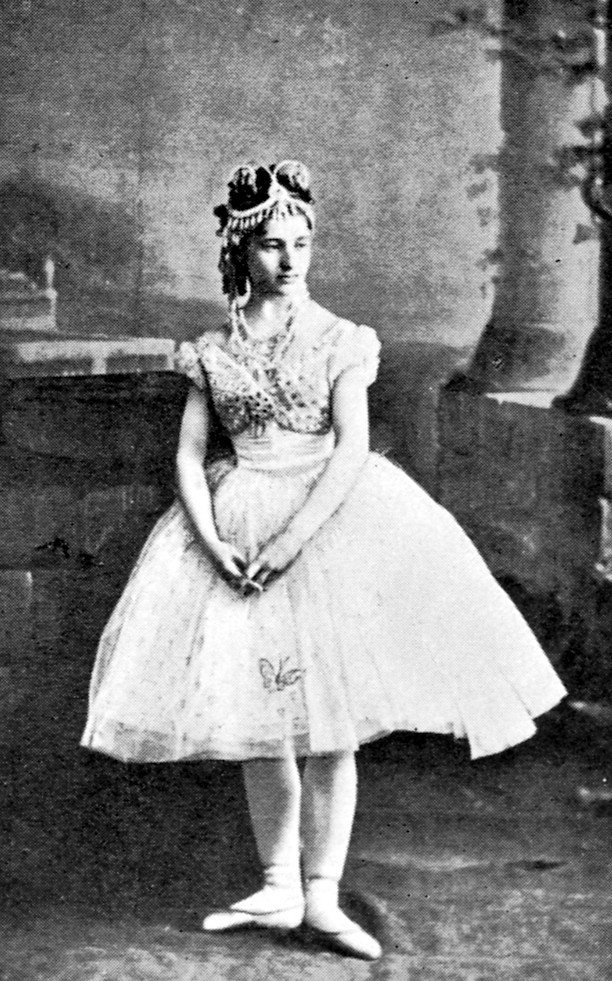
The archival photograph of Giuseppina Bozzacchi, the first Swanilda, does not show the animation trick in motion. It preserves something stranger: a real body fixed into a still image while costumed for a role about the instability of stillness.[7] Bozzacchi looks back from the ballet's first production, but no photograph can tell us where the dancer ends and the character begins.
That uncertainty is exactly what Coppélia added to Hoffmann's afterlife. Olympia is dismantled so that Nathaniel's error becomes undeniable. Swanilda makes certainty theatrical. She can be woman, doll, woman-playing-doll, and dancer-playing-all-three without surrendering control of the sequence.
The ballet's comic answer to “The Sandman” is therefore not that a moving body must be human. Machines move; dolls dance; living people can behave mechanically. Its answer is that agency appears in the ability to change the terms of performance. Hoffmann's Olympia reflects a man's voice until he mistakes the echo for love. Coppélia gives that echo to Swanilda—and lets her alter the rhythm, expose the listener, and walk out of the machine.
Sources
- E. T. W. Hoffmann, “The Sandman,” translated by John Oxenford in Tales from the German (1844), Project Gutenberg; primary text used for close reading.
- The Royal Ballet, Coppélia synopsis for the 2019 cinema relay; scene sequence for Swanilda's substitution, dances, disclosure, and wedding.
- Teatro dell'Opera di Roma Historical Archive, “Coppélia”; original choreography, literary source, and Paris premiere record.
- Bibliothèque nationale de France, catalogue record for Coppélia ou La fille aux yeux d'émail; Charles Nuitter's scenario, its two named sources, and the 1870 premiere.
- Rosella Simonari, “Woman versus Automaton: Beauty and Choreostorytelling in Coppélia, a Dance Adaptation of E.T.A. Hoffmann's ‘The Sandman,’” The Polish Journal of Aesthetics.
- Mara Mandradjieff, “Coppélia's Human-Objects: Winding Up Racialized Automata on the Ballet Stage,” Dance Research Journal 55, no. 3 (December 2023), published online May 8, 2024.
- Wikimedia Commons, “Coppelia — Swanilda — Giuseppina Bozzachi — Act I, Scene 2 — Paris — 1870”; public-domain source page for the archival photograph.