Nathaniel Hawthorne's "Young Goodman Brown" is short enough to look like a moral fable and strange enough to punish that shortcut. A young husband leaves his wife at sunset, walks into the forest, sees or dreams a satanic assembly, and returns unable to trust anyone again. That summary is accurate, but it makes the story sound more settled than it is. The real terror is not simply that Brown discovers evil. It is that every sign by which he once organized goodness becomes unreadable.[1]
The story first appeared in 1835, then entered Hawthorne's larger career as one of the tales that helped fix his imagination to Puritan inheritance, Salem memory, and the moral afterlife of ancestral guilt.[2][3] Those contexts matter because the story is not generic spookiness. It is a symbolic system built out of things that should be familiar: a road, a wife, a family name, a church vocabulary, a meeting, a voice calling from the dark. Hawthorne does not invent a fantasy world. He corrodes the ordinary signs of Brown's world until belief itself becomes a reading problem.
The Road Is A Contract With Ambiguity
The story begins with departure, but Hawthorne makes it feel like a divided promise. Brown steps from Salem village at sunset after leaving Faith, whose name is already too meaningful to be innocent.[1] When he later explains himself with "Faith kept me back awhile," the sentence works in two registers at once: wife and belief, domestic tie and spiritual hesitation.[1] That doubleness is the story's first rule. No important sign stays single.
The forest road sharpens that rule. In a simpler allegory, the road would mean temptation and the village would mean safety. Hawthorne refuses that clean map. Brown meets figures from the apparently respectable world in the very place that should expose hidden wickedness: Goody Cloyse, the minister, Deacon Gookin, and finally a whole community moving toward the dark rite.[1] The road does not lead away from society. It reveals society under another light.
That is why the path feels so dangerous formally. It gives Brown information without giving him a method for judging information. Did he see the truth beneath village hypocrisy? Did he dream a projection of suspicion? Did the devil tell the truth, or does the devil win by making truth unusable? Hawthorne's forest is not just a setting. It is a contract with ambiguity: once Brown enters it, evidence will multiply faster than interpretation can stabilize.[4]
The Pink Ribbons Make Innocence Too Visible
Faith's "pink ribbons" are the story's most delicate objects and its cruelest symbols.[1] They first belong to a domestic image: a young wife calling after her husband, hair moving in the wind, a small sign of softness and ordinary affection. Their color matters because it is neither solemn white nor violent red. Pink makes Faith seem human-scaled, not saintly. She is not doctrine in a dress. She is a person Brown has turned into a spiritual guarantee.
That is why the airborne ribbon in the forest breaks him so quickly. When he cries, "My Faith is gone!" the line again refuses to stay single.[1] He may have lost confidence in his wife. He may have lost theological faith. He may have lost the habit of letting visible tenderness stand for goodness. Hawthorne needs only one small object to collapse all three.
The ribbon also exposes Brown's error before the nightmare reaches its climax. He has treated Faith as proof that goodness exists outside himself and therefore as proof that his own secret errand can still be survived. Once the ribbon appears detached from her body, the sign no longer guarantees anything. It becomes portable, ambiguous, almost evidentiary in the wrong direction. The object does not prove Faith's guilt. It proves Brown's dependence on symbols he has never learned to read carefully.
Family Names Become A Corrupted Genealogy
The older traveler Brown meets on the road looks like a stranger and a relative at the same time.[1] That resemblance matters. Hawthorne makes evil feel inherited before he makes it feel chosen. The traveler claims acquaintance with Brown's father and grandfather, then folds public history, family memory, and private temptation into one lineage.[1] Brown wants to imagine himself as a young man taking one risky walk. The story keeps implying that he is walking inside an older pattern.
Here Hawthorne's Salem context tightens the story. The National Park Service notes Hawthorne's descent from figures involved in Puritan authority and Salem history, and that inherited moral pressure helps explain why his fiction so often returns to guilt, secrecy, and judgment.[3] "Young Goodman Brown" turns that pressure into narrative motion. The past is not background information. It travels beside Brown with a staff in its hand.
The family motif makes Brown's crisis sharper because innocence cannot be recovered by nostalgia. If the father and grandfather are compromised, then Brown's idea of a clean inherited community begins to fail. If the devil is lying, the damage still occurs, because Brown has now imagined his genealogy as corruptible. Hawthorne's point is not that ancestry mechanically determines guilt. It is that a community built on inherited righteousness can be shattered when inheritance starts to look like contamination.
Church Language Turns Into Crowd Noise
The forest assembly is terrifying because it borrows sacred form. Hawthorne fills it with meeting, exhortation, hymn-like sound, and the promise of initiation into "the communion of your race."[1] The phrase matters because it twists Christian fellowship into a darker anthropology. Brown is not being invited into lonely rebellion. He is being invited to believe that shared sin is the deepest social fact.
This is the story's most destabilizing symbolic move. The church does not simply stand over here and the witches' meeting over there. The language of one leaks into the other. The minister and deacon are not merely named as hypocrites; their presence makes institutional speech unstable.[1] After Brown returns, ordinary worship cannot sound ordinary again. He hears the congregation singing and can no longer separate devotion from the memory of the forest.
That aftermath is more important than the spectacle itself. The story does not end with proof, rescue, or confession. It ends with Brown's lifelong incapacity for trust. He becomes a man who cannot hear prayer, blessing, family speech, or even deathbed piety without suspicion.[1] If the forest vision was false, it still destroyed him. If it was true, it did not teach him charity, humility, or discernment. Either way, the symbolic system has failed as a guide to life.
The Story's Map Is Not A Decoder Ring
A weaker reading turns each symbol into a fixed translation: forest means evil, Faith means religion, ribbon means innocence, staff means devil, village means hypocrisy. Hawthorne's story is more unsettling because the symbols work and fail at the same time. The forest does reveal something, but perhaps not cleanly. Faith is meaningful, but Brown's possessive reading of her meaning is part of the disaster. The ribbon carries emotional evidence, but not legal proof. Church language can sanctify community, but it can also be imitated by nightmare.
That is why the tale remains harder than a simple loss-of-innocence story. Brown is not punished for learning that evil exists. He is ruined because he cannot live with uncertainty after the symbols break. He wants either spotless signs or total exposure. Hawthorne gives him neither. The result is a life of frozen suspicion, where every face has become a possible mask and every prayer a possible performance.[1][4]
Read as a motif map, "Young Goodman Brown" is a story about semiotic collapse before it is a story about witchcraft. The forest, ribbon, family line, and communion scene do not merely decorate the plot. They stage the collapse of Brown's reading habits. He enters the woods with a world full of legible signs. He leaves with more signs than ever and no trust in any of them.
Sources
- Nathaniel Hawthorne, "Young Goodman Brown," in Mosses from an Old Manse, Project Gutenberg HTML text used for close reading.
- University of Iowa, "Nathaniel Hawthorne (1804-64), 'Young Goodman Brown' (1835)" - publication and teaching-context notes.
- National Park Service, "Nathaniel Hawthorne" - Salem, family, and biographical context.
- OpenEdition Journals, Journal of the Short Story in English, "A History of the American Mind: 'Young Goodman Brown'" - critical context for historical and interpretive frames.
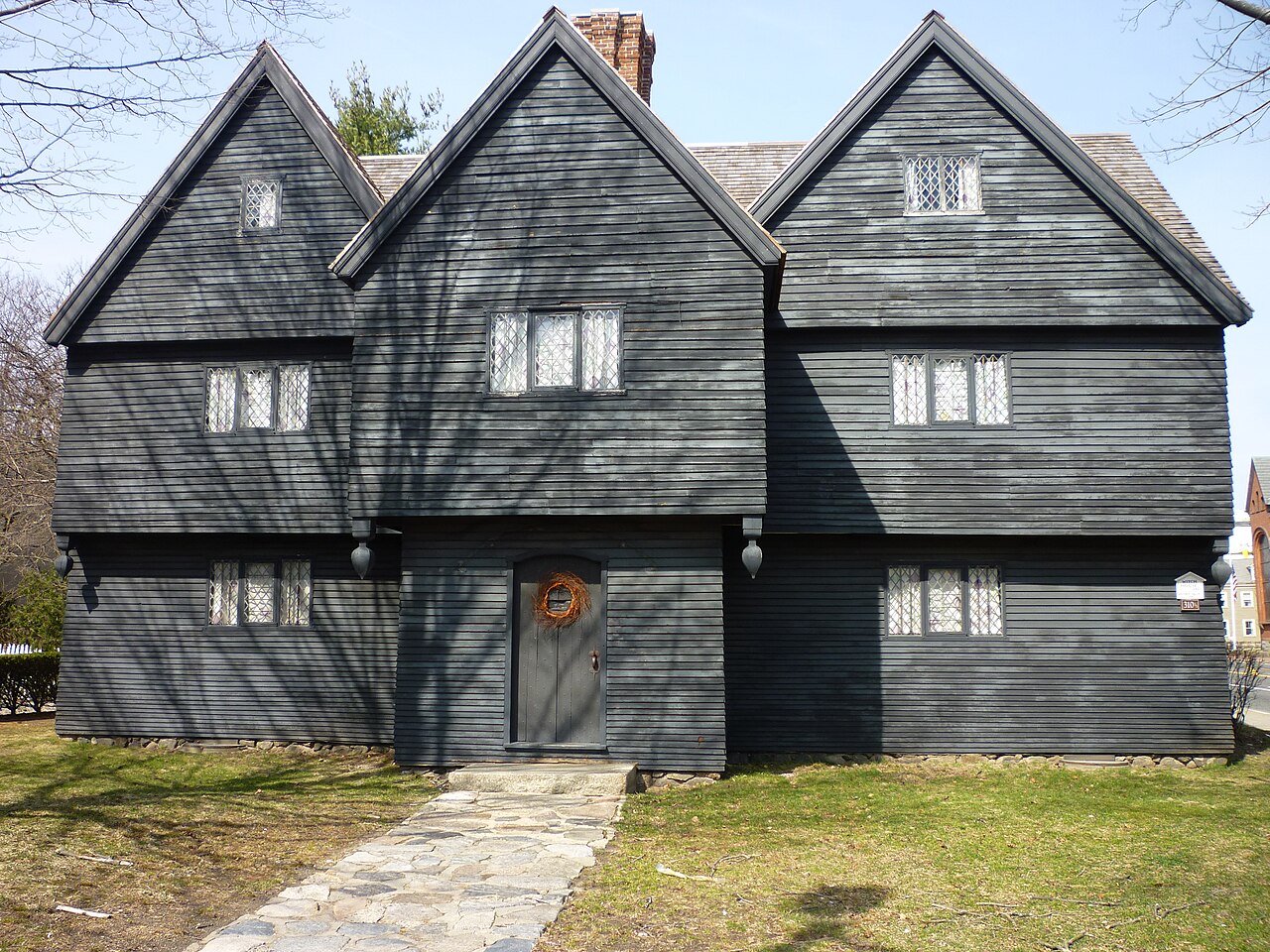
- Wikimedia Commons, "File:The Witch House.jpg" - source page for the real Salem photograph used as the article image.