Balzac's Pere Goriot can look, from a distance, like three familiar stories braided together: a poor old father ruined by his daughters, a provincial student learning Paris, and a criminal tempter hiding inside respectable lodging. The strength of the novel is that Balzac does not merely alternate those stories. He builds a structure that forces them to share air.[1][2]
The machine is Maison Vauquer, the boarding house where status has been stripped to its working parts. It is cheap but not outside society, shabby but not isolated, crowded but not communal in any warm sense. People arrive there when their money, name, health, ambition, or secrecy no longer fits the rooms they wish to inhabit. The house is not background. It is the novel's first system: a sorting device that lets Balzac place Parisian society in miniature before Rastignac starts trying to climb it.[1]
That is why a form reading matters. The novel was serialized in 1834-35 and then published in book form in 1835; later accounts often stress its importance inside La Comedie humaine, especially the way characters recur across Balzac's larger fictional world.[3][4] But the recurring-character idea is not only a bibliographic fact. In Pere Goriot, recurrence starts as an architectural feeling. People are always reappearing at thresholds, in dining rooms, in gossip, in debts, in letters, and in altered social costumes. The structure teaches the reader that no life is private once Paris has assigned it a price.
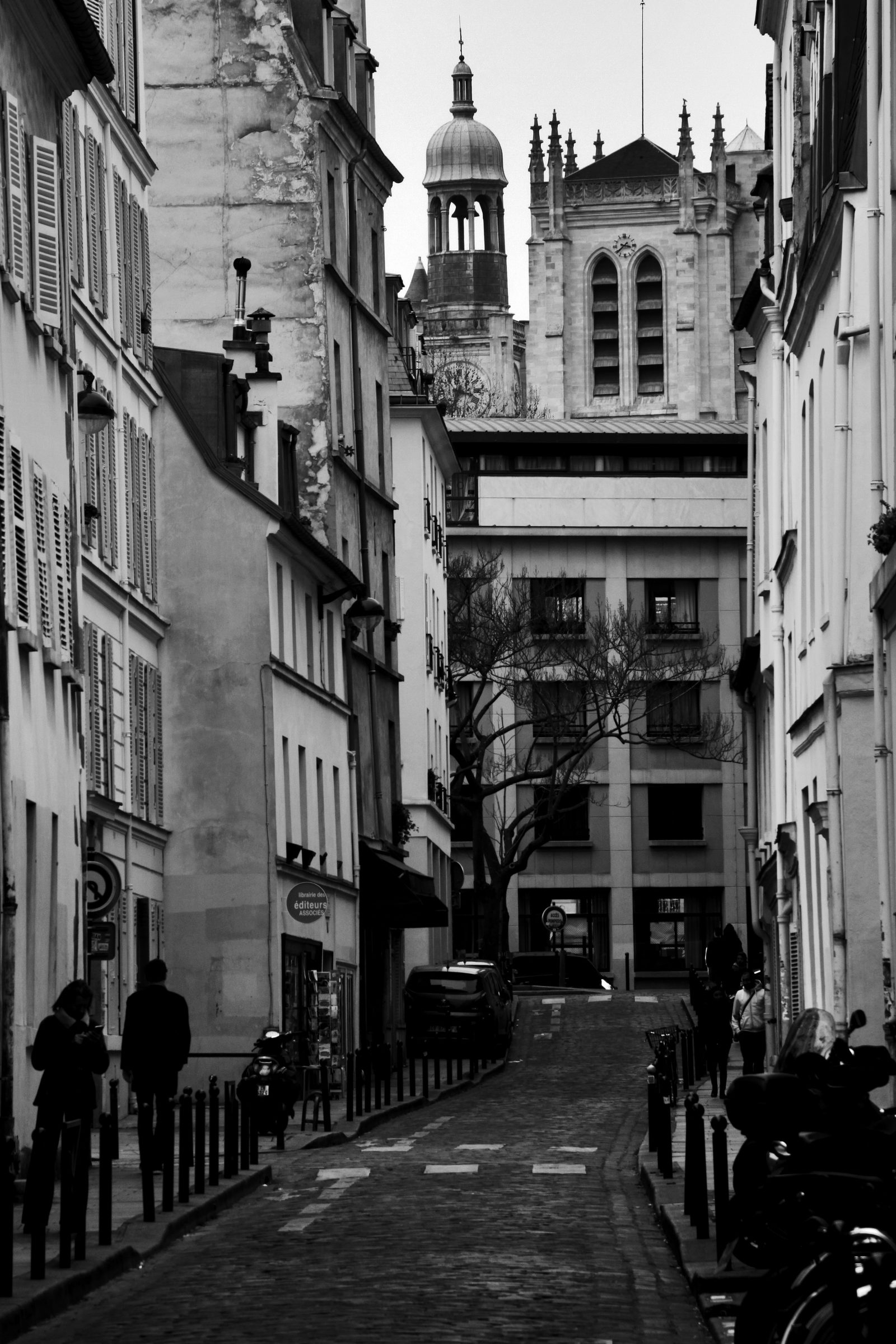
Image context: the Rue Tournefort photograph is deliberately spatial rather than illustrative. Balzac's novel begins by making social information concrete as address, rent, furniture, meals, and reputation; a street-level image keeps that material grammar visible before the essay follows the book into its rooms.[5]
The House Makes Scale Manageable
The first formal problem Balzac solves is scale. Paris is too large to enter as a single field. The narrator calls it "a veritable ocean," and the metaphor is exact because the city threatens to swallow narrative focus.[1] Instead of beginning with a panoramic survey alone, Balzac gives the reader an address, a proprietor, a price structure, a dining table, and a set of boarders. The world becomes legible because it is first compressed.
This compression is not simplification. Maison Vauquer contains several social temperatures at once. Goriot carries the residue of trade money and paternal exhaustion. Rastignac brings provincial hope, family sacrifice, and legal-study respectability. Vautrin brings hidden criminal knowledge and the coldest practical understanding of Paris. Other residents add petty rank, gossip, suspicion, and the daily humiliations of genteel poverty.[1] Every meal becomes a reading exercise: who pays, who watches, who jokes, who is declining, who may be useful.
The house's power lies in its intermediate status. It is not a palace, prison, slum, school, or family home, yet it borrows traits from all of them. It feeds people, confines them, exposes them, and gives them lessons they did not request. Because the residents have been pushed together by economics rather than love, intimacy becomes a surveillance condition. Everyone knows too much and not enough. Balzac's structure lets secrets ripen in public.
Rastignac Learns By Moving Between Rooms
Rastignac's education depends on movement. If he stayed inside Maison Vauquer, the novel would become a boarding-house tragedy. If he left it behind entirely, the novel would become a social-climber plot with sentimental origins. Balzac's form keeps him shuttling between spaces: the lodging house, aristocratic salons, family letters, legal ambition, and the temptations Vautrin names with frightening clarity.[1][3]
That movement turns the book into a map of incompatible moral languages. At the boarding house, money is counted directly. In the salon, money is disguised as manners, marriage, family strategy, or taste. In Vautrin's speeches, money becomes pure mechanism. In Goriot's room, money becomes the last possible expression of love. Rastignac learns Paris not by receiving one doctrine, but by hearing the same fact translated into different rooms.
Balzac's form is severe because each translation changes the young man's available future. Madame de Beauseant teaches him that social power has rules; Vautrin teaches him that rules can be bypassed if one is willing to accept blood beneath success; Goriot teaches him that love without self-protection can become financial self-erasure.[1][4] The novel does not ask Rastignac to choose between innocence and corruption in one dramatic instant. It makes him inhabit a curriculum of rooms until ambition starts sounding like practical literacy.
Goriot Is Placed Low So The Daughters Can Appear High
The title tempts a reader to treat Goriot as the novel's center, and emotionally he is. Structurally, though, Balzac places him low in the building so that the reader feels the violence of social distance. His daughters do not simply neglect him in an abstract moral way. They live in a different system of visibility. Their status must be protected from the degraded address that funds and reveals it.[1][4]
That is the genius of the book's spatial cruelty. Goriot's sacrifice is measured by relocation, furniture, clothing, illness, and the shrinking means by which he can still be useful to his daughters. He has converted commercial success into dowries and social access, only to discover that love can be consumed like capital. The father becomes most necessary when invisible.
Balzac avoids making this only a King Lear variant by embedding it in Parisian logistics. Goriot's daughters are not merely ungrateful children. They are women operating inside marriages, debts, lovers, rank anxieties, and public appearances. Their cruelty is real, but it is also system-shaped.[1][3] The form of the novel keeps that double truth active: private betrayal and social mechanism intensify each other.
Vautrin Reveals The Structure By Speaking Too Clearly
Vautrin matters because he says what the polite rooms metabolize silently. He does not create the Parisian system; he interprets it without euphemism. In formal terms, he is the boarding house's anti-narrator, the figure who can explain how ambition works before Rastignac has found a respectable vocabulary for it.[1]
His danger is not only criminal. It is analytic. He makes social success look procedural: identify the route, remove the obstacle, accept the cost, take the prize. Against Goriot's self-consuming love and Rastignac's half-formed scruples, Vautrin offers a brutal clarity. That clarity is seductive because the rest of Paris is already operating by related pressures while pretending otherwise.
Balzac's structure therefore needs Vautrin inside the house, not outside it. If he were merely a melodramatic villain, the novel could quarantine him. Instead, he sits at the same table as everyone else. His presence reveals that the boarding house is not a refuge from Parisian power. It is where Parisian power has dropped its mask because the wallpaper is cheap.
Recurrence Turns Plot Into Social Weather
The larger significance of Pere Goriot lies in how it begins to make Balzac's fictional world feel continuous. The novel is often discussed as a key point in the development of recurring characters within La Comedie humaine.[3][4] In reading experience, that recurrence has a more immediate effect: characters do not feel used up by one plot. They seem to belong to a city that continues before and after the chapter.
That continuity changes the ethics of realism. A conventional plot can punish, reward, expose, and close. Balzac's Paris does some of that, but it also keeps circulating. Goriot dies; Rastignac looks outward; society absorbs the scandal and continues. The famous energy of the ending depends on this structural refusal to stop the world just because one moral catastrophe has become visible.[1]
The novel's final force is therefore architectural before it is philosophical. Maison Vauquer gathers the elements; Paris distributes them; recurring social life prevents closure from becoming comfort. Balzac's realism is not merely detail piled high. It is detail arranged into a pressure system. A room tells you who can enter. A meal tells you who is falling. A letter tells you who is being spent. A name tells you who may reappear. By the time Rastignac faces Paris, the reader knows the city is not a backdrop. It is the engine.
Sources
- Honore de Balzac, Father Goriot, translated by Ellen Marriage, Project Gutenberg HTML edition used for close reading.
- Honore de Balzac, Le Pere Goriot, French Wikisource text used to verify title and original-language context.
- Wikipedia, "Pere Goriot" overview, used for publication chronology, setting, reception outline, and recurring-character context.
- Balzac Analyse, "Le Pere Goriot - Analysis of the work," used for publication and work-context notes.
- Wikimedia Commons, "File:Rue Tournefort (26613068522).jpg," photograph of Rue Tournefort in Paris, formerly Rue Neuve-Sainte-Genevieve, used as the article image.