Doris Lessing's late interviews are easy to misread if they are treated only as victory laps after the 2007 Nobel Prize. The official Nobel video interview is more valuable than that. Conducted by John Mullan at Lessing's London home and preserved by NobelPrize.org, it catches an elderly writer looking back across a body of work that had never behaved politely for cataloguers: African social realism, the Children of Violence sequence, The Golden Notebook, speculative fiction, political disillusionment, autobiography, pseudonymous novels, and late family memory.[1][2][3] The recording matters because Lessing refuses to turn that range into a tidy brand. Again and again, she makes literary form sound like a practical problem.
That is the historical pressure behind the video. By 2007, Lessing had become a Nobel laureate for a career that the Nobel facts page summarizes as roughly fifty books across several genres, marked by studies of twentieth-century conditions, behavior, history, psyche, politics, and civilization under strain.[3] Humanist Heritage gives the clean biographical arc: born in Kermanshah in 1919, raised in Southern Rhodesia, later moving to London, and known for a versatile career that challenged political, social, and religious orthodoxies.[4] Those facts are necessary, but they can also make her sound more orderly than she was on the page.
The problem with Lessing is not that she wrote in many compartments. It is that the compartments leak. The Grass Is Singing begins from colonial Southern Rhodesia but is already a study of psychological and racial pressure. The Golden Notebook is usually treated as the key feminist and formal landmark, yet its construction works by fracture: notebooks, politics, breakdown, authorship, sexuality, and public history refusing to stay in one container.[2][3][5] The later Canopus in Argos books shocked readers who wanted Lessing to remain in realist territory, but the Nobel interview helps explain why the move was not a decorative swerve. She speaks as a writer who lets scale decide method.
That is why this footage belongs in a literature archive rather than only in a prize archive. Lessing is not performing a ceremonial laureate role. She is preserving a craft ethic: once a story arrives with a certain size, historical range, or pressure, the writer has to find the form that can carry it.[2] The archive gives us Lessing after the arguments about what she "should" have written have already happened, still declining to make genre hierarchy the center of literary judgment.
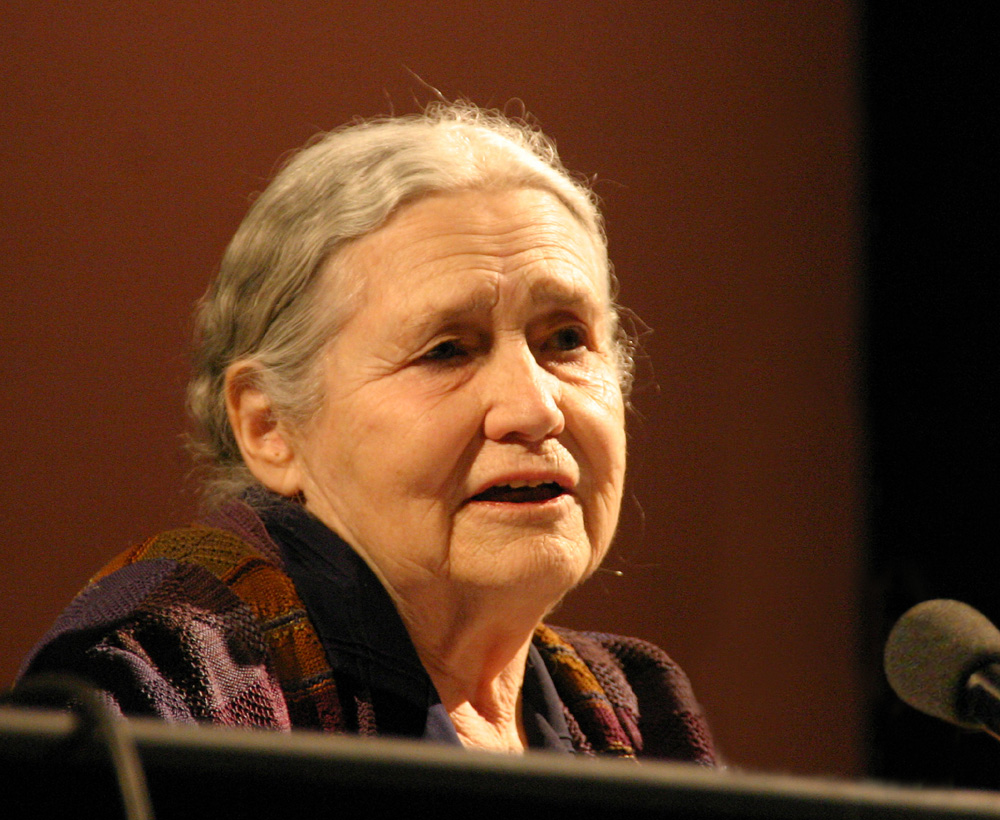
Image context: the cover photograph comes from lit.Cologne in 2006, just before the Nobel year. It is a public literary image rather than a book-jacket substitute: Lessing present, unsmoothed, and close to the period when the Nobel interview would turn decades of argument about her career into one conversational record.[3][6]
Historical Context: A Career Too Large for One Shelf
Lessing's Nobel moment arrived late, but not because her importance was sudden. The Swedish Academy's 2007 recognition placed a public seal on a career that had been difficult in exactly the ways that make it durable: politically alert but not obedient to politics, feminist in consequence but wary of simplification, realist and speculative, autobiographical and anti-confessional, public-minded and impatient with literary piety.[3][4]
The Nobel facts page is useful because it refuses to reduce Lessing to one famous title. It identifies The Golden Notebook as her most experimental novel and describes it as a study of a woman's psyche, writers, sexuality, political ideas, and everyday life.[3] That is a compact way of naming the book's structural ambition. The Golden Notebook Project, built around a full digital edition with HarperCollins permission, preserves the novel as an object readers can approach through both text and commentary, which is fitting for a book whose form already asks readers to handle fragments, frames, and competing records.[5]
Lessing's range also came from geography and history. Her early life in Southern Rhodesia shaped her attention to colonial violence, class, race, labor, and the moral evasions of settler life.[4] Her move to London in 1949 did not simply relocate her; it changed the field of observation. The postwar metropolis, Communist circles, publishing culture, women's lives, exile, and memory all entered the work. The old critical temptation was to decide which Lessing was the "real" Lessing: African realist, political novelist, feminist icon, science-fiction experimenter, memoirist. The video makes that sorting exercise look too small.
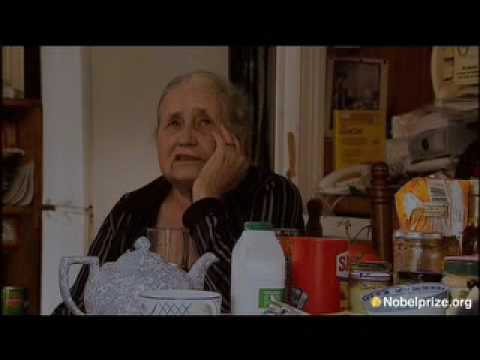
The interview's setting helps. Lessing is not placed at a podium under ceremony lights. She sits in a domestic room, answering a literary critic's questions with a mixture of memory, impatience, amusement, and precision.[1][2] That setting gives the recording its archival texture. A Nobel page supplies institutional authority, but the video itself preserves something less official: a writer testing categories as they are offered to her and often pushing them aside.
The Archival Recording
The embedded video is the official Nobel Prize YouTube upload of the long home interview connected to the 2007 Nobel Prize in Literature.[1] NobelPrize.org identifies the interview page's main video as an April 2008 conversation with Professor John Mullan at Lessing's home in London and lists the topics it covers, including The Grass Is Singing, the Children of Violence sequence, The Golden Notebook, Canopus in Argos, Jane Somers, autobiography, and Alfred and Emily.[2] That provenance gives the clip the features an archival spotlight needs: institutional source, interviewer, place, date, subject map, and a preservation context.
What the Video Makes Legible
The first thing to watch is Lessing's resistance to career summary. A prize interview naturally invites retrospective tidiness: first book, major breakthrough, genre turn, late achievement. Lessing accepts the sequence only partly. She remembers works, circumstances, and reader reactions, but she rarely lets a category harden before complicating it.[2] That matters because her books themselves often attack false wholeness. The Golden Notebook does not merely describe breakdown; it builds a form in which political, sexual, psychological, and writerly records fail to merge neatly.[3][5]
The second thing the video preserves is her practical account of genre. When Lessing discusses why she entered speculative territory, the important point is not whether a bookstore shelf should say science fiction or literary fiction. The important point is scale. Some stories require ordinary rooms, work, sex, class, and memory. Others require a civilizational or cosmic frame. Lessing's career makes more sense when form is understood as a load-bearing decision rather than an identity badge.[2][3]
That is why the archive is especially good for readers who know only The Golden Notebook. The novel's fame can distort the career around it. It can make Lessing seem like the author of one monumental feminist experiment with other works orbiting at a lower intensity. The Nobel interview rebalances the field. It lets her first novel, the Martha Quest books, the Jane Somers project, the autobiographies, the speculative sequence, and the late family reconstruction all appear as attempts to solve different narrative problems.[2][3][4]
The third detail is tonal. Lessing's public manner is not reverent toward literary reputation, including her own. That lack of ceremony is not anti-intellectual. It is a discipline. She often sounds most alive when refusing the glamour of being explained too smoothly. In this respect, the video teaches something about how to read her prose. Lessing's best work does not ask to be admired from a distance. It asks to be argued with, entered through difficulty, and tested against the lives and systems it examines.[4][5]
Why This Is a Literary Archive
A literary archive does not only preserve manuscripts and first editions. It preserves the sound of a writer describing the conditions under which form becomes necessary. In Lessing's case, that sound is unusually important because her afterlife is vulnerable to simplification. She can be turned into the Nobel old master, the feminist classic, the colonial witness, the ex-communist realist, or the writer who "went science fiction." Each label catches something real. Each becomes misleading when it replaces the motion between forms.
The interview corrects that by making motion audible. Lessing's career looks less like a series of departures than like a long refusal to let one successful method become permanent. The historical novel of colonial damage, the fragmented novel of mental and political life, the speculative sequence, the pseudonymous experiment, and the memoir all become ways of asking the same craft question: what form does this pressure require?[2][3]
That question is the clip's legacy. It keeps Lessing from being reduced to a single shelf and keeps readers from treating genre as a verdict. The archive shows a writer for whom "literary" does not mean staying inside approved surfaces. It means following a story until its necessary container becomes clear, even if the container annoys critics, surprises loyal readers, or violates the market's preferred map.
Seen this way, the Nobel interview is not just a supplement to the books. It is a reading instruction. Start with the work's pressure, not its label. Ask what scale of experience it is trying to hold. Ask why one book needs notebooks while another needs colonial realism or speculative history. Lessing's late voice matters because it makes that principle plain without turning it into doctrine. The story dictates the means, and the writer's job is to obey that demand more honestly than reputation, fashion, or genre etiquette would prefer.[2][3][5]
Sources
- Nobel Prize, "Nobel Prize in Literature 2007, Doris Lessing," official YouTube video.
- NobelPrize.org, "Doris Lessing - Interview" (April 2008 interview with John Mullan, topic map, video, and transcript links).
- NobelPrize.org, "Doris Lessing - Facts" (2007 literature prize facts, biographical summary, work summary, and prize motivation).
- Humanist Heritage, "Doris Lessing (1919-2013)" (biographical overview, political context, works, and humanist framing).
- The Golden Notebook Project, Doris Lessing's The Golden Notebook (publisher-authorized digital edition and reader commentary project).
- Wikimedia Commons, "File:Doris lessing 20060312.jpg" (source page for the 2006 lit.Cologne photograph by Elke Wetzig).