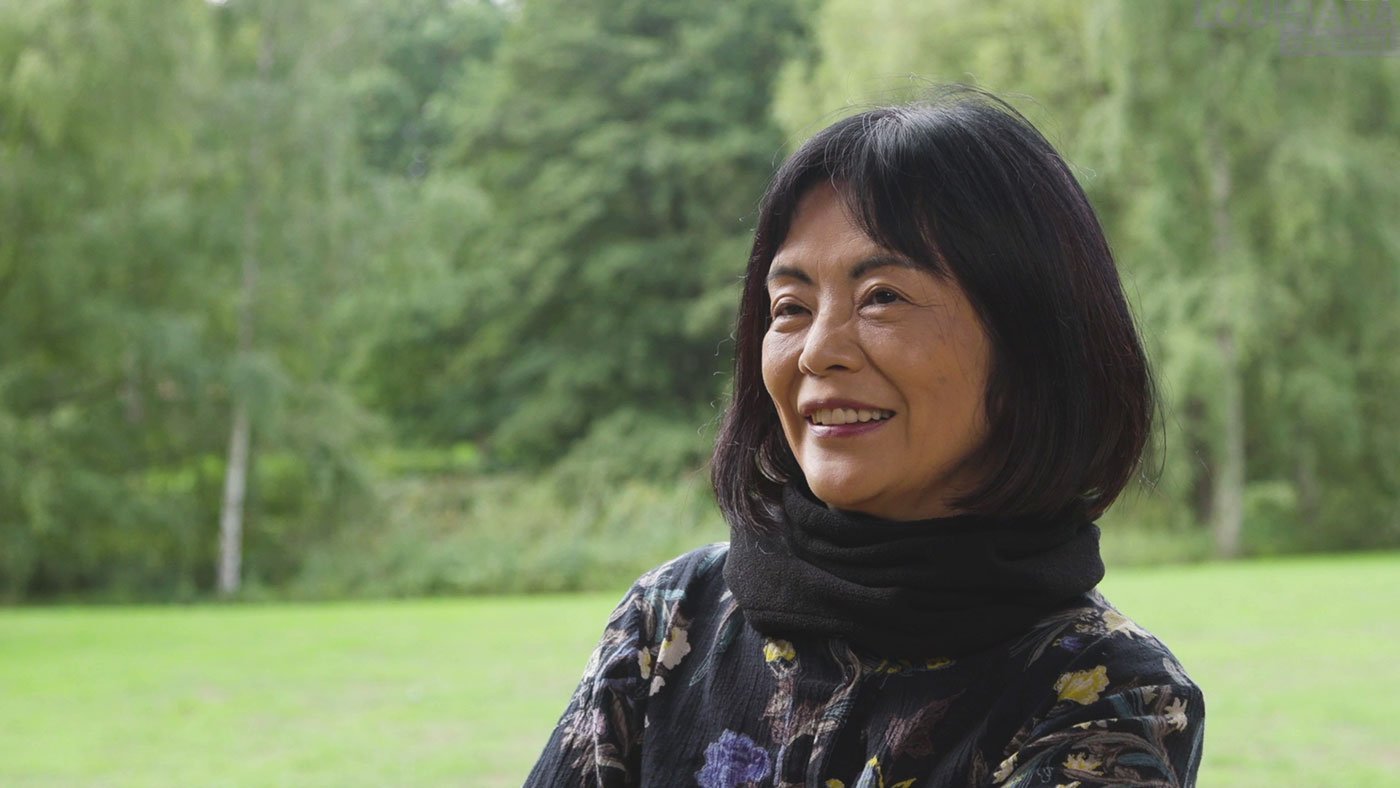

Yoko Tawada's most revealing phrase in this interview sounds, at first, like advice for beginners: literature should “start from zero.” She does not mean that a writer should forget craft, history, or every book already read. She means something more difficult. A writer should resist becoming so comfortable inside a language that its arrangements begin to look inevitable.[1]
That claim carries unusual weight from Tawada. Born in Tokyo, she has lived in Germany since 1982 and publishes in both Japanese and German across fiction, poetry, drama, and essays.[4][6] In the Louisiana Channel film, recorded at Louisiana Literature in August 2018, she speaks in Japanese, German, and English while English subtitles hold the interview together.[2] The changing soundtrack is not decorative multilingualism. It lets viewers hear the practice she describes: entering one language, stepping outside another, and accepting that no single voice will remain effortless.
The film is a compact introduction to that practice, but its best argument emerges when placed beside Memoirs of a Polar Bear. Published in English by New Directions in Susan Bernofsky's translation from Tawada's German, the novel follows three generations of writing and performing polar bears.[3] Its animal narrators do more than cross a border between species. They make familiar human institutions—authorship, political exile, the circus, the zoo, even the pronoun I—look constructed. The book performs on the page what Tawada describes on camera: it makes fluency strange again.
The embedded interview runs about eighteen minutes. It moves among three spoken languages and includes English subtitles; the analysis below supplies its central claims for readers who cannot watch it.
A language becomes visible from outside
In the opening minute, Tawada resists the interview's title before developing its premise. She does not especially like the language of “borders” and “border crossing,” she says; what matters is movement between two places.[1] The distinction prevents an easy heroic story in which the cosmopolitan writer simply defeats boundaries. Movement does not erase difference. It changes the position from which difference can be noticed.
Tawada recalls that, while living only in Japanese, she was in the language and could not stand above it to examine it. Learning German placed Japanese outside her for the first time. Its peculiarities and comic possibilities became perceptible.[1] In a later conversation, she describes that early immersion not as smooth fluency but as an adventure that left her identity “squeezed between two languages.”[4] Foreignness remained creatively consequential rather than a temporary stage on the way to native-like ease.
This is the first useful viewing cue: listen for prepositions. Tawada repeatedly describes herself as in, outside, or moving between languages. These are spatial terms, but her account is not an abstract map. At roughly the six-minute mark, pronunciation recruits the mouth and tongue; writing in a new language depends on the desire to use it, not only measurable ability.[1] Foreignness is bodily before it becomes a theme.
The camera strengthens that point quietly. Tawada sits almost motionless against a green landscape, yet her hands keep drawing positions, spans, and turns in the air. Around ten minutes in, she compares the felt architecture of long German and Japanese sentences. Her gestures make grammar look like a structure one has to move through. A sentence is not a transparent package for meaning. It is an arrangement that teaches the writer where beginnings, endings, and emphasis can occur.
Forgetting is part of the method
The film's sharpest reversal arrives around 7:15. Tawada explains that after writing in Japanese for a week, she starts to lose her feel for German; returning to German means damaging and rebuilding it. The experience makes her unhappy, she adds with a laugh, but she does it deliberately. She does not want to become too accustomed to either language.[1]
It would be tempting to romanticize this as perfect bilingual freedom. Tawada describes something closer to chosen friction. One language does not sit fully available beside the other like a second tool in a case. Attention to one changes access to the other. “Starting from zero” names the cost of recovering surprise: fluency is allowed to loosen so that phrasing can become a decision again.
The publication history of Memoirs of a Polar Bear turns that method into a material fact. Tawada first wrote the work in Japanese and then rendered it herself in German; Bernofsky translated the German text into English.[4] The English edition is therefore not a clear window onto a single, stationary original. It is one more movement through a work already living in two authored forms. The point is not that meaning vanishes in transit. It is that every version has to discover its own sentence-world.
Contemporary reception noticed that productive instability. Alexandra Primiani's 2016 review argues that each of the novel's three sections begins by disorienting the reader and grounding a new consciousness in touch, sight, smell, or movement before social language stabilizes it.[5] That pattern matters more than the novelty of talking bears. Each section asks the reader to locate the speaker again.
The bears do not stand for one thing
Near 12:45, the interview turns from bilingual composition to animal stories. Tawada remembers reading a small collection of Japanese folktales in Hamburg and finding that animal husbands appeared as often as animal wives, although modern retellings favored the latter. That discovery fed The Bridegroom Was a Dog and a larger interest in the unstable line between human and animal.[1]
From about 13:15 onward, she sketches Memoirs of a Polar Bear: a Soviet circus bear who becomes a memoirist, her daughter Tosca, and Tosca's son Knut, modeled on the celebrity cub raised at Berlin Zoo.[1][3] The sequence could invite a simple allegorical reading—bear equals migrant, captive, artist, or climate symbol. Tawada refuses that compression. She says she wanted to look at political and social questions through polar-bear eyes, not merely discuss the real bear who had already been made to symbolize global warming.[1]
That difference is the bridge between the interview's two halves. A symbol lets a human reader translate the animal back into a familiar concept. A viewpoint requires the reader to inhabit unfamiliar grammar long enough for human behavior to become the oddity. The bears write, perform, migrate, and acquire public identities, but the novel does not make them honorary humans. It uses their assured consciousness to unsettle the standards by which “human” narration usually presents itself as neutral.
Two brief sentences expose the mechanism. The grandmother concludes, “Something that can disappear is called ‘I’.” Later, Knut wonders why different humans can all use I without confusing one another.[5] The first speaker discovers that selfhood is vulnerable to language; the third encounters the first-person pronoun as a bizarre shared name. Across the family, I moves from an unstable possession to a grammatical puzzle.
The joke is pleasurable because it is exact. Readers use I thousands of times without needing the pronoun explained. Knut's confusion moves us outside that fluency. His perspective does to ordinary grammar what German once did to Japanese for Tawada: it makes a supposedly natural arrangement available for inspection.
Watch for the restart, not the border
The interview was published in 2019, between the 2016 English edition of Memoirs of a Polar Bear and the wider American recognition that followed Tawada and translator Margaret Mitsutani's 2018 National Book Award for The Emissary.[2][3][6] It works well as an introduction because it connects biography to technique without treating biography as a key that unlocks every fiction.
Watch once for the clear sequence: childhood reading, migration to Hamburg, the physical difficulty of German, deliberate movement between writing languages, Japanese animal tales, then the polar-bear novel. Watch again for the repeated restarts. A mother tongue becomes observable. A practiced German sentence becomes difficult again. A human soul is approached from inside a bear. A common pronoun becomes strange.
Tawada's method is not borderlessness. Borders remain present enough to produce exile, mistranslation, captivity, and unequal power. What literature can do is alter the direction of looking. By beginning from zero—not innocence, but renewed attention—the writer makes room for another language or creature to look back.
Sources
- Louisiana Channel, “Yoko Tawada Interview: Writing Without Borders,” YouTube video, published 19 June 2019.
- Louisiana Channel, “Yoko Tawada: Writing Without Borders” (production credits, interview context, and source page for the lead photograph).
- W. W. Norton & Company Ltd., Memoirs of a Polar Bear by Yoko Tawada, translated by Susan Bernofsky (publisher description, edition record, and three-generation synopsis).
- Yoko Tawada and Irmela Hijiya-Kirschnereit, “The Limitless Possibilities of a Literature Beyond Borders,” Nippon.com, 5 October 2021 (conversation on bilingual writing and self-translation).
- Alexandra Primiani, “Yoko Tawada's Memoirs of a Polar Bear,” Music & Literature, 1 November 2016 (contemporary review of voice, structure, and translation).
- National Book Foundation, “Yoko Tawada” (biography, bibliography, and Translated Literature award context).