The most quoted passage in Emma Lazarus's “The New Colossus” begins with an imperative: “Give.” The poem does not begin there. Before the tired, the poor, the lamp, or the golden door, its first two words are “Not like.”[1]
That order matters. Detached from its opening, the famous invitation can sound like a benevolent motto fastened to a very large statue. Read as a whole, the sonnet does something more strenuous. It first rejects one model of public power, then rebuilds monumentality around a different use: not conquest, but refuge; not the display of a victorious body, but the work of receiving bodies made vulnerable elsewhere.
The welcome has force because it is not merely warm. Lazarus gives her “Mother of Exiles” scale, electricity, authority, and a sequence of commands. The poem does not make power disappear. It asks what power is for.
“Not like”: a monument begins by refusing
The old colossus enters only to be negated:
Not like the brazen giant of Greek fame,
With conquering limbs astride from land to land;[1]
Grammatically, the celebrated ancient statue is subordinate from the start. Its fame, bronze, size, and stance all arrive inside a comparison whose governing answer is no. Even before Lazarus describes the new figure, she has decided that the harbor will not be interpreted through the body language of victory.
Line three pivots on a single locating word: “Here.” Then comes the future tense—“shall stand.”[1] Lazarus wrote the sonnet in 1883 for an auction supporting the still-unfinished Statue of Liberty's pedestal; the statue would not be dedicated until 1886.[2][3] The poem is therefore not simply reporting what an existing monument means. It is issuing a rival commission. Here, it says, is what this object will have to become.
The new figure is not modest in scale. She remains “mighty,” and her eyes “command” the harbor. But her strength no longer takes the form of “conquering limbs.” It has moved upward and outward: torch, eyes, hand, beacon. One body occupies territory; the other makes a threshold visible.
Even the torch resists easy uplift. Its flame is “the imprisoned lightning,” a phrase that holds danger and control together. Lightning has not been extinguished; it has been contained and made useful. The wording also creates a pressure the poem never fully releases: a statue promising that others may “breathe free” carries captive fire in her hand. Esther Schor reads the sonnet as iconoclastic not only toward imperial power but toward a simple Enlightenment story in which light alone guarantees liberation.[3] Lazarus's lamp guides, but it does not pretend that illumination and freedom are identical.
That is why “her mild eyes command” is so exact. Mildness without authority would reduce welcome to sentiment. Command without mildness would reproduce the old colossus. The line refuses to choose between them.
The sonnet turns at the mouth
Lazarus uses a tightly patterned sonnet: an ABBAABBA octave followed by a CDCDCD sestet.[1] The formal turn at line nine is also a change in who controls the sentence. For eight lines, an external speaker contrasts and describes the two figures. Then quotation marks open, and the statue takes over:
“Keep, ancient lands, your storied pomp!” cries she
With silent lips. “Give me your tired, your poor, …”[1]
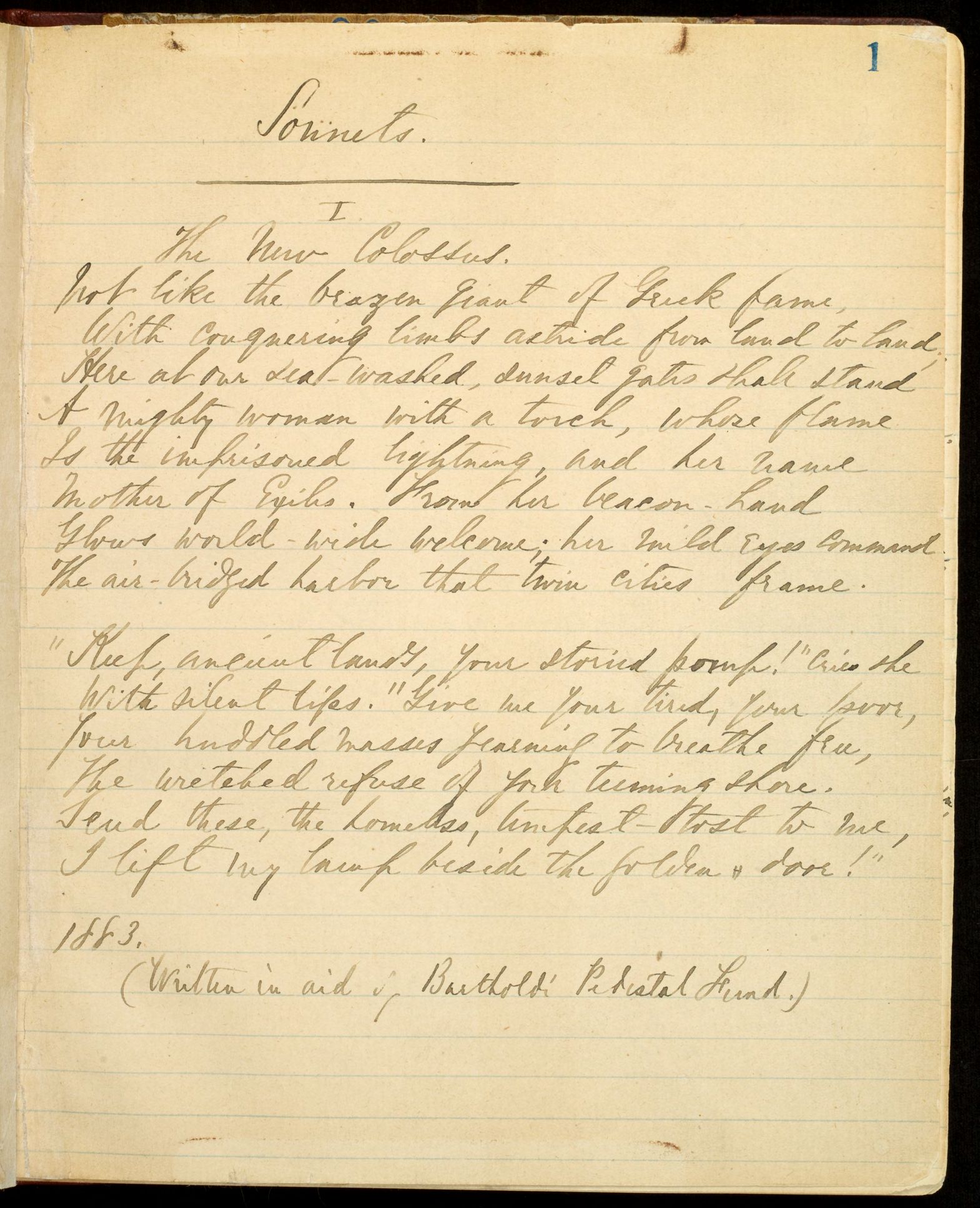
“Cries” runs directly into “silent lips.” The paradox is more than decorative personification. A statue cannot speak, yet this poem exists to give one a public voice. Speech here is written speech: it circulated with the 1883 fundraiser, survives in Lazarus's poetry notebook, and eventually entered the bronze plaque installed inside the pedestal in 1903.[2][5] Inscription makes silence durable.
The handwritten page sharpens the point. “The New Colossus” appears beneath the small generic heading “Sonnets,” followed after its last line by the practical note “Written in aid of Bartholdi Pedestal Fund.”[5] The civic oracle is visibly also a made thing—fourteen lines copied onto ruled paper, with their original fundraising purpose recorded beneath them. Its authority comes not from pretending to be timeless, but from converting an occasion into a voice that can outlast it.
The turn into direct speech also changes the poem's energy. The octave is full of balanced description: sea and sunset, torch and flame, hand and eyes, harbor and cities. The sestet begins with a brusque verb: “Keep.” The Mother of Exiles does not ask the “ancient lands” for permission to reinterpret the harbor. She tells them what they may retain and what they must surrender.
“Your” does the harder work
The sestet's moral structure is carried by a possessive pronoun. In six lines, the statue says “your” five times: “your storied pomp,” “your tired,” “your poor,” “Your huddled masses,” and “your teeming shore.” Against that insistence, “me” appears only twice: “Give me” and “Send these … to me.”[1] The grammar keeps staging a transfer between responsibility and refuge.
The grammar does not let the old lands behave as though displaced people appeared from nowhere. The exiles remain your tired and your poor before they become the speaker's guests. “Your” can sound possessive, but it is also accusatory. On this reading, the shores that cast people out remain implicated in the conditions that made them leave.
This makes the most abrasive phrase in the poem—“wretched refuse”—harder to smooth into civic uplift. “Refuse” turns people into waste; “teeming” can make the foreign shore sound overcrowded.[1] The statue does not attribute that dehumanizing label to someone else or distance herself from it. A responsible reading should let the ugliness remain audible.
Yet the pronoun pattern redirects the insult. These people are not refuse by nature; they are what your social order has treated as disposable. In the next line, “Send these, the homeless” replaces the waste category with a condition.[1] That is an interpretation grounded in the sequence, not a claim that the poem escapes every hierarchy in its period vocabulary. Michael P. Kramer's recent study is useful here: he describes the sonnet as a network of contrarieties, linking its asylum rhetoric to the sharp contrast between refugees on Ward's Island and the Gilded Age exhibition where the poem was first presented.[4]
“Yearning to breathe free” makes another quiet correction. A huddled mass may look passive from a distance, but yearning attributes active desire to the masses. Breath is the smallest imaginable freedom—bodily, continuous, required before any grander promise can matter. The poem moves from the aerial scale of a colossal torch to lungs.
A mother who issues orders
“Mother of Exiles” is often treated as the poem's soft alternative to a male warrior. Lazarus's figure is maternal, but she is not domesticated. She is “mighty.” She commands the harbor. Her speech contains three imperatives: Keep. Give. Send.[1]
Motherhood here names a political relation to people cut off from origins. An exile has lost, rejected, or been rejected by a home; the statue offers kinship at the point of arrival. But the metaphor does not turn entry into private charity. This mother addresses nations and reorganizes a public gateway. Her care operates at monumental scale.
That scale emerged from particular experience. In the early 1880s, Lazarus visited and aided Russian Jewish refugees housed on Ward's Island after fleeing anti-Jewish violence in the Russian Empire. She advocated in print, raised money, and worked in an employment bureau.[2][3] The poem does not reproduce those encounters as documentary scenes. Instead, it changes what a national monument must notice: not simply abstract Liberty, but people arriving under pressure.
There is a productive discomfort in the setting. A poem written for an elite art auction speaks on behalf of people labeled “wretched refuse.” Lazarus herself moved within wealthy New York literary circles even as she worked for refugees.[3][4] The sonnet's achievement is not that it abolishes that distance. It turns privilege into an obligation to address the gate—and leaves readers to judge whether the address becomes practice.
The golden door is a promise, not a mechanism
The final line returns to precious material: after the “brazen” giant and the captured lightning comes the “golden door.”[1] The sonnet has rejected pomp, but not grandeur. It repurposes grandeur as visibility. A lamp beside a door does not conquer the darkness or remove the threshold; it shows where an entrance might be.
That distinction bounds the poem's promise. A sonnet cannot admit a refugee, change a statute, or guarantee what waits on the other side. Even the statue's final action is limited and exact: “I lift my lamp.”[1] She offers orientation and declares welcome. The political institutions represented by the harbor still have to open the door.
The poem's afterlife makes that boundary especially important. Its initial notice faded after the 1883 fundraiser. Georgina Schuyler campaigned to restore it to public attention in 1901, and the plaque followed two years later.[2] Over later decades, the inscription helped bind the statue to immigration and refuge, but it did not turn poetic speech into law. What the poem supplied was a standard—a public sentence against which law and conduct could be read.
This is why the delayed beginning matters. “Give me” is memorable because “Not like” has already cleared the ground. Lazarus does not add compassion as a decorative virtue to the old colossus. She rejects conquest as the monument's governing grammar, preserves the power of command, and changes its object. The giant's limbs dominate the harbor; the woman's lamp makes a door answerable to those outside it.
The sonnet's welcome is not weightless optimism. It is a demand that monumental power turn around.
Sources
- University of Toronto Libraries, Representative Poetry Online, Emma Lazarus, “The New Colossus”—primary text, line references, publication note, rhyme scheme, and sonnet form.
- National Park Service, Statue of Liberty National Monument, “Emma Lazarus”—Ward's Island context, the 1883 pedestal fundraiser, and the poem's 1901–1903 recovery and inscription.
- Princeton University, “Life of Emma Lazarus provides inspiration for Princeton's Schor” (2007)—Esther Schor on Lazarus's refugee work, literary career, and the sonnet's iconoclasm.
- Michael P. Kramer, “The raison d'être of ‘The New Colossus,’” Partial Answers 22, no. 2 (2024), pp. 355–377—peer-reviewed record, abstract, and DOI.
- American Jewish Historical Society, Manuscript notebook from the Emma Lazarus collection, 1877–1887, Center for Jewish History digital repository—archival source for the handwritten page.