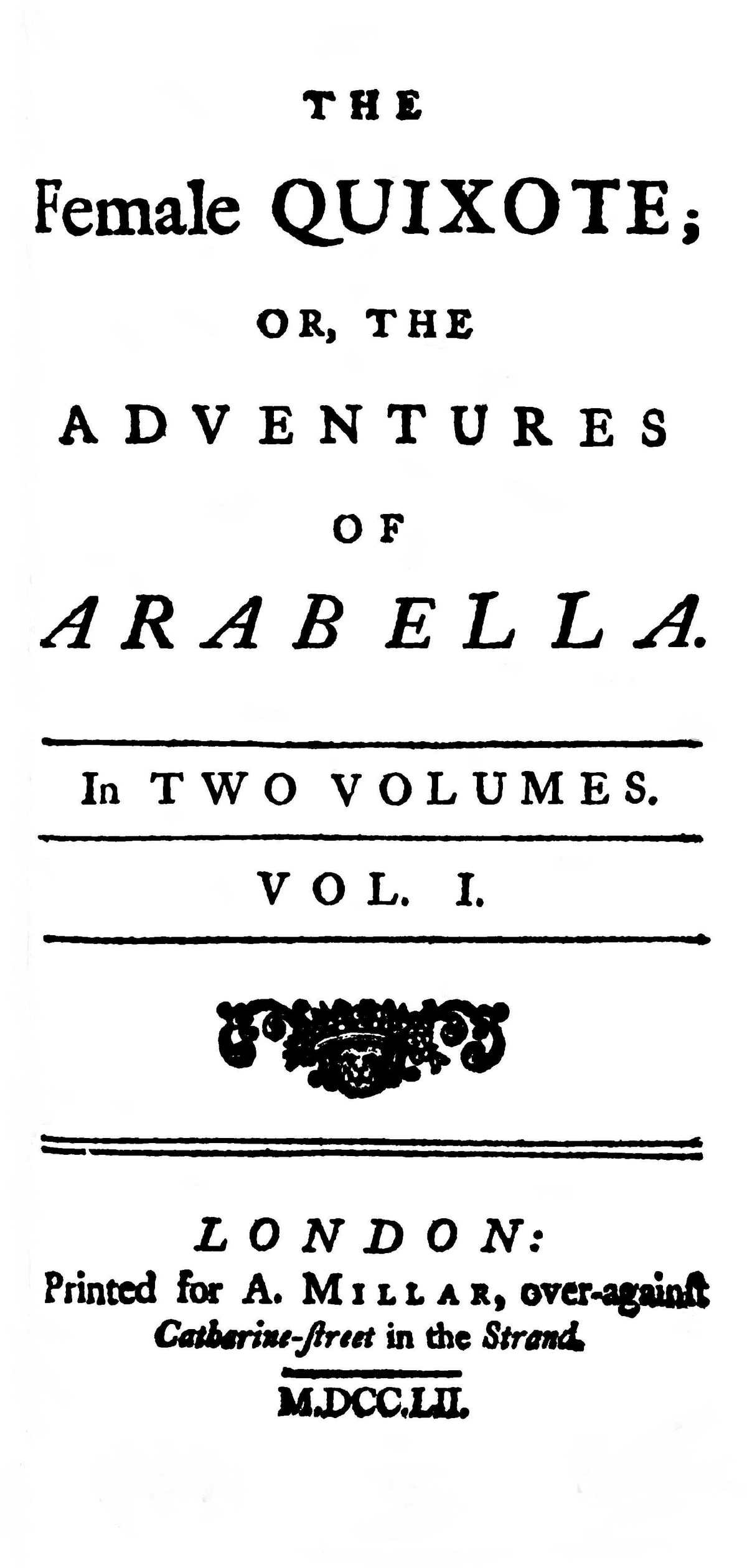
Early in Charlotte Lennox's The Female Quixote, a startled Mr. Hervey asks why Arabella's servants have seized him. “What do you take me for?” His question invites a social answer—a gentleman, a neighbor, perhaps an unwanted admirer. Arabella gives him a literary one: “For a ravisher.”[1]
She is spectacularly wrong. Hervey has approached on horseback, not launched an abduction. Yet the exchange contains the whole pleasure of Arabella as a character. She does not merely misunderstand other people; she assumes the right to interpret them, pronounce judgment, and make the household move accordingly. Her reading is faulty, but it is never passive.
Published in 1752, Lennox's novel gives its young heroine an education in French heroic romances and almost no education in ordinary company. Arabella treats those enormous tales as “real pictures of life,” so every glance predicts a declaration, every disagreement conceals a plot, and every eligible man risks becoming either a worshipful lover or a violent captor.[1] The comedy comes from watching rural England fail to behave like ancient Persia. The character study begins when we notice what Arabella's error lets her do: speak as if a young woman has authority over courtship, reputation, danger, and the stories told about her.
A library supplies the missing world
Arabella's father has withdrawn from court to a remote estate. Her mother is dead; her companions are her father and attendants. The romances she inherits from her mother's closet therefore do not displace a rich social education. They occupy a vacancy. From them she learns that love rules the world and that a beautiful woman governs love by withholding favor.[1]
This is a terrible predictive model and an intoxicating grammar. Arabella does not wait to discover what men intend. She commands Mr. Glanville not to follow her, orders intruders from her chamber, and insists that declarations arrive under conditions she recognizes. Her father can plan her marriage, but romance lets her imagine that consent belongs to the heroine and that the suitor must earn an audience.
The joke repeatedly cuts both ways. Glanville hears absurdity when Arabella speaks of lovers dying at a mistress's command. But Arabella also hears an absurdity that her society treats as normal: a father can announce a husband before his daughter has chosen to love him. Heroic romance magnifies her power beyond reason, yet it supplies a language in which her preference is not a minor detail of the arrangement. Sharon Smith argues that Lennox uses the romance-reading heroine to test the possibilities of women's learning and public participation, rather than simply to prescribe self-denial.[4] Arabella's education is warped, but the size of the self it produces is part of the novel's experiment.
A false alarm can contain a true fear
The “ravisher” scene is funny because the evidence does not support Arabella's charge. Lennox does not soften the mistake. Hervey is humiliated, Glanville is mortified, and Arabella congratulates herself on an escape from a danger she created.[1]
But the novel does not prove that sexual danger is imaginary. Sir George Bellmour soon recognizes Arabella's private code and learns to exploit it. He knows the romances she cites, copies their inflated speech, invents a royal ancestry, and performs a long false history in which he casts himself as a heroic sufferer. Arabella is safest with people who do not understand her and most exposed to the man who reads the same books strategically.
That distinction matters. Robin Runia notes that the novel places Arabella's comic misidentifications beside genuine forms of sexual threat, complicating any easy claim that her fears are ridiculous simply because particular accusations are false.[2] Arabella overestimates spectacular abduction while underestimating familiar manipulation. She sees a harmless horseman and imagines force; she hears Sir George's perfect romance dialect and mistakes fluency for honor.
The error is therefore not “books made her cautious.” It is that one genre has monopolized her sense of probability. Romance tells her what danger ought to look like, complete with armed retainers, coaches, deserts, and castles. It has fewer defenses against a charming man who studies a woman's expectations and feeds them back to her.
The Thames makes that failure physical. Seeing men approach, Arabella calls on her companions to imitate the Roman Clelia and plunges into the river to escape imagined captors. A servant pulls her out.[1] The scene is not an argument for trusting appearances. It is an argument for revising a model when the world keeps refusing its predictions.
Her mistakes can still produce moral clarity
Arabella's interpretive confidence sometimes makes her more generous than the socially competent people around her. When Miss Glanville repeats scandal about Miss Groves, Arabella objects that the woman's life may have been reported “with great injustice.” She believes she knows Miss Groves's secret thoughts because she has heard a romance-like history of them—a ridiculous claim to privileged access. Yet that mistaken premise leads her to resist the pleasure of public cruelty.[1]
She assumes a life has an inside. Reputation, in her view, cannot be reduced to what neighbors saw or said. The romances have trained her to expect hidden motives, coercion, reversals, and suffering behind a woman's visible conduct. Miss Glanville has better gossip; Arabella has the better instinct about judgment.
This is why “deluded reader” never quite contains her. Amy Hodges reads the novel as an education in social literacy: Arabella's collision with public spaces reveals the power structures through which other people interpret her body and position.[3] She misreads those spaces, but everyone around her is also reading. Men translate her beauty into availability, her fortune into a marriage prospect, her fear into comedy, and her confidence into illness. Realism is not a neutral view from nowhere. It is another arrangement of who gets to name what is happening.
Arabella's finest quality is not imagination by itself but her demand that interpretation answer to ethics. She dislikes ridicule, defends absent women, expects lovers to be truthful, and recoils when she finally understands that romance's cult of honor can turn a slight into bloodshed. Her categories are extravagant; her seriousness about what categories do to people is not.
The man who speaks her language reveals its weakness
Sir George is Arabella's most useful double because he proves that literary knowledge does not determine character. They possess much of the same reference library. She uses it to construct a world in which she must preserve virtue and others must act nobly. He uses it to make himself legible to an heiress.
His fabricated history is funny in a different key from Arabella's errors. She believes; he calculates. He watches for the names and gestures that win her esteem, then assembles them into a counterfeit self. Sir Charles laughs at the absurdities, but Arabella hears confirmation that the heroic world has at last recognized her.[1]
The episode also prevents a smug division between bookish folly and worldly sense. Glanville, who has not read the romances, often understands events but cannot explain Arabella to herself. Sir George understands her perfectly and uses that understanding badly. Literacy without honesty becomes fraud; common sense without imaginative patience becomes exasperation. Arabella needs more than either man offers alone: other books, wider experience, and interlocutors willing to argue rather than merely laugh.
Her cure is an argument, not an erasure
Near the end, after the Thames episode, a clergyman undertakes the famous “cure” of Arabella's mind. The word makes the scene sound like a simple removal of madness. The conversation is stranger and better than that.
When the doctor says no injury was intended at the river, Arabella catches his substitution immediately. She asked whether she had cause to fear; he answered a different question about intention. “The laws of conference require that the terms of the question and answer be the same,” she tells him.[1] He later insults romance readers in the heat of argument, and she makes him acknowledge the implication and apologize. She is not defeated by a superior volume of male speech. She sets the burden of proof.
Arabella asks him to establish three propositions: that her histories are fictional, absurd, and morally corrupting. She yields in stages. She accepts that the romances cannot be ancient history when their supposed records appeared only to modern French authors. She rejects the idea that fiction is worthless, forcing the doctor to distinguish fabrication from moral failure. Finally, she changes her mind when he argues that the books make love and revenge matters of human sacrifice. Arabella remembers how close her commands came to encouraging violence and says she will never again balance a punctilio against a life.[1]
That sequence preserves the trait the cure supposedly removes. Arabella revises because she is shown an error in evidence and an injury in conduct. Her conversion is an act of judgment.
The chapter's authorship makes its sudden gravity even more suggestive. The penultimate chapter has long been disputed between Lennox and Samuel Johnson. In 2026, Emrah Peksoy reported that three computational approaches converged on Johnson as the likeliest author or a significant contributor; the published corpus, scripts, figures, and result files make that evidence inspectable.[5] Attribution cannot settle the scene's meaning, but it sharpens its oddity: the most explicit correction of a woman reader may arrive in a male patron's markedly different voice.
What Arabella keeps
After Sir George confesses his deceptions, Arabella feels shame and agrees to marry Glanville. A punitive reading can stop there: unruly reader corrected, commanding woman made wife. The novel itself makes stopping difficult.
Arabella does not become empty. She chooses after evidence changes; she admits harm without surrendering her standards of sense and honor. Even her proposal frames marriage as a gift she decides to make: “To give you myself,” she tells Glanville, while promising to become worthy of the partnership.[1] The phrasing is humbler than her old decrees, but she remains the sentence's acting subject.
The critical afterlife has accordingly divided over whether the ending disciplines Arabella or preserves the disruptive value of her education. Smith's account emphasizes the novel's challenge to narrow models of female learning, while Hodges shows how its competing social spaces teach readers to see power in acts of interpretation.[3][4] Both perspectives fit the character better than a choice between “Arabella was right” and “Arabella was cured.” She was wrong about Hervey, the haymakers, and the Thames. She was right that appearances require interpretation, that a woman's consent matters, and that polite society can disguise predation as ordinary behavior.
Arabella's lasting charm lies in the mismatch. She brings an impossible scale of adventure into rooms that expect her to be manageable. The world corrects her, but she has already exposed the world's own fictions: that arranged marriage is merely practical, that gossip is knowledge, that ridicule is reason, and that only the romance reader is making a story. Her failure is not wanting life to be meaningful. It is trusting one shelf to tell her what every meaning must look like.
Sources
- Charlotte Lennox, The Female Quixote; or, The Adventures of Arabella (1752), Project Gutenberg—primary text, including Books I, VI, and IX.
- Robin Runia, “What Do You Take Me For?: Rape and Virtue in The Female Quixote,” in Interpreting Sexual Violence, 1660–1800. Cambridge University Press, 2014—false accusation, genuine danger, and the novel's treatment of virtue.
- Amy Hodges, “The Female Quixote as Promoter of Social Literacy,” ABO: Interactive Journal for Women in the Arts, 1640–1830 3, no. 1 (2013)—social space, spectacle, power, and women's interpretive position.
- Sharon Smith, “The Good Effects of a Whimsical Study: Romance and Women's Learning in Charlotte Lennox's The Female Quixote,” Eighteenth-Century Fiction 18, no. 2 (2005–06)—romance reading, education, and public participation.
- Emrah Peksoy, The Female Quixote authorship-analysis repository—open corpus, R scripts, figures, and result files accompanying “Who wrote the penultimate chapter of The Female Quixote” (Digital Scholarship in the Humanities, 2026).
- Wikimedia Commons, “The Female Quixote 1st ed.jpg”—source page and metadata for the archival scan of the 1752 first-edition title page.