The first great shock in The Woodlanders is not a seduction, a death, or a betrayal. It is a haircut offer. Hardy introduces Marty South at work, making thatching spars with a bill-hook and an oversized glove, her body already trained into repetitive rural labor.[1] Only after the work rhythm is established does the narration turn toward the one feature that seems to exceed use: her abundant hair, a "rare and beautiful approximation to chestnut."[1] The scene then moves with terrible speed. A barber arrives on behalf of Mrs. Charmond, offers money, hints at tenancy pressure, and asks Marty to let her hair be cut off so a richer woman may wear it.[1]
That passage matters because it states the novel's social method in miniature. The Woodlanders appeared in serial form in 1886-1887 and in book form in 1887, and the Cambridge edition notes Hardy's later remark that, "as a story," it was "the best of all" his novels.[2][3] One reason is that the book wastes very little time announcing what kind of world it inhabits. In Little Hintock, class power does not always arrive as proclamation. It arrives as wages, favors, tools, bark, leases, and bodies that can be used by people higher up the slope.[1][4]
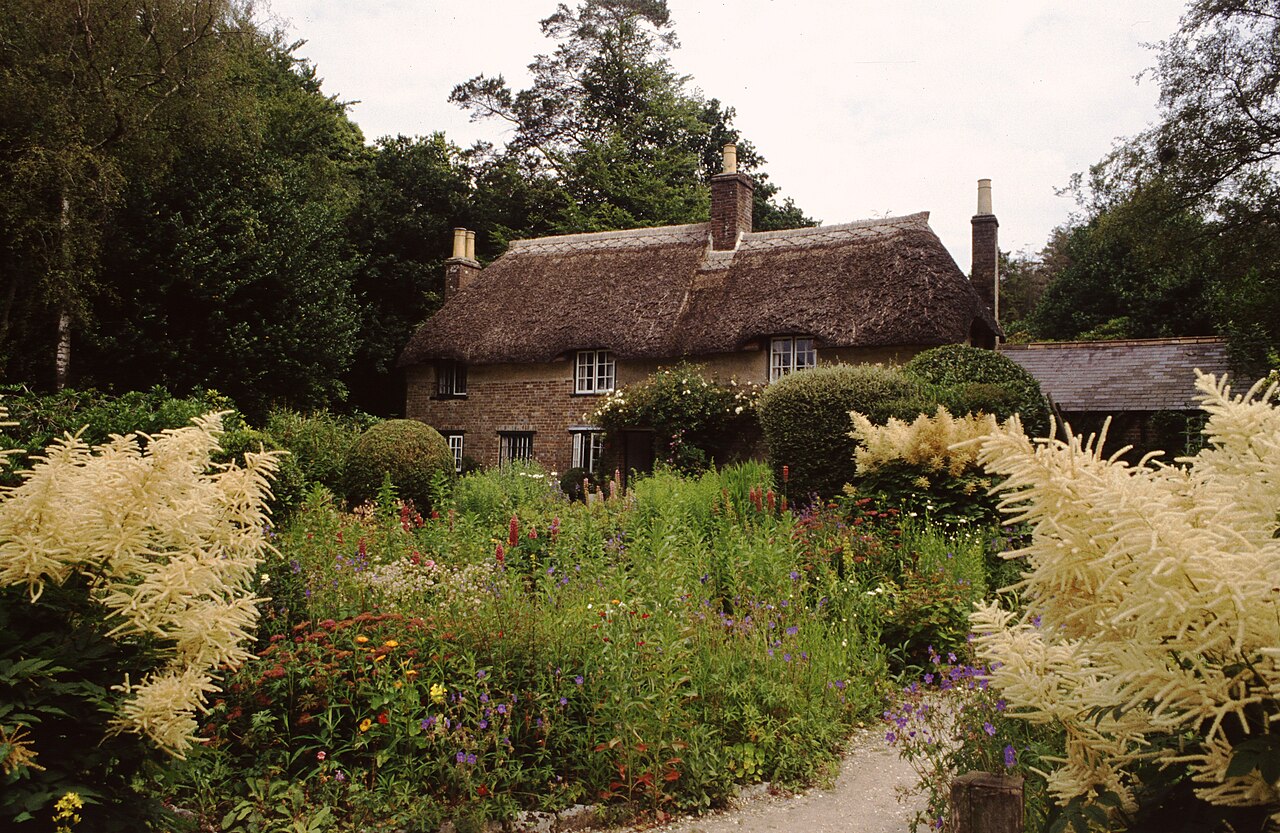
Image context: the cover uses a real photograph of Hardy's Cottage rather than a costume-drama still or symbolic book image. That choice keeps the essay close to Hardy's material world. Marty's scene is built from a cottage room, a fire, wood scraps, wage work, and the woodland economy beyond the walls; a documented Hardy place is a better visual match than a generic Victorian portrait.[5]
1) Hardy introduces Marty as a worker before he lets us see her as beautiful
Hardy is exact about sequence. Giles Winterborne enters the room and sees not a pastoral heroine posed for admiration, but a young woman "busily occupied" making spars by the fire.[1] She wears a leather apron. The glove is too large. The work is fast, practiced, and necessary. Beauty is delayed. When it arrives, it arrives almost against the grain of the setting: Marty has "but little pretension to beauty, save in one prominent particular - her hair."[1]
That ordering is the whole point. Hardy refuses the easy fiction in which female attractiveness appears first and labor comes later as background detail. Here labor is the background only in the sense that it is the ground of existence. Marty's skill with wood defines her before ornament does. Phillip Mallett's Cambridge introduction stresses that the novel belongs to Hardy's world of "character and environment," where people are inseparable from the social and physical conditions that shape them.[3] Marty's chestnut hair therefore does not float free as lyrical excess. It appears as the one striking surplus in a life otherwise governed by necessity.
Victorian Web's discussion of the novel's country is useful here because it insists that Little Hintock is never an innocent pastoral refuge.[4] Hardy's woods may look sheltered, dense, and old, but the same setting is already carrying jealousy, dependence, property, and calculation. That matters for Marty's hair. It is not a lyrical detail dropped into neutral scenery. It is the one vivid surplus in a social landscape that knows how to turn even beauty into usable material.
2) Percombe turns beauty into a parish transaction
Once the barber Percombe sits down, the scene becomes a negotiation over what can be detached from a poor body without formally calling it violence. He begins with market language: how much Marty earns, how much the lady will pay, how easily one sovereign may become two.[1] Marty resists with a phrase whose simplicity is the measure of the threat: "my hair is my own."[1] The line sounds obvious until the scene proves it is not obvious at all.
Percombe does not answer her by arguing about taste. He answers by reminding her where she stands. Mrs. Charmond is the local great lady. Marty lives in one of her cottages. Her father is ill. The barber lets the pressure emerge sideways, under the cover of friendly advice: it would be "as well to oblige her."[1] That is classic Hardy coercion. Nothing is yet an official command, which is exactly why it feels so hard to answer. A sovereign on the mantel glass, a hint about housing, a sick father upstairs, and a woman of property who wants to improve her appearance: the whole parish order is present in the room without needing to declare itself.
Britannica's summary of the novel is useful on this point because it places The Woodlanders among Hardy's sharpest studies of class, desire, and the constraints imposed by rural hierarchy.[2] The haircut scene does not merely introduce Mrs. Charmond before she enters in person. It defines the social physics she will embody. Her desire can travel downhill through an intermediary and arrive as a practical problem for someone else.
3) Hair becomes a transferable class surface
What Mrs. Charmond wants is not just hair in the abstract. She wants Marty's hair because she has seen it in church and noticed that it exactly matches her own.[1] That detail makes the episode much colder. Hardy is not staging a desperate sale to a faceless wig market. He is staging a direct transfer in which one woman's bodily advantage is completed by taking the matching material from another woman's body.
Marty sees the logic almost immediately. "She wants my hair to get another lover with," she says.[1] The remark is sharp not because it is jealous, but because it understands ornament as strategy. Rich beauty in this world is not natural innocence. It is maintained, supplemented, and materially reinforced. Marty's hair will not remain hair. It will become social equipment for a higher-ranking woman.
That conversion also changes how we read Marty's resistance. She says she values her looks too much to spoil them, which can sound vain if lifted out of context.[1] Inside the scene, it is one of the proudest things Hardy ever gives a poor woman to say. Marty owns almost nothing ornamental. Her hair is the single visible thing that has not yet been fully translated into wage work or dependence. To surrender it would be to assist in her own reduction, exchanging one of the few forms of self-possession she has for cash and obedience.
4) Why this scene governs the whole novel
The haircut passage lasts in memory because it teaches you how to read everything that follows. Later in the novel, Marty remains the figure most nearly aligned with Giles Winterborne's patient knowledge of the woods, and Hardy finally says that she alone had approached his level of "intelligent intercourse with nature."[1] That late dignity is already latent here. Marty is not important because the novel pities her. She is important because Hardy quietly makes her the best witness to how class and desire enter material life.
The opening scene also shows why The Woodlanders is harsher than a simple love triangle summary suggests.[1][2] Bodies in this novel are always crossing into other systems: labor system, tenancy system, courtship system, medical system, inheritance system.[1][2][4] Hair can become rent pressure. Education can become estrangement. Charm can become predation. A woodland economy can look intimate and still distribute vulnerability with great precision.
That is why this small passage feels larger than its scale. Hardy does not begin by telling us that Little Hintock is unequal. He begins by making inequality tactile. A firelit room, a pair of sovereigns, a sick father, a barber's shears, a lady's vanity, and one sentence of refusal - "my hair is my own."[1] In that compressed arrangement, The Woodlanders announces the terms of its world. Beauty will not be left alone as beauty. The moment it becomes visible, someone higher up the social ladder will try to wear it.
Sources
- Thomas Hardy, The Woodlanders (Project Gutenberg HTML text; Marty's opening scene, Percombe negotiation, and later references to Marty and Giles).
- Encyclopaedia Britannica, "The Woodlanders" (publication context, plot overview, and thematic framing).
- Phillip Mallett, introduction page for The Woodlanders, Cambridge University Press edition (publication history and Hardy's later assessment of the novel).
- Victorian Web, '"The Country of "The Woodlanders""' (setting context, Hardy's woodland geography, and the novel's social unease).
- Wikimedia Commons, "File:Higher Bockhampton, Thomas Hardy's Cottage from the garden.jpg" (source page for the article image).
Editor's Pick Review
This pick wins on compression and force. The essay takes one small scene from The Woodlanders and makes it carry the whole social weather of the novel: labor before beauty, beauty converted into rent pressure, and class power moving through a barber's ordinary visit rather than through melodrama. It is also visually disciplined under the current image policy. The Hardy's Cottage photograph is immersive and topic-grounded, keeping the reader near the material world of firelight, woodwork, cottage tenancy, and rural dependence instead of substituting an analytical diagram or decorative literary stock image.
The strongest editorial reason to feature it is the bilingual finish. The English argument is narrow, sourced, and memorable; the Chinese version keeps the pressure of the scene legible while preserving Hardy's social mechanics, the key citations, and the image rationale. Among the last-24-hour pool, this piece offers the cleanest blend of close reading, reader payoff, source economy, and image compliance.