Jo March persists because she never settles into the role the book keeps offering her. She is supposed to become legible as one of four sisters in a moral family story, but Alcott gives her too much velocity for that. Jo is first introduced as "very tall, thin, and brown," coltish rather than graceful, a girl whose body seems ahead of the social script prepared for it.[1] Her complaint that she cannot get over "my disappointment in not being a boy" is famous, but it is also easy to flatten.[1][2] The line does not mean Jo wants masculinity as a costume of simple privilege. It means she experiences available girlhood as a scale problem. The world offered to her feels too small for the amount of motion she contains.
That is why Jo still reads as sharper than a generic "tomboy" type.[2][3] Alcott does not make her lovable by smoothing away awkwardness. She gives her a decided mouth, ungainly limbs, bursts of temper, comic self-dramatizing habits, and a hunger to act before she has fully thought through consequence.[1] Jo wants expansion, and the novel's character study begins there: not with abstract rebellion, but with a person who experiences manners, stillness, and ornamental femininity as forms of compression.
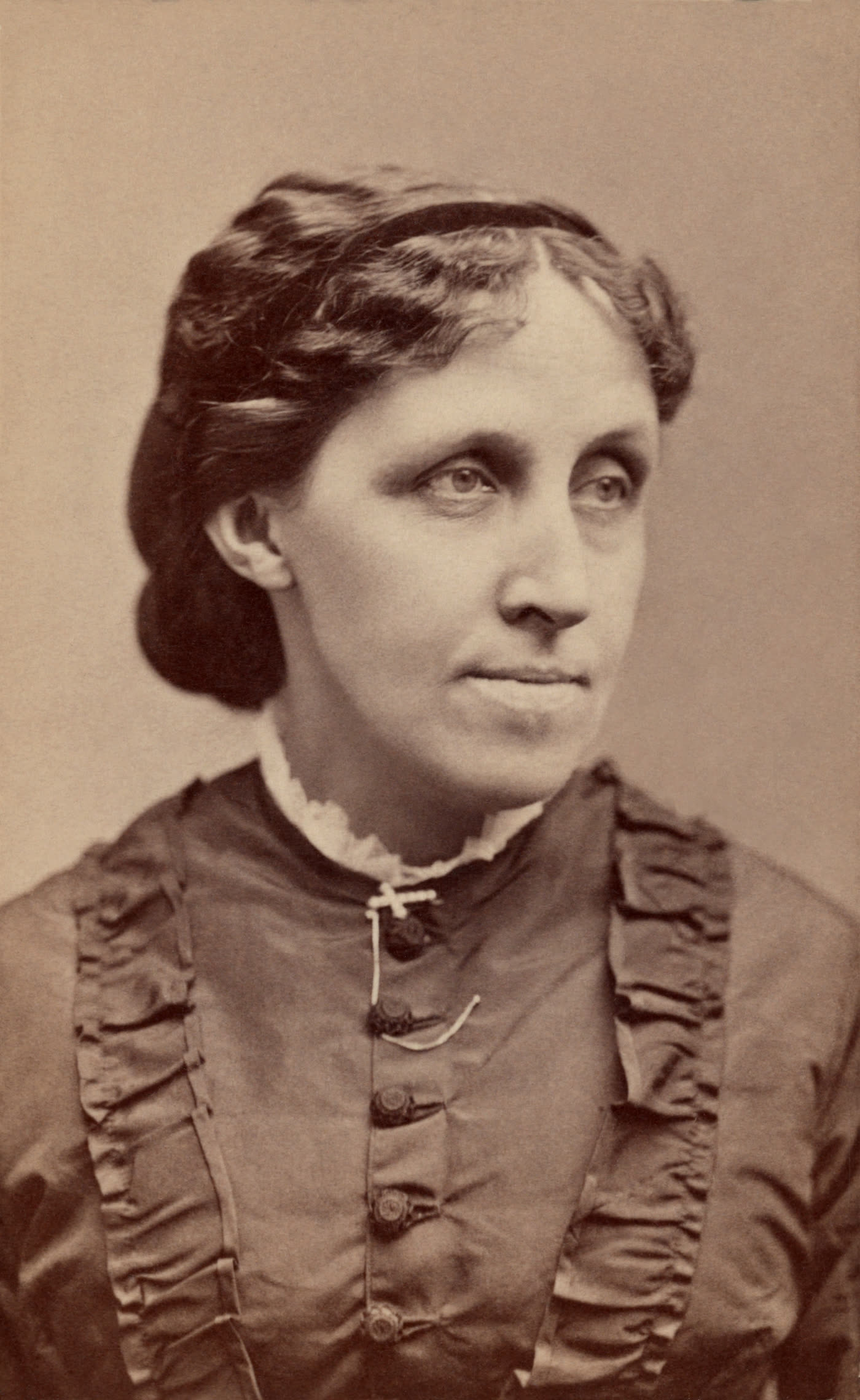
The cover image uses a real archival photograph of Alcott rather than an adaptation still because Jo's energy is most convincing when we remember how close she stands to a working authorial life.[4][6] Orchard House's educational materials are especially useful on this point. They preserve the household play culture behind Little Women, including the boots Louisa wore while playing the theatrical hero Roderigo, a concrete reminder that Jo's boy-role bravado comes out of family performance, improvisation, and writing practice rather than from slogan-like ideology alone.[5]
1. Jo's restlessness is intellectual before it is romantic
Many classic heroines are introduced by beauty, marriageability, or a wound in waiting. Jo is introduced by motion and friction.[1][3] Even when the family is gathered in hardship, she keeps turning feeling into declaration, joke, fantasy, or scheme. That tempo matters. Jo does not merely want things; she wants them quickly, with form, with plot.
Alcott gives the clearest self-description when the sisters imagine their future "castles in the air." Jo does not dream first of comfort, marriage, or display. She wants "something splendid," "something heroic or wonderful," and then states the practical version of that grandeur: "I think I shall write books, and get rich and famous."[1] The movement inside the sentence is the whole character. Jo begins with romance-sized ambition and lands on labor. Writing is not a fallback from action. Writing is how action becomes possible at the scale available to her.
That is a more precise claim than saying Jo is "ambitious." Plenty of nineteenth-century characters want a better life. Jo wants authorship because authorship promises range. It allows one to travel without leaving, to produce events from a garret, to convert embarrassment, boredom, anger, and observation into portable form. Alcott makes literary appetite feel less like gentility than like appetite proper.[1][4]
2. The garret turns authorship into a bodily habit
One reason Jo survives adaptation and classroom memory is that Alcott makes writing look physical.[1][2] The great garret scene does not present inspiration as noble mist. Jo sits in the autumn light with papers spread over a trunk while Scrabble the pet rat runs overhead; "quite absorbed in her work, Jo scribbled away" until the page was full.[1] The verbs matter. She scribbles, ties up the manuscript, pockets it, slips out, catches the omnibus, and carries her work toward the city.[1] Authorship here is hustle.
That physicality keeps Jo from becoming an emblem of vague self-expression. She is not only talented. She is industrious, impatient, and theatrically hopeful. When her little book is burned, the injury lands so hard precisely because Alcott has already shown the reader how much labor and self-projection such pages carry.[1] Jo's writing is not decorative accomplishment. It is an extension of nervous system, pride, and imagined future.
This is where Alcott's autobiographical pressure helps without needing to dominate interpretation. Britannica notes that the success of Little Women allowed Louisa May Alcott to escape debt and transform family obligation through writing.[4] The novel does not simply transpose that fact into Jo, but it does let Jo feel the economic edge of literary ambition. To write books and become "rich and famous" is a fantasy, yes, but it is also a plan for leverage inside genteel poverty.[1][4]
3. Jo's strength is tested by the house, not liberated from it
The usual shortcut is to treat Jo as the sister who points outward while the novel pulls her back indoors. That misses the craft of the character study. Alcott keeps proving that the house is not only a cage. It is also the field on which character is measured.[1][2] Marmee's lesson that work gives "a sense of power and independence better than money or fashion" supplies the ethic that Jo must learn to inhabit rather than merely applaud.[1]
This is why Jo's best scenes are not only the obviously rebellious ones. Her energy becomes more interesting when it is forced into care, patience, and repeat labor. She cuts her hair to help her mother travel to Washington.[1] She learns, badly and then better, that temper can injure people she loves. She discovers that domestic incompetence is not the same thing as moral freedom. The point is not that Jo is tamed into sweetness. The point is that Alcott keeps asking what a fast spirit looks like when it stays answerable to other lives.
That answerability gives Jo density. If she were only a rebel, she would shrink into type. If she were only dutiful, she would lose voltage. Instead, the novel builds her out of collision. She wants sublimity, money, authorship, noise, speed, heroic exception; the household keeps returning her to soup, sewing, illness, errands, apology, and the everyday dependence of sisters.[1][3] Jo's greatness is not that she escapes those things. It is that she keeps trying to enlarge herself through them.
4. Why Jo still feels modern
Jo reads as modern because she experiences identity as an unfinished draft.[1][2] She tries roles rapidly: brother, playwright, family jester, secret author, helper, scolder, dreamer, wage-earner. None quite holds, and Alcott is wise enough not to force one stable label too early. The novel's emotional intelligence lies in understanding that young ambition often appears first as awkwardness. Jo's flyaway clothes, blunt speech, sudden shame, and overdriven plans are not details to be corrected away; they are the visible cost of becoming thinkable to oneself before the surrounding world has language ready for that self.[1][3]
This is also why the character's famous roughness matters more than her charm. The March family in Britannica's summary is lovable partly because Jo is the emotional center and disruptive force at once.[2][3] She keeps the novel from settling into piety. She wants style, splash, and astonishment. She turns moral instruction into theater, and theater back into work.
In that sense, Jo March does not endure because she predicts one later feminist script in tidy form. She endures because Alcott lets contradiction remain active. Jo wants freedom, but not isolation. She wants greatness, but inside affection. She wants literary scale, but she learns through household scale. She is still moving when the book pauses. That unfinished motion is the character's real afterlife.
Sources
- Louisa May Alcott, Little Women; or, Meg, Jo, Beth, and Amy. Project Gutenberg HTML text.
- Encyclopaedia Britannica, "Little Women."
- Encyclopaedia Britannica, "March family."
- Encyclopaedia Britannica, "Louisa May Alcott."
- Louisa May Alcott's Orchard House, "OHO Elementary" educational materials page, including Jo March's theatrical boots and household artifacts.
- Wikimedia Commons, "File:Louisa May Alcott, c. 1870 - Warren's Portraits, Boston.jpg" (source page for the lead photograph).