The afterlife of Alice's Adventures in Wonderland is easy to mistake for a costume trunk: blue dress, white rabbit, grin, tea table, red queen, cards in the air. Those icons matter, but they are not the engine. The book keeps surviving because Lewis Carroll built a grammar that could travel. Wonderland is a sequence of portable pressures: bodies change size, rules arrive late, speech obeys local laws, authority behaves like theater, and a child keeps testing whether sense can be made in a room that changes the terms after she enters it.[1]
That portability began before the printed book existed. The British Library traces the story back to Charles Dodgson's 1862 boat-trip tale for Alice Liddell and her sisters, then to the manuscript he prepared for Alice as Alice's Adventures Under Ground.[2] Publication changed the work again. The Morgan Library's 2015 exhibition notes how the private manuscript was revised, expanded, professionally illustrated by John Tenniel, and pushed into a public object whose early printing troubles only added to its bibliographic aura.[3] Adaptation, in other words, was not a later corruption of a pure original. It was built into the passage from spoken entertainment to manuscript gift to illustrated Victorian book.
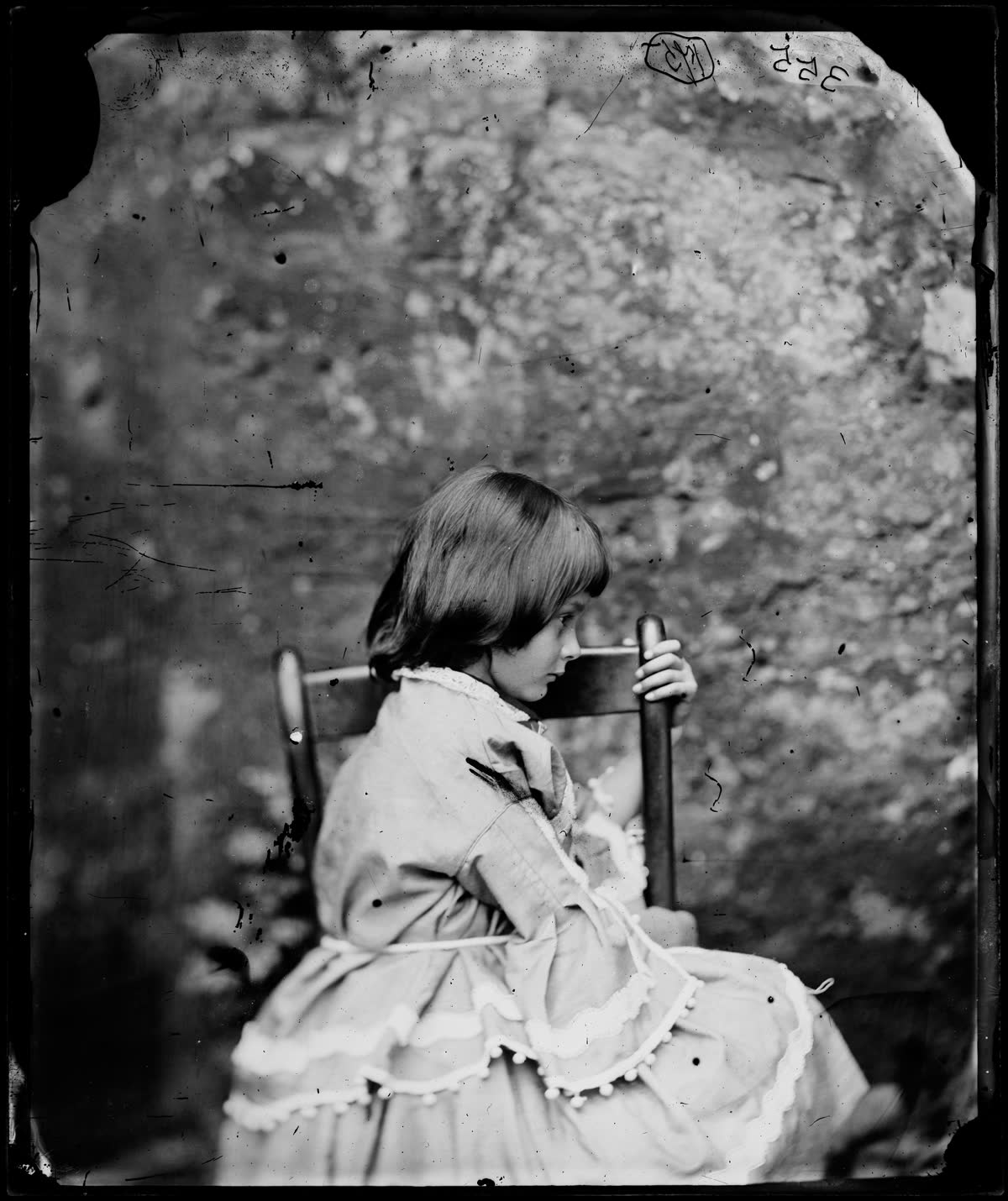
Image context: the cover photograph is not an illustration of Wonderland. It is a historical photograph of Alice Liddell by Carroll, dated 1859-1860 on the Commons file page.[5] Its usefulness lies in restraint. It keeps the essay close to the material origin story while reminding the reader that the fictional Alice is an artful construction, not a transparent portrait of a child.
A book made from detachable tests
The plot of Alice is famously loose. Alice follows the White Rabbit, falls, changes size, enters rooms, meets creatures, listens to poems, attends a tea party, plays croquet, and reaches a trial.[1] A tidy quest would make adaptation simpler in one way and poorer in another. Carroll's book works more like a kit of scenes. Each scene tests a different contract between language and world.
At the beginning, Alice wants pictures and conversation; the book then gives her both in excess.[1] She is not rewarded for obedience, courage, or sentimental goodness in the usual nursery-book pattern. She is forced to interpret. A bottle says "Drink me"; a cake says "Eat me"; a caterpillar asks identity questions as if identity were a puzzle with a correct procedure; a duchess turns moralizing into comic violence; the Hatter's table makes social ritual feel like broken machinery.[1]
That scene logic explains why the book survives translation across media. A stage designer can build doors and scale changes. A filmmaker can make the fall elastic. An illustrator can choose whether the Cheshire Cat is charming, predatory, abstract, or decorative. A museum exhibition can arrange manuscript, drawing, edition, and toy as one chain of transmission.[3] The plot tolerates these rearrangements because the deeper continuity is not what happens next. The continuity is how Alice meets a rule, tests it, and discovers that the rule belongs to an unstable local world.
Tenniel gave nonsense a public skeleton
Carroll's manuscript drawings belonged to the private gift. Tenniel's illustrations gave the printed book a public skeleton. The British Library emphasizes that Dodgson sought a professional illustrator and that Tenniel produced forty-two illustrations, more than Carroll had drawn for the manuscript.[2] It also notes that Tenniel's images became the best-known visual basis even as later artists multiplied after copyright expired.[2]
This matters for adaptation because Alice is unusually dependent on the meeting of verbal and visual timing. The White Rabbit with a watch is already theatrical before an image appears, but Tenniel's graphic authority made the theatricality repeatable. The Hatter, the Duchess, the Queen, the Caterpillar, the cards, and Alice's changing body became a shared inventory. Later versions could reject Tenniel, soften him, brighten him, quote him, or fight him; they still had to answer the silhouette he helped stabilize.
The Morgan exhibition's account of the suppressed first edition sharpens the point. Tenniel's dissatisfaction with printing quality led to withdrawal, and the surviving copies became rare objects.[3] That episode looks like production history, but it also shows how early the book's afterlife depended on reproduction standards. Wonderland needed not only sentences but a durable visual surface. If the pictures failed materially, the book's public body was incomplete.
Disney made Alice familiar by smoothing the sequence
The 1951 Disney film is the most powerful modern familiarizer for many viewers. Disney's official page gives the release date as July 28, 1951, and identifies the film as an animated family adventure built around Alice's pursuit of the White Rabbit through a topsy-turvy world.[4] The film gathers Carroll's episodes into a brighter, more continuous sensory ride. It makes Wonderland musical, elastic, saturated, and immediately recognizable.
That recognition is both a gain and a narrowing. Carroll's book often keeps Alice's intelligence under pressure. She is polite, irritated, literal-minded, lonely, curious, and stubborn by turns. The prose lets her ask, "Who in the world am I?" without turning the question into a modern identity anthem.[1] The Disney grammar tends to make the world more legible as spectacle. The reader's discomfort with rules becomes the viewer's pleasure in visual transformation.
Still, the film did not replace the book so much as prove the book's strange adaptability. A weak literary original disappears under a strong studio style. Alice does something more resistant. Even inside a famous animated version, the material remains recognizably Carrollian because the scenes are already built as experiments in transformation. Disney can make the mushrooms, doors, flowers, cards, and tea table move with studio fluency, but it inherits the deeper premise: language and world keep slipping out of alignment, and Alice must keep adjusting her scale.
Nonsense as a discipline, not a mood
The word "nonsense" can make Alice sound airy. The book is actually disciplined. Carroll was a mathematician and logician as well as a writer, and Britannica's biographical account places Alice's Adventures in Wonderland and Through the Looking-Glass at the center of his literary reputation while keeping his Oxford mathematical life in view.[6] That double life matters. Wonderland's absurdity is funny because it behaves with local rigor.
The Mad Tea-Party is not merely random. It is a social setting where etiquette remains visible after meaning has failed. The Queen's croquet ground is not merely chaotic. It is a political space where equipment, animals, bodies, and orders refuse stable function.[1] The trial is not merely silly. It is a legal performance that exposes verdict, evidence, rank, and procedure as theater before justice can appear.[1]
This is why later adaptations can tilt the material toward comedy, nightmare, surrealism, children's fantasy, or adult allegory without severing the source. Each emphasis is already latent in the book's method. The book does not tell readers that logic has vanished. It shows little systems forming and collapsing. The pleasure comes from watching Alice learn the local system quickly enough to survive its next failure.
The afterlife belongs to Alice's method
The British Library notes that the published Alice books remained in print and were translated into more than seventy languages.[2] Britannica goes further in reception scale, describing the two Alice novels by Carroll's death as the most popular children's books in England and, by his 1932 centenary, among the most famous in the world.[6] Those claims describe reach, but reach alone does not explain durability. Many once-famous children's books now require historical explanation before they produce pleasure. Alice still produces the pleasure first.
That pleasure comes from method. Alice does not master Wonderland by defeating it. She keeps asking what kind of world she has entered. She checks labels, questions categories, answers badly framed questions, notices unfairness, and grows impatient with authority that cannot justify itself.[1] Adaptations can change costume, color, sound, casting, tempo, and medium; the usable core remains a child moving through systems whose rules are vivid, arbitrary, and temporary.
The final trial makes the afterlife legible. Authority swells until it becomes absurd; Alice grows until the court's scale can no longer intimidate her; the pack of cards loses its power as a governing image.[1] That ending is not a simple escape from fantasy into waking reason. It is a release from one local rule-system back into another. The reader has learned the book's deeper lesson: nonsense is not the absence of structure. It is structure exposed as provisional, theatrical, and available for rearrangement.
That is why Wonderland could become an illustrated classic, a museum object, a Disney film, a design vocabulary, and a recurring shorthand for distorted logic. The afterlife did not begin when later media discovered Alice. It began when Carroll's spoken tale became a manuscript, when the manuscript became a Tenniel-illustrated book, and when that book proved that a child walking through unstable rules could carry an entire imaginative system in her wake.[2][3]
Sources
- Lewis Carroll, Alice's Adventures in Wonderland, Project Gutenberg edition of the public-domain text.
- The British Library, "Lewis Carroll's Alice's Adventures in Wonderland" (manuscript history, publication development, illustration history, and reception notes).
- The Morgan Library & Museum, "Alice: 150 Years of Wonderland" (2015 exhibition page on genesis, publication, first edition, and enduring appeal).
- Disney Movies, "Alice in Wonderland" (official page for the 1951 animated film, release date, genre, and production credits).
- Wikimedia Commons, "File:Alice-Liddell-by-Carroll.jpg" (Lewis Carroll photograph of Alice Liddell, 1859-1860, image source page).
- Encyclopaedia Britannica, "Lewis Carroll" (biographical context, Oxford background, origins and publication of Alice's Adventures in Wonderland, and reception scale).