Northanger Abbey is usually introduced as Jane Austen's joke against Gothic excess: Catherine Morland reads too many thrilling books, goes to an old house, and lets imagination outrun judgment.[1][2][3] That description is true as far as it goes, but it underrates Austen's precision. Cambridge's introduction to the novel is useful on this point because it treats Northanger Abbey as a book about how reading shapes perception rather than as a mere period spoof.[2] Catherine's mistake does not come from private foolishness alone. It is produced by a whole social education. Bath teaches her to watch entrances, infer motives, decode flirtation, and treat manners as clues. By the time she reaches Northanger, she has been trained to think that what people say openly and what they mean privately may be very far apart.[1][2]
That is why the novel still feels sharper than the summary attached to it. Austen opens by refusing Catherine the ornamental destiny of a ready-made heroine. She was not "born to be an heroine"; she liked boys' games, preferred cricket to dolls, and had to be taught into literary seriousness rather than being born inside it.[1][4] Yet the joke in that opening is not that Catherine is empty-headed. The joke is that novels, like drawing rooms, come with scripts, and Catherine enters both as someone learning how powerful those scripts can be.
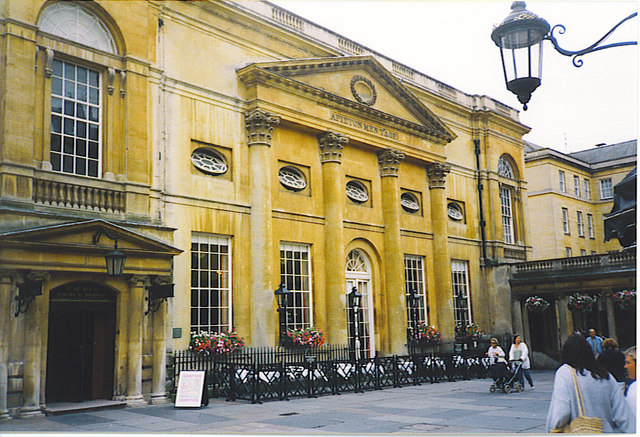
Image context: the cover uses a real photograph of Bath's Grand Pump Room from Wikimedia Commons. That is the right visual grammar for this essay because Austen's novel is built less from ruined masonry than from public performance: who sees whom, who sits where, who enters at the right moment, and how quickly a room can teach someone to misread what it stages.[5]
Bath teaches Catherine to read surfaces as if they were plots
Before Northanger becomes a building, Bath has already become a training ground. Catherine arrives in a city organized by circulation: assemblies, walks, visits, carriage arrangements, pump-room encounters, accidental meetings that are never entirely accidental.[1][2] She is inexperienced, but the world around her is full of people who already understand social timing as technique. Isabella Thorpe can turn friendship into performance in a sentence. John Thorpe narrates his own importance nonstop. Henry Tilney, more benevolently, treats language itself as a game of tonal control.[1]
This matters because Catherine is not wrong to feel that public life hides motives. It does. Austen keeps showing her a society in which speech is courteous on the surface and strategic underneath. Plans change according to advantage; invitations are used competitively; absences are interpreted; benches in the pump room become observation posts.[1] Even affection is filtered through timing and placement. Catherine's moral problem is therefore subtler than simple gullibility. She is entering a world that really does reward interpretive alertness.
Bath also explains why the Gothic frame takes hold so easily. The British Library's account of the novel is useful here because it emphasizes Austen's play with the Gothic reading culture of the 1790s, including Catherine's delight in the so-called "horrid" novels.[3] But Austen's parody works because Bath has already made ordinary social experience feel theatrical. By the time Catherine looks toward Northanger, she has spent weeks learning that respectability can conceal vanity, that intimacy can be tactical, and that people often mean more than they say. Gothic fiction does not drop into an empty mind. It lands in a mind already trained by polite society to expect hidden designs.
The abbey fantasy is wrong in mechanism, but not in atmosphere
When Catherine learns she is invited to stay at Northanger, the whole novel pivots on desire. The phrase that governs her excitement is not subtle: she will live under the "roof of an abbey."[1] Austen gives her the full weather of anticipation. Ancient passages, old stories, possible memorials of injury, the dream that architecture itself may store a buried narrative.[1] Catherine's imagination turns the house into a machine for revelation before she has even entered it.
The famous correction is that nothing supernatural waits for her. The chest, the cabinet, the corridor, the late-night noises all collapse back into ordinary explanation.[1] Yet the novel does something more interesting than simply laugh. It lets the Gothic misfire on mechanism while preserving its intuition that power can inhabit a house. General Tilney is no secret murderer. Henry's rebuke makes that plain, invoking roads, newspapers, and a nation of "voluntary spies" who would expose such crimes.[1] On one level, he is right. Catherine has imported Radcliffean atrocity into a world that does not contain it.
On another level, Henry's speech is too confident about how visible coercion really is. General Tilney's force is not hidden murder but controlled hospitality. He regulates movement, meals, schedules, impressions, and the emotional climate of the house.[1] He can be ostentatiously polite while making everyone around him feel his pressure. Catherine's imagination gets the form wrong, but it has registered the atmosphere correctly. Northanger is ruled space. The mistake is not that she senses danger where none exists. The mistake is that she gives ordinary patriarchal authority the costume of Gothic crime.
That distinction is what makes the abbey chapters better than a satire summary suggests. Austen is not merely curing Catherine of fantasy. She is refining her object of attention. Catherine must learn that domination in English domestic life will usually arrive without trapdoors, yet it will still shape rooms, silence daughters, and make guests study the face of a host before they trust the day.[1][2]
Henry's correction cannot cancel General Tilney's reality
The novel's hardest turn comes after Catherine's shame. Once Henry forces her to confront the extravagance of her suspicion, she seems fully recalled from romance.[1] A lesser novel would stop there, having taught its heroine the superiority of common sense. Austen keeps going because she wants to expose a crueler truth. Catherine may have misjudged the mode of danger, but the social order around her is still capable of humiliation without warning.
General Tilney's expulsion of Catherine is the proof. Austen's language becomes suddenly stripped and severe: she is sent away "without any reason that could justify" the abruptness or insult.[1] The journey is real, the danger practical, the indignity public. Catherine's earlier Gothic terrors dissolve before this because actual incivility, backed by rank and male authority, requires no imaginative inflation.[1] It is simply there.
This is where Northanger Abbey becomes more than a comedy of reading mistakes. Cambridge's introduction is again helpful because it treats the novel as a study of how fiction and language shape a young reader's mental construction of the world.[2] That makes Catherine's education look harsher than simple embarrassment. She learns that social reality contains forms of arbitrariness and power which Gothic fiction exaggerates, but does not invent. The old novels prepared her badly for the mechanism; experience corrects that. Yet experience also confirms that innocence has to navigate vanity, property, surveillance, and authority all the same.[1][2][3]
The ending does not erase this lesson. Catherine gets Henry, the misunderstanding is repaired, and the plot closes in comic order.[1] Even so, the book's intelligence lies in what it has made visible along the way. Bath taught her to read. Northanger taught her to revise the genre of what she read. General Tilney taught her that the worst injuries in Austen are rarely melodramatic enough to announce themselves as horror. They arrive as etiquette weaponized by power.
That is why Northanger Abbey still reads so well in 2026. It remains a novel about bad reading, but also about why bad reading can be such an understandable stage on the way toward judgment. Catherine is not merely a girl who mistakes life for a novel. She is a girl who discovers that polite life is already half theatrical, that every room teaches its own habits of suspicion, and that growing up means learning which plots are false without ever concluding that power has become harmless.[1][2][3]
Sources
- Jane Austen, Northanger Abbey (Project Gutenberg full text).
- Janet Todd, "Northanger Abbey," in The Cambridge Introduction to Jane Austen. Cambridge University Press.
- Tanya Kirk, "Jane Austen and the 'very horrid' Northanger Abbey." British Library, December 16, 2014.
- Library of Congress, "Baseball and Jane Austen" (on Catherine Morland's famous preference for 'base ball').
- Wikimedia Commons, "File:Grand Pump Room Bath.jpg" (lead-image source page).