Nikolai Gogol's The Overcoat is easy to summarize badly: a poor clerk needs a new coat, loses it, dies, and returns as a ghost. That summary captures the plot while missing the machine that makes the story endure. The real event is not the overcoat. It is the voice that keeps changing its distance from Akaky Akakievich Bashmachkin, the copying clerk whose life seems so small that the narrator must first decide how to make smallness audible.[1]
The story was published in Russian as "Shinel" in 1842, and Britannica places it among the works that became foundations for the great nineteenth-century Russian realist tradition.[2][3] Yet the realism is never plain reportage. Gogol's narrator behaves like an office gossip, a mock historian, a sentimental witness, and a supernatural stage manager by turns. He notices rank, salary, weather, sewing, insults, addresses, and official self-importance; then he lets those details swell until a government department feels both absurdly tiny and morally enormous.[1][4]
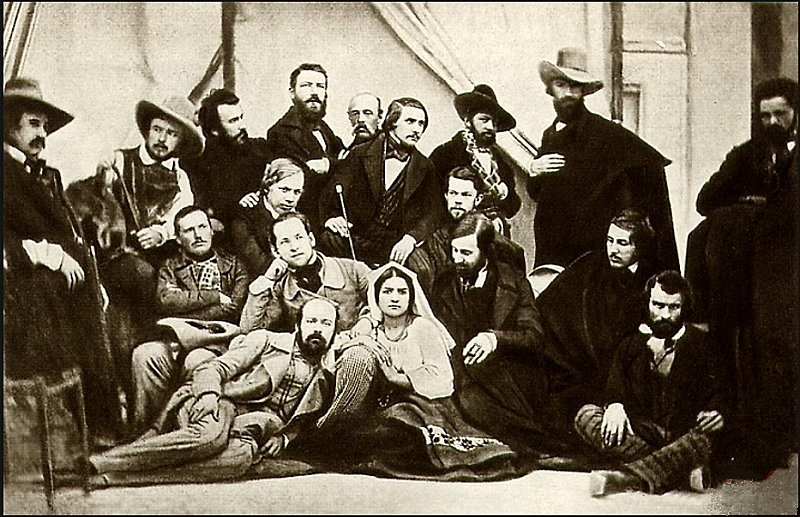
Image context: the cover photograph comes from Wikimedia Commons' file page for Sergey Levitsky's 1845 group daguerreotype of Gogol with Russian artists in Rome. The image does not illustrate Akaky's St. Petersburg directly. Its relevance is more precise: it gives the article a real archival photograph of Gogol inside the nineteenth-century visual culture of pose, rank, costume, and public face, exactly the social surfaces the story keeps turning into drama.[5]
1) The narrator begins by refusing official seriousness
The story opens with one of Gogol's great evasions. Instead of naming the department cleanly, the narrator withholds it, as if bureaucratic designation itself were both necessary and ridiculous.[1] This is the first tonal clue. The world of The Overcoat worships exact titles, ranks, and filing channels, but the storytelling voice refuses to treat that exactness as dignity.
That refusal matters because Akaky's life is almost entirely made of official routine. He copies documents, returns home, copies more if he can, and loves the line-by-line fidelity of the work.[1] A flatter social-protest version of the story would make him simply pitiable. Gogol does something stranger. He lets the narrator sound amused by Akaky's narrowness and then slowly makes that amusement unsafe. The reader is invited to laugh at the copying clerk's limitations before recognizing that the laughter belongs to the same culture that has trapped him.
The style therefore performs moral correction without announcing a sermon. Encyclopedia.com's Reference Guide essay is useful on this point because it emphasizes the narrator's fussy, pedantic mode: the telling distances itself from Akaky while still carrying moral urgency.[4] That doubleness is the story's engine. Akaky is treated as comic material, but the comedy keeps leaking into accusation.
2) Office cruelty enters as sound before it becomes ethics
Gogol's most devastating early turn is acoustic. Akaky does not defeat his tormentors through speech. He barely interrupts them. But the narrator makes his small protest echo in the mind of a younger clerk who suddenly hears cruelty inside ordinary office play. Akaky's words are simple: "Do leave me alone!" and "Am I not your brother?"[1] The point is not rhetorical brilliance. It is the shock of a voice that should have been ignorable becoming impossible to file away.
That scene shows how the story thinks. Bureaucracy works by reducing persons to replaceable functions: copyist, superior, petitioner, "important personage."[1] Gogol lets the office culture speak in roles, nicknames, jokes, procedures, and tonal habits. Then a single human cry disturbs that speech system. It does not reform the office. It does not save Akaky. It does something narrower and more haunting: it proves that the system has to keep converting human sound into background noise in order to keep working.
This is why the story should not be read only as a parable about poverty. Poverty is central: Akaky's old coat is physically inadequate, and the cold of St. Petersburg is a material pressure, not a metaphor.[1][2] But the narrative voice keeps showing that social death begins before physical death. Akaky is spoken about, laughed over, redirected, and dismissed until his presence exists mainly as an irritation in other people's speech.
3) The coat turns style into weather
The overcoat itself becomes powerful because Gogol lets material detail change the temperature of the prose. The old coat is not just shabby; it has been seen, named, mocked, patched, and socially interpreted.[1] Once the tailor Petrovich announces that repair is impossible, the story's rhythm changes. Akaky enters the arithmetic of deprivation: food, candles, laundry, walking carefully to spare shoe leather, all organized around one future garment.[1]
That is where the style becomes almost tender without losing its grotesque edge. Akaky's new coat is practical protection, social costume, erotic shimmer, feast invitation, and identity experiment at once. Britannica's summary rightly foregrounds the underpaid clerk's need to replace his ancient coat, but Gogol's language makes the replacement more than a purchase.[2] The coat gives the office a new way to look at him, and therefore gives Akaky a new way to be endangered by being seen.
The narrator's voice is crucial here. He does not simply say that Akaky becomes proud. He lets the coat reorganize social attention. Congratulations, invitations, street movement, and fantasy all gather around the garment. The world has not become kinder; it has merely discovered a new surface on which to write value. The coat warms Akaky's body while exposing how coldly recognition works.
4) Rank speaks as theater
The "important personage" is one of Gogol's funniest and most frightening inventions because he is almost entirely made of performance.[1] His authority depends on address, posture, delay, audience, and the ability to make a petitioner feel improper for needing help. In another story, he might be a villain. In The Overcoat, he is closer to a speech position that has swallowed a person.
That distinction keeps the satire sharp. Gogol does not need to build a complex psychology for the official because the office has already supplied one. The man has learned to sound important, and sounding important becomes a substitute for judgment. When Akaky seeks help after the theft, the official's language turns loss into procedural insolence.[1] A stolen coat becomes a lesson in hierarchy.
This is where the story's realism and absurdity become inseparable. Britannica's broader discussion of Russian literature notes Gogol's comic and nonsensical force, including the way language can seem to generate absurd content of its own.[3] The Overcoat proves that this is not decoration. Bureaucratic speech is absurd precisely because it has consequences. It can chill a room, block help, humiliate a sufferer, and leave a body to the weather.
5) The ghost ending is not an escape from realism
The ghostly coda often looks, at first, like a genre swerve: the poor clerk dies, then returns to snatch coats from the living.[1][2] But the ending works because the story has been spectral all along. Akaky was already half-erased inside the office. His name was a joke before his death; his voice had to become an echo before anyone heard it; his coat had carried more social reality than his body.
The ghost does not cancel the social reading. It completes the style. A world that refused to register Akaky as a person is forced to register him as a rumor, a threat, a story moving through the streets. Encyclopedia.com notes that readers have disagreed over whether the supernatural ending disrupts or confirms the story's unity.[4] The stronger reading is that the ending reveals the logic already present: if official speech reduces the living to paperwork, Gogol's narrative will let the dead return as unofficial circulation.
The result is why The Overcoat has such a strange afterlife. It is short, almost slight in plot, and built around a garment that ought to be modest. Yet the voice makes every small thing unstable: a name becomes humiliation, a copying desk becomes destiny, a coat becomes weather and status, an office title becomes theater, a ghost becomes the only form of notice left.
Gogol's achievement is not merely that he pitied a poor clerk. It is that he made pity pass through mockery, chatter, technical detail, rank-conscious comedy, and ghost-story revenge without allowing any single register to settle the matter. The Overcoat sounds almost human before it turns ghostly. That is its accusation: a society may fail to hear a person until only the story can make him audible.
Sources
- Nikolai Gogol, The Mantle, and Other Stories, translated by Claud Field, Project Gutenberg edition including "The Mantle" / "The Overcoat".
- Encyclopaedia Britannica, "The Overcoat" (publication, plot, and work-level overview).
- Encyclopaedia Britannica, "Russian literature - Nikolay Gogol, Satire, Realism" (Gogol's place in Russian literary history and comic language).
- Herbert Marder, "The Overcoat (Shinel') by Nikolai Gogol, 1841," Reference Guide to Short Fiction, via Encyclopedia.com.
- Wikimedia Commons, "File:1845. Н. В. Гоголь в группе русских художников в Риме.jpg" (Sergey Levitsky daguerreotype source page).