Readers often remember Winesburg, Ohio for one word: grotesques.[1][3] That word matters, but it can also send the book in the wrong direction, as if Sherwood Anderson's method were mainly to fill a town with odd cases. The stronger claim is technical. Anderson makes loneliness audible by refusing both grand rhetoric and neat diagnosis. His sentences tend to arrive plain, physical, and only partly explanatory. They begin on porches, in dust, in store light, in the angle of a body crossing a street. Only then do they edge toward feeling. The result is a style that sounds simple until one notices how much pressure it can hold.[1][2][4]
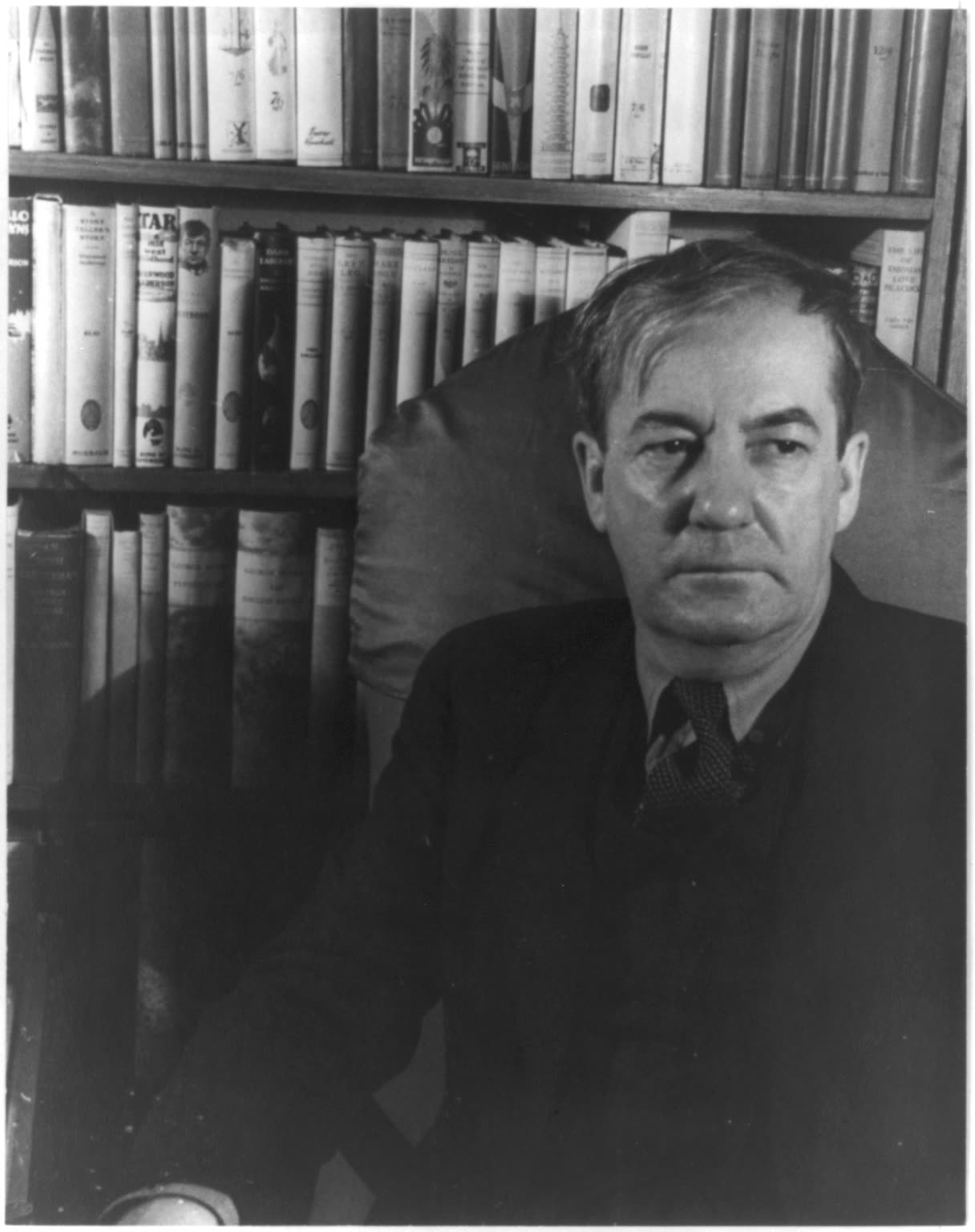
Image context: the cover uses a real 1933 archival portrait of Sherwood Anderson from Wikimedia Commons. That choice suits the article because Anderson's prose can look almost unauthored at first glance. The portrait restores the maker behind the effect: a writer whose plainness is not casual but composed, and whose emotional force depends on restraint rather than display.[5]
1) The book's plainness begins as a theory of distortion
The short prefatory sketch "The Book of the Grotesque" gives the whole cycle its tonal contract.[1] Anderson does not introduce Winesburg through civic description, historical overview, or realist exposition. He begins with an old writer in bed, a carpenter, a conversation, and then a parable about people who seize one truth and harden around it until "the truth he embraced became a falsehood."[1] The language is strikingly unacademic for such a large claim. Abstract ideas are broken down into almost graspable objects: truths lying about, people snatching them up, lives bent by overcommitment.[1]
That matters stylistically. Anderson wants generalization, but he distrusts the inflated vocabulary that would make generalization feel finished. Britannica is right to emphasize that Winesburg, Ohio became a turning point in modern American fiction because it treated inward frustration and provincial life with unusual psychological intimacy.[2][3] What makes that intimacy work on the page is not analytic precision alone. It is the way Anderson lets theory arrive through fable, gesture, and compressed spoken rhythm. The book's first principle is already visible: say something large in language that still feels hand-held.
2) Anderson's sentences start outside the character and then move inward
Again and again, the stories open by fixing a person in a visible setting before they tell us what hurts. "Hands" begins "Upon the half decayed veranda" of a small house by a ravine, with Wing Biddlebaum moving nervously while dust rises in the road and young laborers shout from a wagon.[1] "Adventure" starts with Alice Hindman as a store clerk, then quietly notes the "continual ferment" beneath her placid exterior.[1] "Sophistication" opens on the county fair, dust, wagons, sticky children, and a town laboring at amusement before George Willard's inward loneliness comes into focus.[1]
This is one of Anderson's signature moves. He does not treat scenery as padding before psychology. Exterior description is the delivery system for psychology. People in Winesburg do not merely have feelings; they stand in weather, in failing rooms, in storefront glare, in fields that widen or trap the mind. That helps explain why the prose can remain so uncluttered without feeling thin. The sentence keeps touching wood, dust, beds, lamps, roads, and hands, so emotion arrives embodied rather than merely announced.[1][3]
3) The style keeps circling speech that never quite completes itself
What the characters want most is often not action but utterance. They want to tell, confess, bless, warn, touch, or explain, and the prose records the strain of almost doing so. Wing Biddlebaum tries to pass something living to George Willard and retreats in terror from his own hands.[1] Kate Swift tells George that the real task is to grasp "what people are thinking about," not the cleaner surface of what they say.[1] Elizabeth Willard burns with a life she never fully converts into public decision.[1] Alice Hindman moves through years of suspended address after the man she loved leaves town.[1]
Anderson writes these people with an almost reportorial patience. He rarely gives them brilliant speeches that solve them. More often he repeats structures of wanting, trying, stopping, turning away, sitting alone, or lying awake. That repetition is the style. It builds a world in which speech is always near and seldom adequate. Library of America places Anderson among the major renovators of the American short story, and this is a central reason why: he discovered a prose rhythm that could stay close to ordinary speech while making silence itself feel like narrative material.[4]
4) George Willard is the book's listening instrument
The cycle's calmest technical invention is George Willard. He is not the book's master interpreter. He is its gathering surface.[1] Reporter, son, listener, errand-runner, object of projection, future departure, George moves from story to story absorbing unfinished feeling from people older than he is. Others speak toward him because he has not yet hardened into one more Winesburg certainty. Their half-confessions give the book continuity, but they also shape its voice. The prose learns to hover, receive, and delay judgment because George does.
That is why the late stories matter so much. In "Sophistication," George's loneliness is rendered less as adolescent drama than as a new fatigue, a weather of adulthood settling over him before he has language ready for it.[1] By "Departure," the style opens outward without becoming triumphant. He leaves at dawn with a bag, a trunk, and expectation, but the prose keeps one foot in the town's long fields and habits.[1] Anderson does not convert leaving into clean liberation. He gives it the same tonal mixture that governs the whole book: tenderness, exhaustion, incompletion, and the possibility that motion itself may become another form of thinking.
5) Why the book still feels modern
Winesburg, Ohio still matters because Anderson found a middle distance between lush symbolism and hard-boiled minimalism.[1][2][4] He can sound biblical for a sentence, colloquial for the next, then suddenly almost clinical, only to return to an image as bare as a road at dusk. The shifts are quiet enough that readers can miss how controlled they are. But that control is exactly what lets the stories avoid caricature. The grotesques are not monsters. They are people who have lost proportion between inward need and available language.
That is why the book has survived changes in taste. Later fiction would become more streamlined, more ironic, more formally difficult, or more socially panoramic. Anderson's breakthrough was different. He made plainness capable of carrying shame, thwarted desire, erotic confusion, religious panic, and the ache of small-town repetition without forcing any of it into declarative wisdom. Winesburg, Ohio sounds bare because it strips away the language people use to pretend they are whole. Under that stripped surface, the sentences keep trembling.[1][3][4]
Sources
- Sherwood Anderson, Winesburg, Ohio. Project Gutenberg ebook 416.
- Encyclopaedia Britannica, "Sherwood Anderson."
- Encyclopaedia Britannica, "Winesburg, Ohio."
- Library of America, "Sherwood Anderson" (author page and career context).
- Wikimedia Commons, "File: Sherwood Anderson (1933).jpg" (source page for the lead photograph).