Tess of the d'Urbervilles is often remembered as if its power came mainly from plot cruelty: seduction, misunderstanding, labor, abandonment, execution.[1][2] Those things matter, but Hardy's deeper force is verbal. Before the novel asks readers to decide how tragic Tess's life is, it trains them to hear a voice that keeps changing scale around her. One sentence will stand close to the grain of rural speech, bodily fatigue, and weather. The next will widen into philosophical complaint, biblical irony, or classical fatalism. That constant resizing is what keeps pity from turning passive.
The subtitle matters here. Hardy calls the book A Pure Woman Faithfully Presented, and that phrase already puts style into argument.[2] It tells readers that naming Tess will be part of the conflict, because the moral vocabulary around her is unstable from the beginning. Hardy does not simply narrate the destruction of an innocent country girl. He keeps showing how innocence, purity, guilt, sympathy, and justice are produced by language long before they harden into social verdicts.[1][2][3]
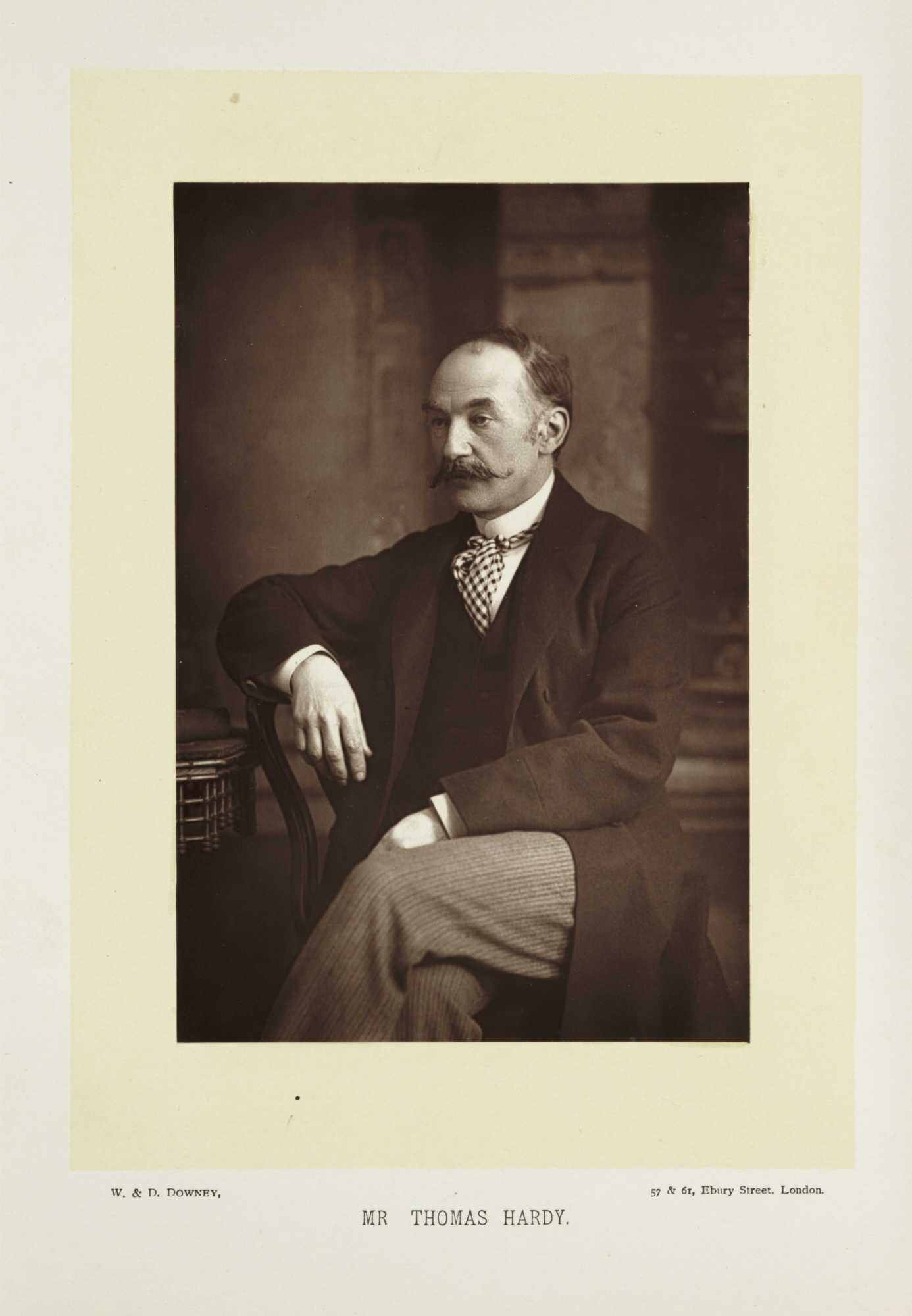
Image context: the cover uses a real 1894 photographic portrait of Thomas Hardy from Wikimedia Commons rather than a scenic Dorset landscape. That choice suits this essay because the novel's energy does not lie in pastoral atmosphere alone. It lies in Hardy's habit of looking closely and then suddenly judging, as though every descriptive passage might become a moral deposition a sentence later.[5]
1. Hardy first distinguishes Tess by giving her more expressive weather than the crowd around her
When Tess first appears in the Marlott club-walking scene, Hardy places her among other village girls in white, then quietly lifts her out of the group with a sentence whose texture already matters. She is described through her "mobile peony mouth" and "large innocent eyes."[1] That is not ornamental prettiness. The phrase gives Tess surplus expressiveness from the start. Her face looks readable before her life is.
This is a basic Hardy move. He often begins with social grouping, custom, procession, or labor, then lets one figure gather an extra charge of pressure inside the sentence. Tess is still of Marlott, still shaped by local speech and rural obligation, yet the prose keeps making room around her for more than local color.[1][3] Later, when Hardy describes the ideas forming in her as "the ache of modernism," he performs the same lift in a different register.[1] A poor country daughter is not reduced to quaintness or simple pathos. Her feeling is given conceptual amplitude.
That enlargement is crucial to the novel's tone. Hardy wants Tess to remain concretely situated in work, kinship, and place, but he also refuses to let the reader file her away as merely one village type among others. The style keeps insisting that the local scene contains more moral and intellectual voltage than polite culture is prepared to credit.[1][3] Tenderness begins here, at the level of descriptive attention.
2. The narrator does not stay neutral. He repeatedly breaks realism open into protest
Many nineteenth-century novels build sympathy through patient observation, then leave judgment to event and consequence. Hardy is more interventionist. After Tess's violation in The Chase, the narration suddenly widens into one of the book's most famous acts of moral protest, asking why "upon this beautiful feminine tissue, sensitive as gossamer," there should be traced "such a coarse pattern," and why "the wrong man" so often appropriates "the woman."[1] The sentence does not sound like detached chronicle. It sounds like a mind unable to accept the proportion between harm and victim.
That authorial intrusion matters stylistically because it refuses one of realism's easiest comforts: the idea that if we describe social facts with enough accuracy, moral truth will take care of itself. Hardy does describe facts precisely, but at key moments he also interrupts the texture of ordinary narration with open complaint.[1][2] The result is a voice that will not let Tess's suffering settle into mere plot function.
This is where Hardy's tenderness becomes accusatory. He never permits readers to think that Tess is tragic only because life is sad in general. The language keeps steering us toward the systems that name, sort, and damage her: sexual double standards, class vanity, paternal irresponsibility, religious insufficiency, and the brutal neatness with which society converts a harmed woman into a compromised one.[1][2][3] The prose does not simply feel for Tess. It pressures the reader to feel against the framework judging her.
3. Hardy's style keeps sliding between sensuous labor detail and mythic altitude
The novel would become shrill if every page sounded like direct protest. Hardy avoids that by writing some of his most charged passages through matter: milk, mud, dawn light, birds, threshing, winter fields, wet leaves, horseflesh, stone.[1] At Talbothays, the dairy scenes are sensuous and bodily, full of udders, pails, breath, warmth, and repetitive work rhythms.[1] The writing seems briefly to promise a world where Tess can exist without being reduced to judgment.
Yet Hardy never lets that register stand alone. Angel Clare begins calling her "Artemis" and "Demeter," and at one dawn moment the narration says she seems to him "a whole sex condensed into one typical form."[1] Those phrases do two jobs at once. They elevate Tess, giving her symbolic breadth. They also expose the danger of elevation, because Angel's love depends partly on turning a woman under pressure into an idea clean enough for worship.[1][2] Hardy's style keeps the lyric and the diagnostic in the same frame.
The same doubleness governs the movement from Talbothays to Flintcomb-Ash and then toward Stonehenge. Environmental description never functions as scenic filler. It measures what sort of reading is being forced upon Tess at a given moment.[1] In one place she can seem abundant, milk-rich, seasonally alive. In another she is driven into mechanized winter labor. At Stonehenge the language becomes almost ritualistic, as if the novel had traveled out of agricultural realism and into sacrificial myth.[1][2] Hardy does not abandon realism there. He stretches it until human exposure begins to look civilizational.
4. Even the melodramatic turns work because Hardy has already made language itself unreliable
Readers often single out the letter that slips under the carpet and fails to reach Angel as the novel's most melodramatic device. George Landow's note on Hardy and melodrama is useful precisely because it asks the right question: does such plotting weaken the book, or does it intensify tragedy?[4] In Tess, the answer lies in style. The note matters because Hardy has already shown that communication around Tess is structurally broken. Words like pure, fallen, wife, confession, pardon, and justice never carry one stable value for all the characters involved.[1][2][4]
Once that instability is established, the mislaid letter stops looking like a cheap external trick. It becomes a physical version of the novel's larger language problem. Tess can speak, confess, write, endure, and still fail to arrive inside the moral vocabulary governing her life.[1][4] Hardy's plotting is often harsh, but its harshness feels earned because the prose has been preparing us for the fact that meaning keeps getting blocked, mistranslated, or received too late.
That is why the ending lands with such terrible force. Hardy gives the arrest and execution the stripped theatricality of a final public verdict, then seals the scene with the black flag and the line that "'Justice' was done, and the President of the Immortals ... had ended his sport with Tess."[1] The wording is savage. "Justice" arrives in quotation marks; the cosmic phrase sounds grand, but the effect is bitter rather than consoling. Hardy does not close by revealing higher order. He closes by making official order look linguistically obscene.
5. Why the novel still feels modern
Hardy's modernity in Tess does not come from narrative fragmentation or urban irony. It comes from tonal instability held under control. He can write a village procession, a dairy yard, a girl's exhausted walk, or a winter work detail with tactile fidelity, then swing outward into social protest or metaphysical sarcasm without losing the thread.[1][3] That flexibility is what keeps the novel from becoming either pure pastoral lament or pure thesis.
The result is a rare kind of readerly pressure. We are never allowed to pity Tess in a way that leaves the world around her intact. Every time the novel invites tenderness, it also sharpens the question of what structures made such tenderness necessary.[1][2][4] That is why the book's sadness remains active rather than ceremonial. Hardy writes as if sympathy that does not alter judgment has failed its task.
Read this way, Tess of the d'Urbervilles is less a monument of fatalism than a study in moral weather. Its voice keeps moving from close touch to wide indictment, from milk pails to mythology, from local speech to prosecutorial abstraction. That movement is Hardy's real technical achievement. He makes pity sound like accusation, and in doing so turns one woman's catastrophe into a lasting critique of the language that claimed to explain her.[1][2][3]
Sources
- Thomas Hardy, Tess of the d'Urbervilles (Project Gutenberg HTML text).
- Wikipedia, "Tess of the d'Urbervilles" - publication history, subtitle, plot outline, and reception context.
- Wikipedia, "Thomas Hardy" - biographical and literary context for Hardy's fiction and social criticism.
- George P. Landow, "Thomas Hardy, Tess, and Melodrama." The Victorian Web.
- Wikimedia Commons, "File:Thomas Hardy, 1894. (7893553602).jpg" - source page for the archival portrait used as the article image.