Willa Cather is still too often introduced as though her greatness were mainly regional: Nebraska plains, immigrant farms, New Mexico missions, old houses, remembered roads.[1][4][5] Those things matter, but they can blur the harder formal fact. Cather does not use landscape as setting in the decorative sense. She makes it the measure by which human plans are tested. In O Pioneers!, My Ántonia, and Death Comes for the Archbishop, the land is never neutral background. It slows vanity, enlarges labor, and forces memory to admit distance.[1][2][3][4]
That is why her fiction still feels exact rather than nostalgic. Cather's people do not become meaningful because they deliver eloquent theories about nation, faith, or the frontier. They become legible because weather, acreage, roads, mesas, and seasons keep putting their proportions under pressure.[1][2][3] Her strongest scenes ask a simple question in several different forms: can this person live at the scale the place requires?
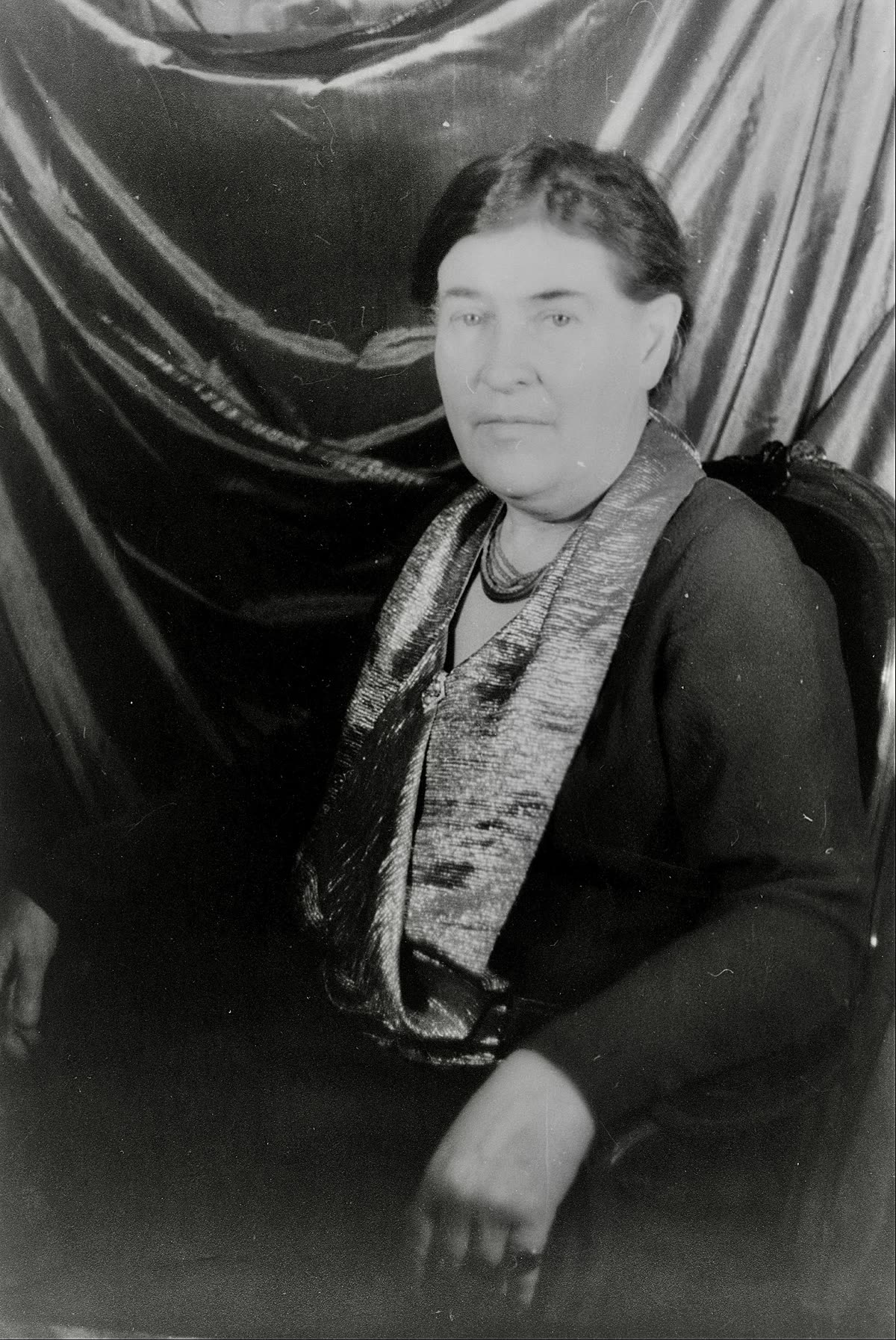
Image context: the cover uses a real archival photographic portrait of Willa Cather from Wikimedia Commons rather than a prairie view or book jacket. That choice suits the essay because Cather's art is rarely about scenic display by itself. It is about the distance a writer can hold between a person and a place before the place begins to reorganize the person's meaning.[6]
1) In O Pioneers!, the land does not reward passion first; it rewards reading
The opening of O Pioneers! makes the principle plain. Cather tells us that "the great fact was the land itself," then sharpens the point by saying it "wanted to be let alone."[1] Those lines do not romanticize the prairie. They remove all sentimental shortcuts. The Divide is not waiting to confirm immigrant virtue on arrival. It is resistant, impersonal, and slow. Anyone who wants to live there has to learn its terms.[1][4]
That is why Alexandra Bergson matters so much in Cather's career. Alexandra is not merely admirable because she is hardworking. Plenty of people in Cather work hard. Alexandra matters because she reads better than the men around her. She watches markets, soil, weather, and timing. She understands that endurance on the prairie is not a theater of masculine will but a discipline of attention.[1] Cather builds the novel so that prosperity arrives not as a reward for rhetoric or self-dramatization, but as the result of staying with material conditions longer than other people can bear to do.
The effect is larger than one plot. Cather quietly strips pioneer mythology of its easiest heroics. The land in O Pioneers! does not become meaningful because settlers impose significance upon it. Meaning emerges when a character stops demanding immediate recognition and starts learning duration. Cather's frontier is therefore neither a blank canvas nor a nationalist emblem. It is a medium that exposes who has mistaken appetite for knowledge.[1][4][5]
2) In My Ántonia, distance turns labor into memory without making it soft
If O Pioneers! is about learning to read the land in the present tense, My Ántonia is about what happens when that same land is recollected across time. Jim Burden's first vision of Nebraska is famously severe: there is "nothing but land," "the material out of which countries are made."[2] The sentence is one of Cather's best because it does two things at once. It empties the scene of familiar social markers, and it suggests that nationhood, belonging, and settlement are still only potential, not achievement.[2]
That pressure remains in the novel's most memorable images. When Jim and Antonia see the plough framed against the sunset, the machine becomes "heroic in size."[2] Cather does not use that enlargement to flatter conquest. She uses it to show how memory makes ordinary labor monumental without erasing its hardness. The plough is not a symbol detached from work; it becomes image because work has already marked the world so deeply that the world can return it at a larger scale.[2][4]
This is where Cather's distinctiveness becomes unmistakable. Many writers of settlement fiction turn labor into uplift, proof, or moral accounting. Cather does something subtler. She lets labor remain bodily and unsentimental, then allows memory to discover form inside it afterward. That is why My Ántonia keeps its emotional charge. The novel does not say the prairie was noble because it was difficult. It says difficulty altered what could later be remembered, and therefore altered the shapes of loyalty, longing, and gratitude available to the narrator.[2][4][5]
3) In Death Comes for the Archbishop, space becomes a school for perception
By the time Cather writes Death Comes for the Archbishop, her treatment of landscape has become even more abstract and exact. Bishop Latour rides into New Mexico and finds a country so "featureless" that it seems "crowded with features, all exactly alike."[3] That is a brilliant Cather sentence because it refuses the easy opposition between emptiness and detail. The problem is not absence. The problem is undifferentiated abundance. Seeing this place requires a new order of attention.[3]
Later Cather writes that the country is "waiting to be made into a landscape."[3] The line can be misread if it is taken as a colonial boast, as though the Bishop were simply arriving to confer culture on emptiness. The novel is more rigorous than that. What must be "made" is not the land itself but a human way of perceiving relation within it.[3][4] Latour succeeds, insofar as he does succeed, by abandoning fantasies of mastery and learning proportion: distance between settlements, fragility of routes, stubbornness of terrain, layered religious history, and the difference between spiritual ambition and theatrical authority.[3]
Cather's form follows that lesson. Death Comes for the Archbishop is not driven like a conquest narrative. It advances by episodes, intervals, remembered meetings, and returns. The structure itself refuses simple forward triumph. Space breaks continuity, and the book learns to live with that brokenness.[3][4][5] What looks at first like narrative looseness is actually formal obedience to geography.
4) Her plain style is severe because it withholds false nearness
Readers often describe Cather as lucid, plain, even transparent.[4][5] All of that is true, but it can be said too softly. Her style is plain because it refuses counterfeit intimacy. She does not crowd the page with commentary to guarantee that readers feel in the approved way. Instead she places a person in relation to weather, work, architecture, open distance, or remembered objects and lets judgment arrive through spacing.[1][2][3]
That is why she still belongs with the major modernists even when she seems less formally conspicuous than Joyce, Woolf, or Faulkner.[4][5] Cather's innovation is not flamboyant difficulty. It is controlled distance. She knows how far a narrator should stand from a character, how much explanation an image can survive, and when a place should do the emotional work that another novelist would assign to confession. The result is prose that looks settled while carrying tremendous pressure underneath it.
This pressure is inseparable from her biography, though it should not be reduced to biography. The National Willa Cather Center's account of her life shows how fully her imagination was formed by movement between Virginia, Nebraska, Pittsburgh, New York, and the Southwest, and by long acts of return through memory and revision.[5] What matters artistically is that she turned those crossings into a method. Her fiction keeps asking how a life changes when distance is no longer an obstacle to meaning but the condition that gives meaning contour.
5) Why Cather still feels present-tense
Cather lasts because she mistrusts inflated scale while caring intensely about durable form. Her books are full of settlers, priests, farmers, children, travelers, and remembered friends, but the real drama is often whether these lives can be seen without distortion.[1][2][3] Landscape, in her work, is the instrument that corrects distortion. It cuts boastfulness down, preserves labor from sentimentality, and turns memory into something earned rather than merely felt.[1][2][3][4]
That is also why she reads so well now, in an age flooded with self-advertisement and instant declaration. Cather keeps asking readers to accept proportion. Human beings are not abolished by her terrains, but they are resized by them. In O Pioneers! the prairie tests whether intelligence can outlast panic.[1] In My Ántonia the plain becomes the distance through which work reappears as image and attachment.[2] In Death Comes for the Archbishop the mesa country teaches that relation must be perceived before it can be governed.[3] Across all three books, Cather's signature move is the same: she makes land the hardest truth in the room, and from that truth she builds a style of unusual calm and lasting force.[1][2][3][4]
Sources
- Willa Cather, O Pioneers! (Project Gutenberg ebook 24).
- Willa Cather, My Ántonia (Project Gutenberg ebook 242).
- Willa Cather, Death Comes for the Archbishop (Project Gutenberg ebook 69730).
- Encyclopaedia Britannica, "Willa Cather."
- National Willa Cather Center, "Willa Cather Biography."
- Wikimedia Commons, "File:Portrait of Willa Cather LCCN2004662684 (cropped).jpg" (source page for the lead photograph).