In Charles Brockden Brown's Wieland (1798), a command seems to arrive without a speaker. In James Hogg's The Private Memoirs and Confessions of a Justified Sinner (1824), an ally seems to arrive wearing his listener's face. Both encounters end in religious murder. Yet the novels do not simply repeat the same warning about fanaticism. They give false revelation opposite designs.
Carwin can place a voice where his body is not. Gil-Martin can place another person's features—and apparently that person's habits of thought—on his own body. Brown detaches speech from a visible source; Hogg makes visible likeness itself untrustworthy. In each book, however, the counterfeit succeeds because it meets a listener already equipped to call it sacred. The impostor supplies the sign. The listener supplies the authority.[1][2]
That distinction keeps responsibility from settling neatly on demon, trickster, victim, doctrine, or damaged mind. These are not puzzles with one loose clue left for the reader to fit. They are studies of what happens after the source of a message can no longer guarantee its meaning.
This essay discusses both novels' endings.
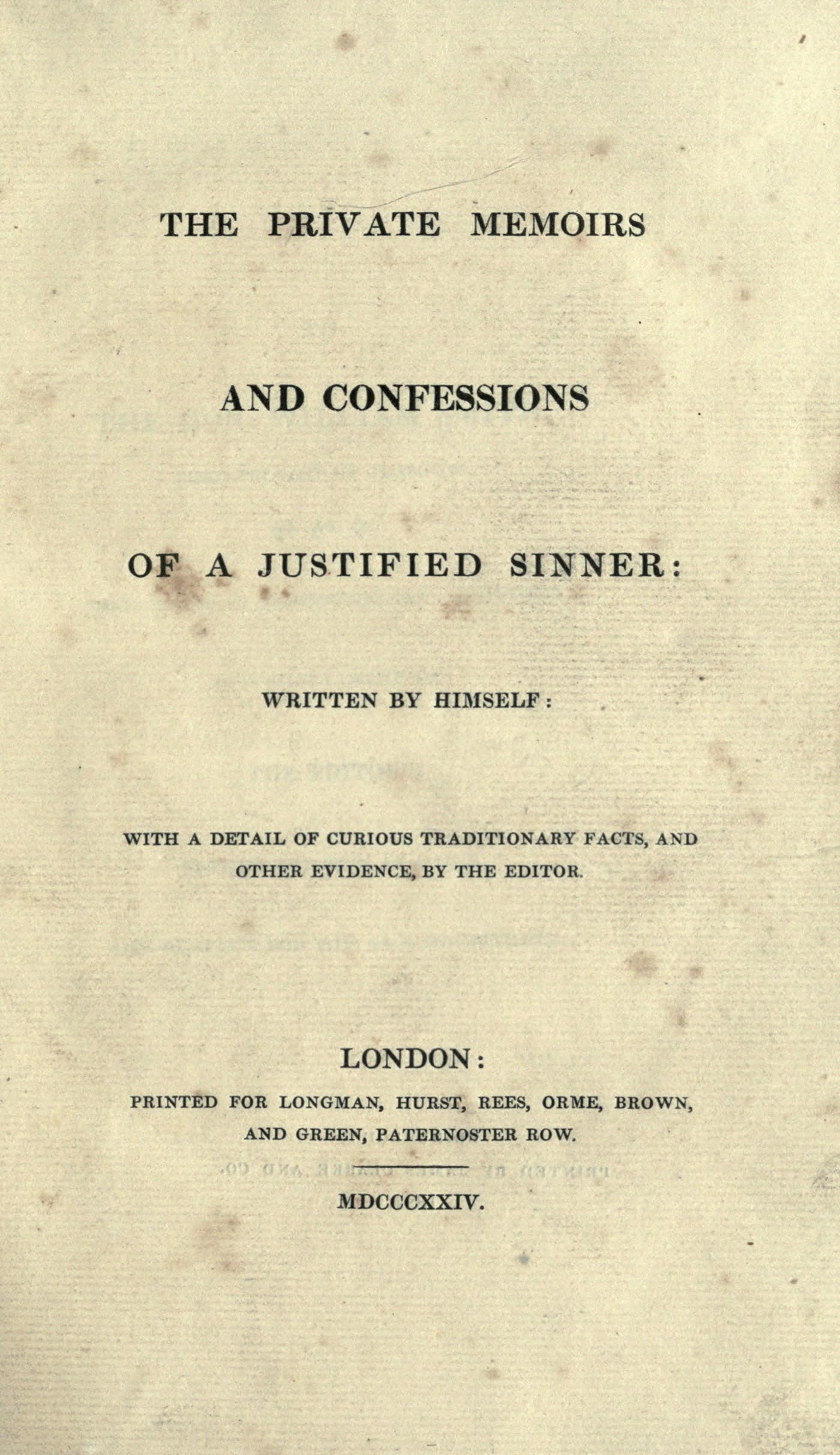
Image context: the lead image is an archival scan of the actual 1824 first-edition title page, not a modern typographic reconstruction.[2] Its grammar is already divided. One text is “written by himself”; a second authority promises “traditionary facts, and other evidence.” Before Gil-Martin borrows a face, the book has given authorship more than one mask.
One counterfeit leaves the body; the other occupies it
Carwin names no established science for his power. In his confession to Clara, he says only that it enables him to imitate another voice exactly and alter its apparent direction and distance. Brown's footnote offers the terms “biloquium, or ventrilocution,” but the narrative effect is simpler and more disturbing: a sound can retain every mark of identity while becoming detached from the person it identifies.[1]
This is why the first mysterious voices do more than frighten the Wieland circle. Catharine's voice seems to speak while Catharine remains elsewhere. A warning appears to come from an invisible protector. Pleyel hears what seems to be Clara speaking in private and treats acoustic recognition as moral proof. Carwin does not need to invent a persuasive argument; he needs only to counterfeit the location and ownership of familiar speech.
Gil-Martin works in the reverse direction. When Robert first meets him, the stranger appears identical in clothes, age, hair, eyes, and features. He later explains that by contemplating a face, his own countenance assumes its appearance; with the likeness, he claims to acquire “the same ideas” and “the same mode of arranging them.”[2] This is imitation at the level of style. A face is not merely copied as an image. It becomes an entry into another person's mental syntax.
The difference changes how each novel distributes fear. Wieland asks: where did that voice come from? Justified Sinner asks: whose intention is moving inside this recognizable form? One makes evidence travel without a body. The other gives a body too many possible owners.
The listener supplies the theology
Neither manipulator creates belief from nothing. Before Carwin's interventions, the Wieland family already lives in the shadow of the elder Wieland's private religion and mysterious death. Theodore Wieland is reflective, educated, and accustomed to treating inward conviction as morally serious. At his trial, after killing his wife and children, he insists that his deed was “enjoined by heaven” and that obedience was the test of perfect virtue.[1] The horror lies partly in the composure of that claim. He has converted atrocity into evidence of disinterested duty.
Robert Wringhim is likewise prepared before Gil-Martin arrives. His minister and guardian declares him elected, his redemption “sealed and sure.” Robert has already learned to divide humanity into the chosen and the reprobate, and to interpret doubt as weakness rather than as a reason to stop. He meets Gil-Martin on the same day he believes his eternal acceptance has been confirmed.[2] The double does not plant the first premise. He enters through it.
That sequence matters. Read lazily, both novels can become stories in which an evil outsider whispers and an innocent believer obeys. The texts are harsher and more exact. Carwin's projected speech and Gil-Martin's adaptive likeness work because Wieland and Robert have methods for turning uncertainty into permission. Each man treats private assurance as evidence that no other person can audit.
This is also the boundary of the comparison. Brown and Hogg do not argue that religious conviction naturally becomes violence. They construct two unusually closed interpretive systems: obedience proves Wieland's purity even when its object is murder, while election guarantees Robert's safety regardless of what he does. The counterfeit message is lethal because each system has disabled the moral feedback that an action would ordinarily produce.
Brown puts the ear on trial
Clara Wieland narrates by repeatedly testing—and retesting—what hearing can establish. Her sentences fill with questions: was a warning awake experience or dream, human contrivance or supernatural protection, Carwin's intervention or another agency? She does not simply lack information. She possesses sensations that are vivid enough to compel belief and mobile enough to support incompatible explanations.[1]
Carwin's confession should stabilize the case. Instead, it draws a boundary through the evidence. “It was my voice that you heard! It was my face that you saw!” he admits about one encounter. But he denies producing the commands that sent Wieland to kill: “I have slain no one; I have prompted none to slay.” He calls his ability a “tool of wonderful efficacy” handled without caution.[1] That formulation is self-protective, but it is not empty. Carwin is directly guilty of deception and indirectly responsible for teaching the household that voices can cross impossible distances. He has made every later sound harder to judge.
Brown's most audacious move comes at the climax. When Wieland is about to kill Clara, Carwin throws another voice from above. This time the counterfeit announces a rational diagnosis: “not heaven or hell, but thy senses have misled thee.” Wieland accepts the new command as readily as the old ones. Once deprived of his belief in righteous obedience, he sees the family he has destroyed and kills himself.[1]
Truth has arrived through a lie about who is speaking. The content is corrective; the delivery repeats the original injury. Brown therefore refuses the comforting idea that exposing a technique automatically repairs its effects. A person trained to obey disembodied authority may obey the debunking voice too. Carwin rescues Clara, but he does so by using the same unaccountable channel that helped make rescue necessary.
Hogg gives doubt two complete narrators
Hogg expands the problem from suspicious messages to the architecture of the whole book. The Editor's Narrative arrives first, assembling parish registers, tradition, gossip, legal testimony, and comic set pieces into an apparently public history. Its opening moves quickly from “it appears” to “it is certain.” The editor's confidence lets heterogeneous materials sound as though they corroborate one another even when witnesses describe impressions, rumors, or disputed identities.[2]
Robert's memoir then retells much of the same story from inside the accused man. It begins, “I was born an outcast in the world, in which I was destined to act so conspicuous a part.”[2] The sentence assigns abandonment and destiny before Robert has acted. Throughout the confession, providential grammar tries to turn choices into roles already written for him.
Yet Robert's prose leaks resistance. During the ambush of the preacher Blanchard, he wishes inwardly that the intended victim might turn back. His hand initially refuses to fire. When the shot finally comes, Robert writes that “my piece was discharged,” briefly removing himself from the sentence's position of agent.[2] The passive construction cannot acquit him; it shows justification working at the level of grammar. Responsibility is not denied outright. It is made syntactically difficult to hold.
The two narratives do not click together into a solved case. Their duplicated incidents expose different blind spots. Robert's account supplies terror, motive, hesitation, and lost time that the editor cannot know; the editor supplies witnesses and consequences that Robert cannot control. Adrian Hunter argues that the novel is as skeptical of the editor's confident rationalism as it is of Robert's zealotry, noting that the supposedly disinterested frame rests on bias, unstable testimony, and a final grave-robbing search for proof.[7] More information does not produce a neutral narrator. It produces a second style of certainty.
Confession cannot return responsibility to one body
Carwin and Robert both confess, but their confessions point in opposite moral directions. Carwin tries to limit the causal perimeter of his guilt: these voices were mine, those commands were not, my experiments were reckless, my intentions were not murderous. Robert writes to enlarge the significance of his life and preserve its providential logic. Even at the end, pursued by Gil-Martin and terrified of suicide, he curses whoever might “alter or amend” his little book.[1][2]
Neither document is disposable. Carwin's account explains real mechanisms, and Robert's records real hesitation and suffering. Neither is sufficient. A confession is still a designed act addressed to a future judge. It selects the border between action and intention, influence and agency, error and evil.
The novels' endings make that problem physical. Clara survives long enough to add a postscript three years later. Time changes the voice that had declared itself ready to die; she can now see the injustice of some earlier judgments, though no later calm restores the dead. Carwin has withdrawn into rural obscurity, his denial of direct involvement in the killings and his indirect responsibility still uneasily paired.[1]
Hogg offers no comparable settling voice. The editor returns after Robert's memoir, digs up a suicide's grave, finds the printed-and-manuscript bundle, considers changing its title, and finally admits: “I dare not venture a judgment, for I do not understand it.” He ultimately follows that admission with another narrow either-or—Robert must be an unparalleled wretch or a religious maniac.[2] The editor has learned that he cannot explain the book without learning how to stop explaining.
Why these two books remain unsettled
The comparison is formal, not a claim that Hogg simply borrowed Brown's machinery. Their afterlives have also been different. Wieland now sits at the center of scholarly editions and accounts of early American Gothic, although its critical history has repeatedly changed the meaning of that centrality.[3][4] Hogg's novel had a fitful early reception, returned in a bowdlerized posthumous version, and did not regain its unbowdlerized form or modern standing quickly; the Stirling/South Carolina edition is part of a larger recovery of Hogg from condescension and damaged texts.[5][6]
Read together, the books clarify why recovery cannot turn either one into a tidy cautionary tale. Carwin proves that a voice can be accurate in sound and fraudulent in source. Gil-Martin suggests that a face can be accurate in appearance and fraudulent in ownership. Wieland and Robert then prove the more frightening point: identifying the counterfeit does not exhaust responsibility, because the hearer has helped decide what the sign permits.
The durable question is therefore not only “Who spoke?” It is “What in the listener was waiting to call this revelation?” Brown sends that question across a room without a body. Hogg lets it approach wearing the reader's own face.
Sources
- Charles Brockden Brown, Wieland; or, The Transformation: An American Tale (1798), Project Gutenberg HTML text—chapters VI–VII, XIX, and XXIII–XXVI for the mysterious voices, the trial, Carwin's confession, and the final intervention.
- James Hogg, The Private Memoirs and Confessions of a Justified Sinner (1824), University of California Libraries first-edition scan via Internet Archive—the Editor's Narrative, Robert's memoir, concluding frame, and lead-image title page.
- Charles Brockden Brown Electronic Archive and Scholarly Edition, “Classroom Editions”—bibliographic history of modern Wieland editions and related Memoirs of Carwin texts.
- Library of America, Charles Brockden Brown: Three Gothic Novels—publication context and editorial placement of Wieland within Brown's early American Gothic fiction.
- University of Stirling, “Stirling/South Carolina Research Edition”—the Hogg edition's recovery aims, textual standards, and 2001 Justified Sinner volume.
- Cambridge Core, “Introduction” to the 200th-anniversary edition of The Private Memoirs and Confessions of a Justified Sinner—first-edition sales, the bowdlerized 1836–37 text, and the delayed return of an unbowdlerized version.
- Adrian Hunter, “Taking Possession: Alice Munro's ‘A Wilderness Station’ and James Hogg's Justified Sinner,” Studies in Canadian Literature 35.2 (2010)—the editor's rationalist bias, unreliable witnesses, and Hogg's refusal of narrative capture.