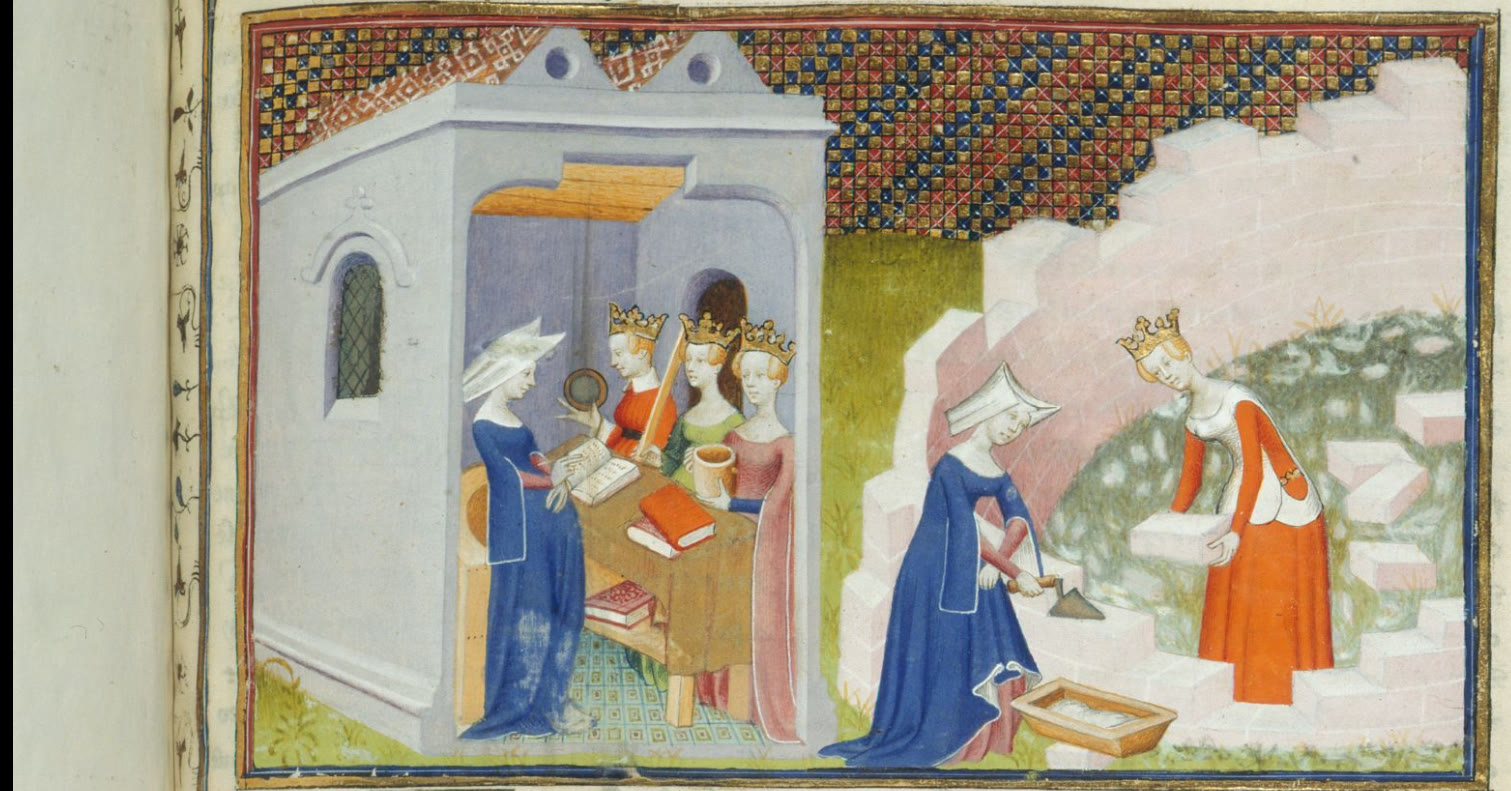
The Book of the City of Ladies begins with a reader losing confidence in her own reading. Christine, the author’s textual double, sits in her study with a volume of Matheolus and wonders why so many learned men have written such “wicked insults” about women. Repetition starts to look like proof. If authorities across philosophy, poetry, and moral instruction agree, she reasons, perhaps her own experience is the unreliable thing.[1][4]
The answer that arrives is not another book dropped on top of the pile. Three crowned women enter the room: Reason carries a mirror, Rectitude a ruler, and Justice a vessel of gold. They commission Christine to build a fortified city whose inhabitants will be women of demonstrated worth. The conceit sounds grand, even static—a gleaming refuge sealed against slander—but the book is animated by work. Ground must be cleared, stones selected, mortar mixed, streets measured, rooms filled, roofs finished, and gates secured.[1][2]
Follow the three objects and the city becomes more than a monument to famous women. Each object changes the intellectual task. The mirror corrects how evidence is seen. The ruler tests and arranges it. The vessel exposes how judgment apportions what each person is due. Christine’s most durable invention is therefore not the fantasy of escape. It is a sequence for turning injured judgment into counter-authority.
Image context: The lead image is a real manuscript illumination from Harley MS 4431, the “Queen’s Manuscript” prepared in Paris under Christine’s supervision for Isabeau of Bavaria around 1410–14.[5] Its split scene makes the method visible at a glance. Inside, books and the three symbolic objects crowd a table; outside, Christine and Reason handle stone and mortar. Reading, writing, and building occupy one continuous frame.[7]
Unless another source is named, the short English quotations from the Harley manuscript transcription below are rendered literally from its Middle French.[1]
The mirror: first repair the act of seeing
Reason’s mirror appears in Book I, chapter 3, where it takes the place of a scepter. Its first promise is self-knowledge, but not in the modern sense of private affirmation. The mirror discloses qualities, proportions, and the nature of things. It asks Christine to compare what she has read with what she can test through reason and experience.[1][3]
That distinction matters because Christine’s opening error is epistemic before it is emotional. She has mistaken the number and prestige of hostile witnesses for the quality of their evidence. Her despair shows what a tradition can do when it trains its target to cite the tradition against herself. Reason does not simply tell her to feel better. She exposes the faulty procedure: Christine has granted written authority priority over observation without making the authorities answer for their contradictions.
The mirror therefore turns outward as well as inward. In Book I, chapter 8, Reason takes Christine to the “Field of Writings” and tells her to use the “pickaxe of your understanding.” Digging is interrogation. The inherited ground contains claims about women’s weak minds, defective judgment, unfitness for rule, and incapacity for invention; the builder must loosen those claims before anything can carry weight. Christine’s questions are the excavation, while Reason’s replies haul the debris away.[1][2]
This is why the long procession of queens, warriors, inventors, poets, and scholars should not be read as a decorative hall of fame. The stories bear structural loads. Getty’s comparison of Christine with one of her major sources, Boccaccio’s Concerning Famous Women, is especially revealing. Boccaccio frames Arachne through pride and self-destruction. Christine drops that punitive ending and emphasizes her textile arts and useful inventions instead.[4] She has not discovered a neutral Arachne hiding behind every earlier version. She has changed the editorial question—from “How does ambition ruin this woman?” to “What did her intelligence make possible?”
That is also the mirror’s limit. It does not abolish selection or interpretation; no anthology can. It makes selection visible as an exercise of judgment. Christine answers a tradition made by arranging examples with an arrangement of her own. The book’s honesty lies in staging that labor rather than pretending its city rose naturally from uncontested ground.
The ruler: make rebuttal inhabitable
Rectitude’s object is more plainly architectural. In Book I, chapter 5, she calls her ruler a measure that separates right from wrong and distinguishes good from evil. It will set out temples, palaces, houses, streets, and squares. When Reason finishes the foundations and enclosing wall at the end of Book I, Rectitude takes charge of the city’s interior in Book II.[1][3]
The handoff changes the feel of the argument. Reason establishes that inherited generalizations fail; Rectitude asks what social life looks like once those generalizations no longer control the plan. Her section moves through women’s education, judgment, marital counsel, constancy, generosity, family loyalty, and endurance under mistreatment. The point is not simply that an exceptional woman somewhere did an exceptional thing. The ruler tests whether a moral standard has been applied evenly to women and men, and then asks where women’s ordinary actions belong in the record.[1]
Consider the book’s linked discussions of education. In Book I, Reason argues that girls taught the same subjects as boys would learn them just as fully. In Book II, Rectitude rejects the fear that study naturally corrupts women’s morals.[1][4] Together the claims work by measurement: ignorance created by exclusion cannot then be offered as proof of natural incapacity. The ruler catches a rigged comparison. It also redraws civic space, because a woman admitted to learning can no longer be confined to the role that her manufactured ignorance was used to justify.
Christine’s prose repeatedly performs this measuring action. A charge is stated. She asks whether it holds. One of the Virtues identifies the distorted standard. A sequence of examples supplies counterweight. The recurrence can feel almost relentless, but that rhythm is the book’s masonry: allegation, question, correction, placement. A wall is persuasive because no single stone has to pretend it is the whole building.
The writing metaphor becomes explicit at the transition into construction. Christine takes the “trowel of your pen”; at the start of Book II she is told to “mix the mortar in the inkhorn.”[1] As Christine Bourgeois observes, the city keeps pointing back to its real material: literary examples joined by ink.[2] Getty describes the biographies as building blocks and the city as the book itself.[4] The ruler, then, measures both ethics and form. It determines not only which claims are just but how separate lives become a legible public structure.
Rectitude is not drawing a modern democratic city. Admission still depends on virtue, and virtue remains shaped by Christian, courtly, and household ideals. Queens, martyrs, loyal wives, learned women, and heroic daughters do not dissolve hierarchy simply by living behind the same wall. But the ruler makes a radical procedural demand: inherited prestige does not exempt a claim from remeasurement. Even a culture’s favorite authorities must fit the line of justice they profess to honor.
The vessel: justice is a question of portion and judgment
Justice’s golden vessel is the strangest of the three objects because it is not a construction bucket but a measuring cup. In Book I, chapter 6, she describes it as a perfect measure that allots each person what is due. Rectitude’s ruler draws distinctions in the human city; Justice’s vessel invokes a divine standard against which earthly measures appear partial—too much for some, too little for others.[1][3]
Its function changes the governing question. The mirror asks, “What can be seen truly?” The ruler asks, “By what standard should it be arranged?” The vessel asks, “What is each person due, and where has earthly judgment given too much or too little?” Justice does not lay the foundations or build the inner streets. In Book III she completes the highest roofs, brings the Virgin Mary as the city’s sovereign, and settles saints and martyrs in its upper places. The movement is vertical as well as sequential: cleared earth becomes civic enclosure, then a polity crowned by sacred authority.[1][5]
The vessel also prevents justice from becoming vague praise: its promise is an exact due, not indiscriminate approval. That symbol should remain distinct from Justice’s later narrative duties. The city’s admission rule is stated separately—Reason says early that the refuge is for women in whom virtue is found—while Justice populates the sacred heights and completes the defenses. Near the end of Book III, the women who served and sheltered apostles and saints “serve as gates and enclosures”; hospitality itself becomes fortification.[1] The image is wonderfully paradoxical. The boundary is made not from refusal alone but from practiced care.
That paradox should check an easy separatist reading. Christine does imagine protection from a literary culture that has attacked women as a class. Yet the city is not secured by making all relation impossible. It is populated by stories of counsel, teaching, shelter, governance, devotion, and making. Its walls defend the conditions under which those relations can be remembered without hostile narrators assigning their meaning in advance.
There is a harder boundary too. A city measured by virtue necessarily judges, and its ideals do not map neatly onto twenty-first-century freedom. The book can recover women while still sorting them through chastity, piety, noble service, and exemplary suffering. The gates make that limit visible rather than incidental. Christine contests who has been denied a rightful portion; she does not abandon the idea that a rightful portion is measured by a moral order.
The city survives because the method can be repeated
In Harley MS 4431, the Cité’s rubric begins at folio 288c, its main opening and construction miniature appear at folio 290r, and the text continues through folio 374a.[1] It sits within a collection of about thirty works produced under Christine’s supervision.[5] The manuscript’s lavishness matters, but so does its practicality. The author who turns a quill into a trowel was also involved in making books as physical objects—coordinating text, scribal work, image, and patronage. In the illumination, the same blue-robed Christine who reads at the table kneels at the wall. The fantasy does not cancel material labor; it gives that labor an intellectual likeness.[5][7]
The work continued to change containers. Brian Anslay’s 1521 English translation brought the Cité into print, and a modernized edition published in 2025 makes that Tudor version newly readable. Its editors argue that the early print carried Christine’s defense beyond aristocratic manuscript libraries and later helped renew interest in her work.[6] Translation does not leave the city untouched, but it proves the usefulness of its design: examples can be remeasured, language can be rebuilt, and the gates can open without the structure vanishing.
Mirror, ruler, vessel: the order is the argument. See the inherited record again. Test its standards. Build a form capable of holding the lives it excluded. Then ask honestly what the new form still leaves outside.
At the end of Book III, Christine says that the city’s material is “entirely virtue.”[1] The phrase names the book’s aspiration and its boundary. Yet the more surprising material is method. Slander arrives as a finished structure—old, crowded, and authoritative. Christine teaches her reader to walk back onto the building site.
Sources
- Christine de Pizan, Le Livre de la Cité des Dames, University of Edinburgh transcription of British Library Harley MS 4431, ff. 288c–374a—primary Middle French text used for part, chapter, folio, and construction-language references.
- Christine Bourgeois, “The Disembodied Tongue; or, The Place of the Book in the Livre de la Cité des Dames,” in The Futures of Medieval French (Boydell & Brewer, 2021)—the book/city overlay and the pickaxe-and-trowel spatial allegory.
- Christine McWebb, “Christine de Pizan’s Lady Reason and the Book in Beinecke MS 427,” Florilegium 18.1 (2001)—the iconography and textual functions of Reason’s mirror, Rectitude’s ruler, and Justice’s vessel.
- J. Paul Getty Museum, “A Medieval Feminist Manuscript Makes Its Getty Museum Debut” (2025)—opening-text context, Christine’s revision of Boccaccio, and the biographies-as-building-blocks structure.
- British Library Archives and Manuscripts Catalogue, “Harley MS 4431: Christine de Pizan, Collected works (‘The Book of the Queen’)”—date, royal provenance, authorial supervision, contents, and miniature attribution.
- Iter Press and University of Chicago Press, The Boke of the Cyte of Ladyes: Brian Anslay’s Translation of 1521 in Modernized English (2025)—English print history, editorial context, and later reception.
- University of Bergen, “Women’s Literary Culture and the Medieval Canon”—source page identifying the lead image as a British Library photograph of The Book of the City of Ladies in Harley MS 4431.