
A brick facade fills the frame. Then another. A schoolboy walks through narrow Philadelphia streets, past doors that look nearly interchangeable from the pavement. A Place to Live, the sixteen-minute housing film that Muriel Rukeyser co-wrote in 1941, begins by making “place” look like the simplest noun in the language. A place is an address, a doorway, a route home. The film spends the rest of its running time showing why that noun is not simple at all.[1][2]
The boy's destination is what the film calls a “bandbox” house: three rooms stacked vertically, with domestic life forced into a shape too tight for rest, privacy, health, or play.[2] The camera moves from street to room, from a child's movement to a mother's account, and then back outward to factories, demolition, and new housing. That change of scale is the film's literary action. It does not merely illustrate a policy claim. It builds a sentence in which the household and the city become impossible to separate.
A Place to Live was no isolated detour from a literary career. Eastern Michigan University's Rukeyser Collection describes a body of work spanning fifteen poetry collections, prose about American culture, memoir, children's literature, plays, films, translations, and biographies.[5] The list matters because it refuses a narrow definition of what a poet makes. In this film, the question is not whether verse can decorate a policy argument, but whether literary attention—metaphor, scale, voice, juxtaposition—can help a public need become newly perceptible.
A collaborative film with an archival afterlife
Authorship needs care here. A Place to Live was sponsored by the Philadelphia Housing Association, produced by Documentary Film Productions, and directed and produced by Irving Lerner. The National Film Preservation Foundation credits Rukeyser and David Forrest as writers, Roger Barlow as cinematographer, David Diamond and Max Goberman for music, and William Watts as narrator.[2] It is therefore misleading to assign every cut or sentence to Rukeyser alone. Her importance lies in the collaborative form itself: image, narration, staged testimony, location photography, and music arranged into a public argument. Catherine Gander's study of Rukeyser describes precisely this career-long movement among filmic, photographic, journalistic, historical, and literary documentary forms.[4]
The version below is the 16:31 YouTube copy to which PennSound directs readers from its Rukeyser archive.[3] The National Film Preservation Foundation also presents a preservation copy in its Screening Room, supplies the full production record, and offers a downloadable film file.[2] Those two routes matter. The embed gives the film a usable contemporary viewing surface; the preservation page keeps its origin and collaborative credits visible.
The walk home is a unit of thought
The opening does not rush into the family's interior. It makes us travel there. Early facade shots hold long enough for doors, basement windows, worn steps, and patched glass to become a visual vocabulary. Around the two-minute mark, an elevated view briefly turns blocks into pattern; soon afterward, the camera returns to pavement level. The movement resembles a documentary poem changing pronouns. First there is an anonymous “they,” legible only as roofs and rows. Then there is a “he”: one boy, on one route, approaching one door.[1]
That route prevents the house from becoming an isolated scene of misfortune. The boy does not cross an invisible line from a functioning city into a private family failure. He walks continuously through the same built environment. Street, school, dwelling, and industrial skyline belong to one system. Gander calls Rukeyser's documentary practice a poetics of connection; here, connection is not a soft word for sympathy. It is the harder claim that apparently separate facts acquire meaning through placement and collision.[4]
The film's “bandbox” image makes this method tangible. A box is compact, closed, and easy to handle from the outside. Inside, however, three stacked rooms turn ordinary family movements into negotiations over stairs, heat, sleep, washing, and air. The house is both object and syntax: each room sits on the next like a clause that cannot open sideways. By giving the dwelling a memorable shape, the film makes a housing category readable without pretending that a metaphor can replace the people living within it.[2]
Staged testimony, not an unfiltered confession
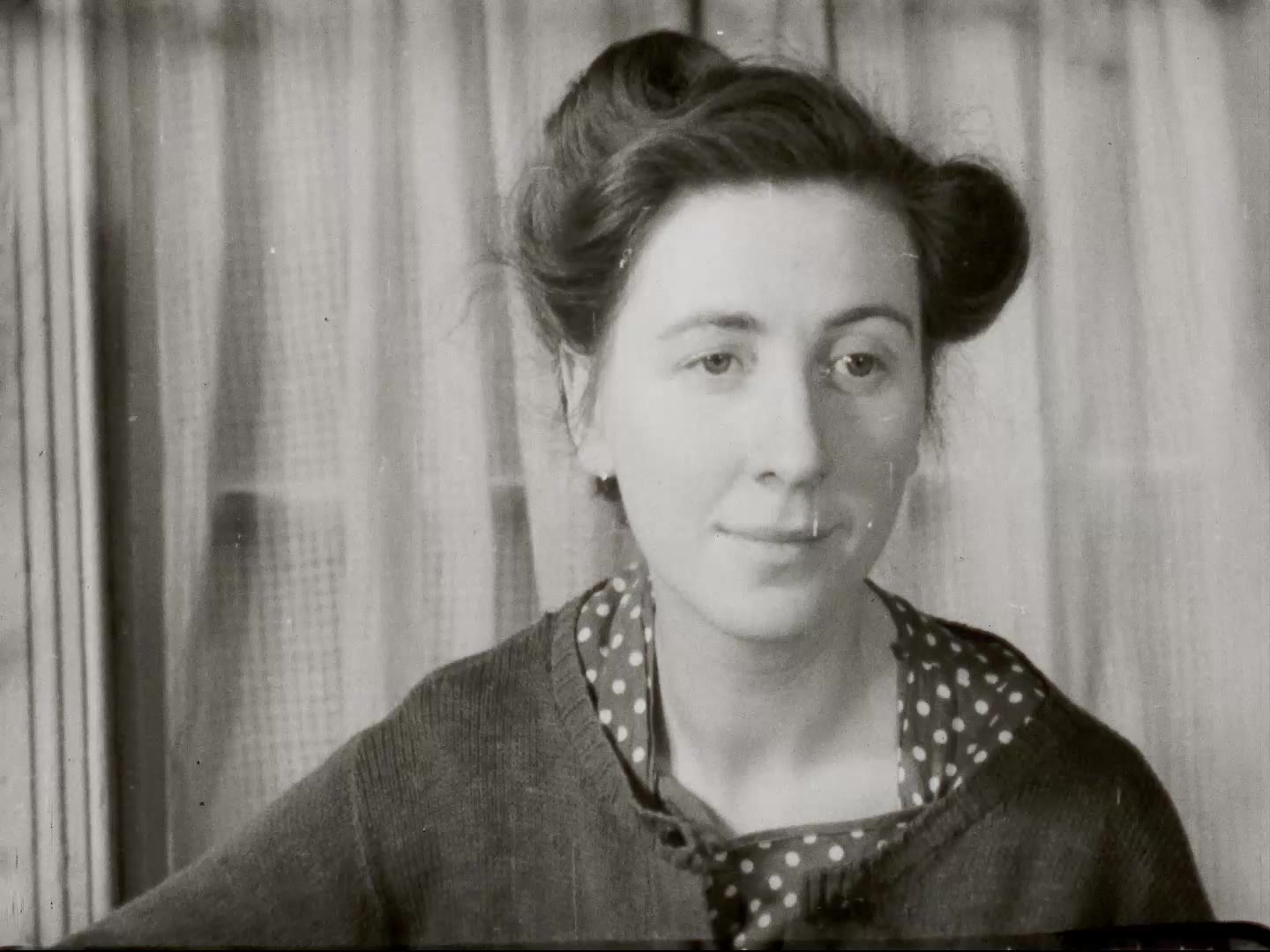
Near the five-minute mark, the mother faces the camera. Her direct gaze changes the film's distance. Until then, buildings and streets have carried much of the argument; now a person appears to answer the conditions around her. A later bathing scene crowds mother, child, basin, chair, and plumbing into the same shallow field. Care is visible, but so is the labor that inadequate space adds to care.[1]
The National Film Preservation Foundation describes these domestic passages as dramatized scenes.[2] That label is essential. The mother's address should not be mistaken for unmediated oral history, and the boy's day is not candid observation from beginning to end. The film creates a representative household through performance. Its ethical wager is that staging can make a structural problem felt without turning the family into a mere statistic. Its limitation is the other side of that wager: one selected family cannot carry every tenant's experience, and a persuasive scenario can smooth away disagreement.
Rukeyser's contribution is most legible in this refusal to choose between document and felt life. The mother is neither only evidence nor only character. Her face interrupts the architectural survey, while the surrounding rooms keep her testimony from being reduced to personality. The film asks the viewer to hold both scales at once. That double attention is closer to poetry than a slogan would be: an image retains its particular pressure while entering a larger pattern.
Montage turns a room into a civic argument
The film next widens its field. An older stone house, smoking industrial stacks, children running along brick walls, a half-demolished building, and the cleaner stair of newer housing arrive in succession. This is not a neutral inventory of Philadelphia. The sequence makes an argument through adjacency: civic inheritance and industrial productivity mean little if domestic space remains unsafe; clearance means little unless it produces somewhere livable; a model interior means little if it remains exceptional.[1][2]
Seen now, the demolition image deserves resistance as well as recognition. The film treats rubble as a threshold to improvement. Later histories of urban clearance make it impossible to assume that demolition itself is benevolent, or that every institution using the language of renewal serves the people displaced. A Place to Live cannot answer that entire later history. What it can show is the advocacy logic at an early, unusually compact stage: identify an intolerable room, connect it to municipal scale, and end by demanding continuation rather than applause.
That final move is the film's best formal decision. A polished staircase, a lamp on a landing, and a smiling child could have supplied the tidy ending common to sponsored films: problem observed, solution displayed, viewer reassured. Instead, the narration insists that “all that has been done is just a beginning.”[1] Grammatically, the line refuses a full stop. The improved dwelling is evidence of possibility, not evidence of completion.
Why this small film belongs to Rukeyser's literary record
A Place to Live was nominated for an Academy Award for Best Documentary Short Subject, but its deeper afterlife lies beside Rukeyser's poems, lectures, photo-texts, and documentary experiments.[2][4] It shows what her literary method looks like when the line break becomes a cut: facade to face, room to factory, rubble to stair. The meaning does not reside in any image alone. It emerges from the pressure between them.
The film also clarifies what “use” can mean in Rukeyser's thinking. Useful art is not art that becomes disposable once it delivers information. The film remains worth watching because its advocacy is formally alert and because its solution is deliberately unfinished. A viewer who cannot see the embedded copy can still follow its central sequence: a child's route narrows into a crowded home; a mother's staged account restores the person inside the category; montage enlarges the home into a civic relation; the apparent solution reopens as obligation.
The title therefore ends differently from how it begins. “A place to live” first sounds like the minimum—a roof, an address, a box on a map. By the final image, it names a relation among private care, public design, money, health, memory, and power. Rukeyser's documentary poetics do not let the room seal itself off from the city. They leave the sentence open because the city is still responsible for how it ends.
Sources
- Brandon Films, A Place to Live (1941; YouTube upload, 16:31).
- National Film Preservation Foundation, “A Place to Live (1941)” — preservation copy, production credits, synopsis, and film notes.
- PennSound, “Muriel Rukeyser” — archival recordings page linking the YouTube copy and documenting Rukeyser's recorded work.
- Catherine Gander, Muriel Rukeyser and Documentary: The Poetics of Connection (Edinburgh University Press, 2013) — publisher-provided book preview.
- Eastern Michigan University, “The Muriel Rukeyser Collection” — institutional overview of Rukeyser's work and archival scholarship.