Vernon Lee's “A Wicked Voice” begins after the haunting has apparently won. Magnus, a Norwegian composer devoted to Wagner's music of the future, now writes elegant imitations of the eighteenth-century style he despises. His admirers think he has converted. He knows that his taste has been occupied.
The occupier is Zaffirino, a long-dead Italian castrato whom Magnus first meets as an engraving and eventually hears as a voice without a stable body. Magnus calls that voice a “violin of flesh and blood,” a phrase that gives the story's problem in miniature: an instrument should be an object under a musician's command, but this instrument is alive, sensuous, and commanding.[1]
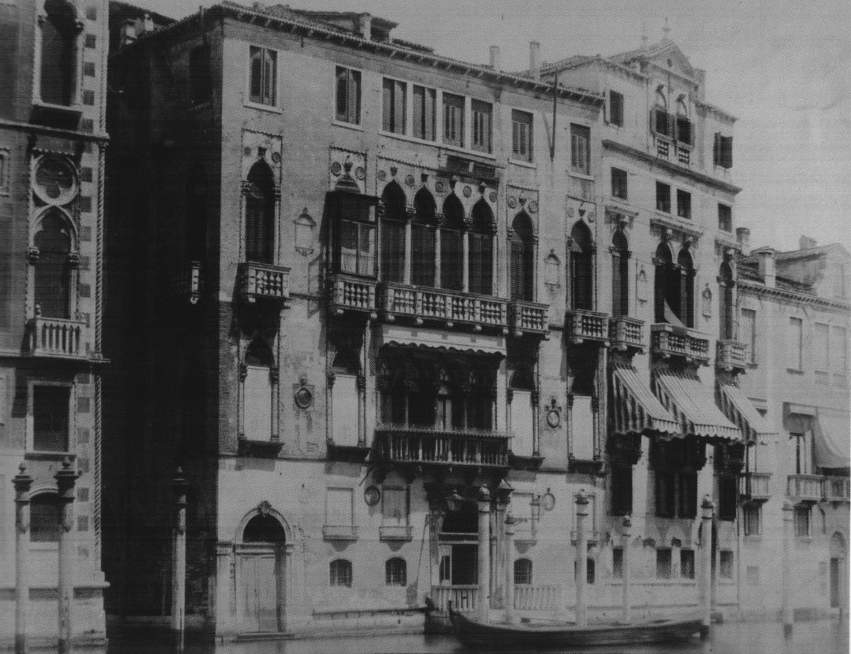
Lee's tale first appeared in French in 1887 and entered Hauntings in English in 1890. Its dedication remembers Mary Wakefield's singing at Palazzo Barbaro in Venice the previous year.[1][2] That origin matters because the story does not simply oppose reality to hallucination. It follows the ways an aesthetic experience changes medium—memory into story, face into print, song into weather, weather into fever—until the distinction between an impression and an infection no longer holds.
Four recurring objects and atmospheres make that movement visible. The engraving promises a ghost with edges. Moonlight dissolves those edges. Bad air carries the past into the present. A broken harpsichord finally supplies material evidence that explains nothing. Follow that chain and the tale looks less like a puzzle about whether Zaffirino exists than a study of why Magnus needs him not to.
The engraving: a ghost given edges
Magnus receives Zaffirino in the safest form imaginable: a cheap print bought in the square of San Polo. It has a sitter, a decorative frame, and a scholarly apparatus. Magnus can identify the singer's costume and cite a fictitious eighteenth-century biography. He can classify the face as effeminate, the style as corrupt, and the period as dead. Collecting turns disturbance into expertise.[1]
Yet the image embarrasses that mastery almost immediately. Magnus's companions ask him to perform one of the singer's songs. He crushes the paper while continuing to look. Attraction arrives through the hands before he will admit it in words: the object is contemptible, but he cannot leave it alone. Later he tears the engraving and lets the pieces fall from a window. Destroying the likeness does not silence its subject. It merely removes the visible place where Magnus had stored his desire.
The sequence makes the engraving more than a Gothic prop. It is a failed container. A portrait lets Magnus imagine that identity can be read from appearance and that the past can be held at the distance of a collector's arm. Zaffirino's voice defeats both assumptions. Gondoliers cannot agree whether the unseen singer is a man or a woman, while Magnus's language keeps crossing disgust with involuntary physical longing. Patricia Pulham treats the castrato voice as the story's crucial aesthetic object and as a pressure on stable gendered subjectivity; Alexandra Milsom similarly reads Magnus's Wagnerian heroics against an attraction he cannot make conform to them.[2][3]
The important boundary is between those critical readings and the tale's evidence. Lee never gives Zaffirino a modern identity label. What the text does give, insistently, is Magnus's failed act of visual judgment. The portrait seems to authorize a verdict about the singer's body. The disembodied performance makes the verdict useless.
Moonlight: the visual world learns to listen
Once the print is gone, Zaffirino spreads through Venice. Lee prepares that escape by making moonlight behave like water indoors. In the boarding-house, light turns a former ballroom into a second lagoon. Outside, the actual lagoon becomes a reflective surface crossed by boats whose lamps reveal movement without revealing bodies. Neither space offers a firm line between room and city, reflection and source.[1]
Then sound borrows the same visual grammar. On a solitary gondola ride, Magnus hears a “thread of sound slender as a moonbeam.”[1] The simile is exact: a thread is narrow enough to follow, yet moonlight on moving water cannot be grasped or traced back with certainty. The voice seems now ahead, now behind, now inside the surrounding silence. It occupies distance without surrendering an origin.
This motif changes the usual machinery of a ghost story. Zaffirino does not step into view under the moon. The moon instead teaches the visible world to act like his voice—diffuse, reflected, and capable of entering a room through an opening. Magnus searches for a singer because a singer could be confronted. Lee gives him an acoustic environment.
The result is also a struggle over composition. Magnus rows out to imagine the heroic world of his unfinished Wagnerian opera, Ogier the Dane. The lagoon answers with ornamented vocal music from the century he rejects. His desired artwork requires a sovereign composer arranging effects; the haunting arrives as atmosphere, without a score he can own or a performer he can direct. Even before Zaffirino takes Magnus's inspiration, Venice has made authorship feel porous.
Bad air: when atmosphere enters the body
Lee names the Venetian atmosphere “moral malaria.”[1] The phrase joins aesthetics to a medical theory available to a late-Victorian reader. When Hauntings appeared in 1890, the malaria parasite had been identified, but the mosquito's role in transmission had not yet been conclusively demonstrated. Older ideas about marsh vapors therefore remained culturally legible. Suvendu Ghatak shows how the story exploits that history: stagnant water, temporal stagnation, musical aria, and supposedly dangerous air become one vocabulary for a past that infects the present.[4]
That vocabulary protects the tale's ambiguity. Magnus may be physically ill. Heat, sleeplessness, palpitations, and fever can distort perception. Doctors advise him to leave the lagoon, then warn him against night air in the countryside. But every rational explanation also repeats the haunting's imagery. The cure is a change of air; the ghost is an aria. The retreat from Venice takes Magnus to Mistrà, the villa where family legend says Zaffirino once sang a woman to death.
Smell completes the crossing of thresholds. Flowers, damp vegetation, mildew, and old interiors give the air texture before the voice appears. These details are not proof of the supernatural. They are how the story makes listening bodily. Magnus does not receive a clean sequence of notes at an intellectual distance; he grows faint, thirsty, hot, and permeable. By the climactic performance, the voice is “taking volume and body.”[1] At the same time, Magnus imagines himself becoming fluid enough to mingle with it.
This reversal is the motif map's center. At first the singer has a pictured body and no audible voice. At the villa the voice gains body while Magnus loses the sense of possessing his own. The ghost does not need to materialize as a person. It makes the listener its material.
The broken harpsichord: evidence that refuses to explain
The last room appears to settle everything. Through a small gallery, Magnus sees an eighteenth-century performance: Zaffirino at a harpsichord, a woman hidden in the shadows, song rising toward a fatal cadence. He tries to break in before the phrase ends. When the door yields, stage, singer, and victim vanish. Blue moonlight fills an empty storage room. The only instrument is a cracked harpsichord with broken strings.[1]
That wreck is the story's best piece of evidence and its least useful. It proves that the room has a past and that Magnus has found a physical object capable of producing sound. When he strikes the keys, however, they answer with a grotesque jangle, not the exquisite voice. Matter remains; causality does not.
Lee could have ended with the discovery, allowing the instrument to expose a trick or certify a ghost. Instead the broken harpsichord repeats what the torn engraving already taught. No object can retain the experience Magnus wants to locate inside it. The print cannot confine the singer's face; the instrument cannot account for his sound. Both are residues, and the haunting lives in the transfer between residue and listener.
Magnus survives the fever but cannot recover his artistic agency. New melodies arrive in his mind with the intimacy of his own invention and the alienness of dictation. His final wish is not for silence but for one more note. Hatred has been the grammar that allowed him to keep returning to what he desired. Once Zaffirino's music becomes internal, Magnus can no longer tell possession from inspiration.
A haunting made of afterlives
Lee's own preface to Hauntings rejects the courtroom ghost that could provide evidence on demand. Her preferred specters arise from impressions, old places, fragments, and the imagination.[1] “A Wicked Voice” makes that aesthetic theory into plot. Every apparently stable carrier—the portrait, the city, the climate, the instrument, even the category of the composer's own work—turns out to be a passage.
The story has acquired passages of its own. Colby College's Vernon Lee Collection now holds more than a thousand letters, 136 manuscripts and articles, and 117 photographs, a material archive through which readers reconstruct a writer fascinated by the unstable life of cultural remains.[5] Contemporary criticism has likewise made the story newly audible by attending to Wagnerism, the castrato, queer desire, malaria, and historical time.[2][3][4]
But the tale's craft keeps those interpretations from becoming a new frame around Zaffirino. Its motifs do not decode into one answer. They describe a route: image becomes sound; sound becomes atmosphere; atmosphere becomes illness; illness becomes style. By the time Magnus asks where the ghost is, the better question is what part of him still stands outside it.
Sources
- Vernon Lee, Hauntings: Fantastic Stories (1890), Project Gutenberg illustrated HTML text—primary text of “A Wicked Voice” and Lee's preface on literary ghosts.
- Alexandra Milsom, “Manlier than Mozart: The Anti-Wagnerian Stance of ‘A Wicked Voice’” (2010), UC eScholarship—performance context, dedication, Wagnerism, and queer attraction.
- Patricia Pulham, “The Castrato and the Cry in Vernon Lee's Wicked Voices,” Victorian Literature and Culture 30, no. 2 (2002), University of Portsmouth Research Portal—study of the operatic voice, supernatural aesthetics, and subjectivity.
- Suvendu Ghatak, “Italy, The Malarial Queer, and Victorian Untimeliness in Vernon Lee's ‘A Wicked Voice,’” Nineteenth-Century Gender Studies 20, no. 2 (Summer 2024)—medical, environmental, temporal, and queer context.
- Colby College, “The Vernon Lee Collection”—institutional overview of Lee's surviving letters, manuscripts, articles, photographs, and personal materials.
- Wikimedia Commons, “Palazzo Barbaro Venice (1880s)”—source page for the archival photograph dated to about 1880 and used as the article image.