The first voice in Castle Rackrent does not belong to Thady Quirk. It belongs to a fictional editor who calls Thady an “illiterate old steward,” labels his attachment to the Rackrent family obvious, and promises notes for the “IGNORANT English reader.” He even says he considered translating Thady into plain English. Then his authority buckles: Thady's idiom, he admits, is “incapable of translation.”[1]
That concession gives Maria Edgeworth's short novel its durable mischief. The editor wants to present Thady as a specimen—a loyal Irish servant whose local words need metropolitan explanation. Thady proceeds to become the book's most agile reader of contracts, reputations, family weaknesses, and profitable silences. He may call each ruined landlord my poor master, but he places every unpaid debt and self-serving bargain exactly where a reader can see it.
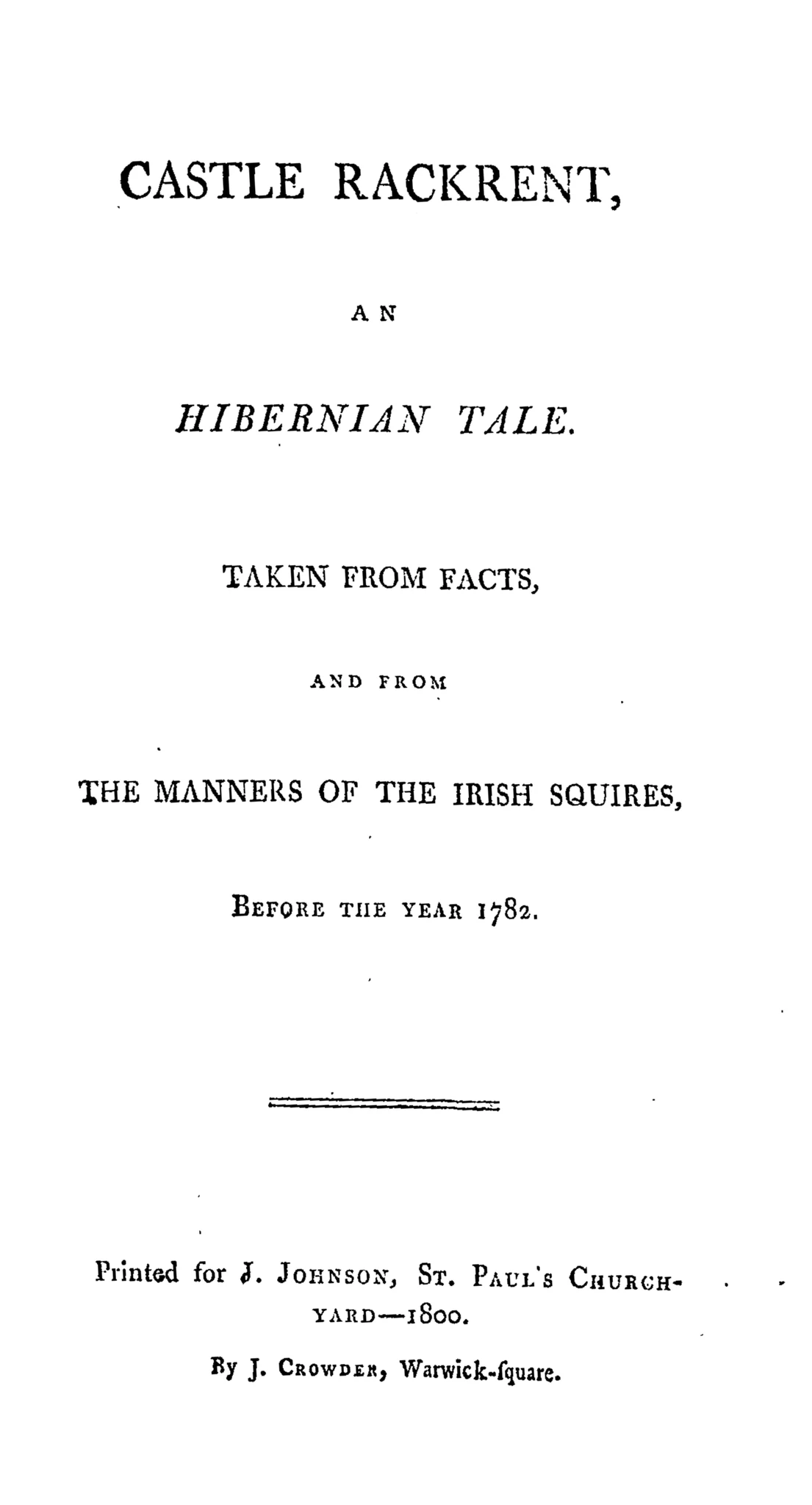
Published anonymously in 1800, the novel announces itself on its title page as an “Hibernian tale” taken from facts and from the manners of Irish squires before 1782.[5] Its apparatus matters as much as that claim: preface, footnotes, conclusion, and glossary surround a first-person family chronicle. Alex Watson describes such notes as a site of cultural translation aimed at metropolitan English readers.[4] Yet the margins never simply decode the story. They stage a contest over who is qualified to explain whom.
The editor labels the witness before he speaks
The preface praises private anecdote over grand history. Public actions are unreliable, it argues; “careless conversations” and “half-finished sentences” reveal character. It even claims that a “plain unvarnished tale” is safer than polished literary manufacture.[1] This sounds like an invitation to listen closely to Thady. It is also an attempt to finish his meaning in advance.
Before Thady gets a line, the editor supplies the verdicts: illiterate, partial, lazy, authentic. Each label tells the English reader how much intelligence to grant the narrator and where to locate the irony. Thady will expose the Rackrents without understanding that he does so; the editor will stand above both servant and landlords, converting local disorder into legible evidence.
But the preface's theory turns against its speaker. If polish creates suspicion and partial speech discloses truth, then the editor's own balanced explanations deserve less trust than Thady's unruly clauses. The man who praises unfinished sentences keeps trying to finish one speaker's sentence for him. He also insists that these are “tales of other times” and imagines Ireland looking back after losing its identity in union with Great Britain.[1] The frame is not neutral scholarship. It has a politics, a desired audience, and a future it wants to declare settled.
“Honest,” “Old,” and “Poor” are roles Thady can wear
Thady's opening quietly takes back the work of definition. “My real name is Thady Quirk,” he says, before listing the names the family has given him: “Honest Thady,” then “Old Thady,” and now “Poor Thady.”[1] The adjectives look like descriptions, but their sequence makes them social costumes. They change as his usefulness and age change. His name remains his own.
He immediately adds another costume: “true and loyal to the family.”[1] The phrase recurs in different forms until loyalty becomes the rhythm by which ugly facts enter the record. Sir Patrick's celebrated hospitality ends with his corpse seized for debt. Sir Murtagh's legal brilliance becomes a lawsuit for every letter of the alphabet. Sir Kit lives abroad “to the honour of his country” while his agent extracts rent from tenants who may have to pay twice. Praise opens the door; evidence walks through it.
This doubleness has produced a long critical argument. S. R. Trzinski summarizes one tradition that treats Thady as a transparent, naïve retainer and another that sees a more conscious, self-interested performance beneath the servility.[3] The prose does not require us to settle Thady's private degree of calculation in every scene. Its sharper achievement is formal: sincerity and advantage can occupy the same sentence. Thady can love Sir Condy, protect his own household, and recognize a bargain without becoming three different narrators.
“I said nothing” says almost everything
Thady's most revealing refrain is a declaration of silence. During Sir Kit's absence, the middleman agent “ferreted the tenants out of their lives.” Thady reports the damage, then explains: “I said nothing, for I had a regard for the family.” The sentence continues. The agent has always been civil to Thady and has taken notice of his clever son Jason.[1]
The order is devastating. Thady does not accuse himself of complicity; he simply puts collective injury beside private access. Soon Jason is copying rent accounts, taking leases, replacing the agent, lending money, purchasing distressed land, and mastering the paper machinery that the Rackrents refuse to understand. Every promotion can be narrated as useful service. Together they describe a transfer of power.
Silence also protects Thady's wider kin. When Sir Condy decides whether to marry Thady's relative Judy by tossing a marked halfpenny, Thady watches without disclosing his hopes. The coin falls against the match, and he admits he was “glad I had kept myself to myself.”[1] The pleasure changes the earlier silence retroactively. Keeping quiet is not an absence of judgment; it is one of the ways judgment acts without becoming answerable.
Edgeworth makes the refrain do more than signal hidden cunning. “I said nothing” is Thady's alibi, transition, and editing mark. It lets him preserve the sound of deference while controlling what follows. Each refusal to interpret draws attention to the sequence he has chosen. The reader learns to hear arrangement as argument.
Thady's voice is crowded, not isolated
Jane Hodson calls Castle Rackrent exceptional among novels of its period for putting a non-standard-speaking servant at the center rather than using such speech for a brief comic encounter. She also notes that Thady's narrative weaves his voice together with those of the people around him.[2] That crowd is essential to his authority.
Thady does not offer a solitary confession. He restages kitchens, elections, debt settlements, deathbeds, quarrels, and bargaining sessions. Judy corrects him. Jason's clipped business language presses against Sir Condy's evasions. Servants carry news that landlords do not possess. Legal phrases learned through proximity to estate business appear beside idioms that the editor marks for explanation. Thady's page behaves like a household whose official owner has lost control of the rooms.
The dialogue also keeps him from being reduced to a single dialect effect. His characteristic manner is not merely spelling or vocabulary. It is timing: an affectionate blessing placed next to evidence of folly, a practical detail after a lofty claim, an excuse that opens onto a transaction. Hodson cautions that literary dialect is constructed rather than a transparent record of real speech.[2] That boundary matters. Thady is not a phonographic sample of an Irish servant in 1800. He is a written voice designed to make social knowledge arrive from a position the editor calls subordinate.
The glossary starts telling stories of its own
The editor's notes are supposed to stabilize that voice. Some translate a word; others explain law, tenancy, wakes, food, or custom. But explanation repeatedly swells into anecdote. A tiny phrase can release a paragraph of social history, personal recollection, or comedy. Watson argues that the margins mediate rural Ireland for English readers, while also carrying ethnographic and polemical work.[4] In practice, the mediator keeps wandering into the tale.
One note exposes the problem beautifully. During an election, men stand on transported sods so they can swear they have been on the land that qualifies them to vote. Thady calls the maneuver a “piece of honesty.” The editor responds with an Irish boundary-dispute story about another strategically moved sod. He initially thinks such verbal ingenuity uniquely Irish—until an English friend offers a Shropshire custom built on an equally literal-minded trick. The comparison, the editor says, mortifies his “national vanity.”[1]
The gloss meant to mark an Irish peculiarity ends by finding its English double. Instead of fixing the distance between plain English and Thady's idiom, the note reveals shared habits of loophole, story, and self-excuse. The editor has not escaped Thady's method. He, too, builds knowledge by retelling a local anecdote and letting its phrasing carry more than one moral.
Even a seemingly literal gloss becomes performance. “I'll leave it all to your honour,” the editor explains, means leaving the trouble to the person addressed. He then tells a story about a justice who paid disputants merely to avoid hearing their cases, thereby attracting still more petitioners.[1] The translation cannot remain a definition. To explain Thady's speech, the editor has to speak like a storyteller.
The ending leaves both narrators exposed
By the last pages, Jason's documents have outlasted Rackrent hospitality. Sir Condy has signed away control, lost the estate, and retreated to the lodge. He dies after trying to match an ancestor's drinking feat. Thady closes with fatigue, caution, and one extravagant warranty: everything set down from memory and hearsay is “nothing but truth” because everybody knows it already.[1]
The claim is comic, but it also completes the book's argument about voice. Thady's truth does not rest on detachment. It rests on circulation—what servants witnessed, what tenants repeated, what papers enforced, what a whole community could recognize even when Thady's professions of loyalty softened the names of things.
Then the editor returns and announces that he could have made Sir Condy's catastrophe more dramatic but refused to “varnish” faithful Thady's plain tale.[1] The old hierarchy is restored for barely a paragraph. The editor immediately generalizes about Irish character and speculates about political union. He cannot certify the narrative without adding another narrative of his own.
That final double exposure is why the reliability debate remains productive rather than soluble.[3] If Thady were only an innocent mouthpiece, his silences and family advantages would feel accidental. If he were only a secret mastermind, his grief for Sir Condy would become thin camouflage. Edgeworth's voice work is harder and more pleasurable than either solution. Thady's loyalty is real enough to shape what he can say and flexible enough to help his family survive what the Rackrents squander.
The editor thinks he has framed Thady. Thady thinks he has honored the family. The novel gives the last task to a third voice—the reader who can hear the distance between those intentions without translating either one into plain English.
Sources
- Maria Edgeworth, Castle Rackrent, Project Gutenberg illustrated HTML edition—primary text of the preface, Thady's narrative, editorial conclusion, notes, and glossary.
- Jane Hodson, “Talking to Peasants: Language, Place and Class in British Fiction 1800–1836,” English Language & Linguistics 27, no. 3 (2023), Cambridge Core—open-access study of literary dialect and Thady's exceptional centrality.
- S. R. Trzinski, “Politics, Paratexts, and Paternalism in Castle Rackrent,” Nineteenth-Century Gender Studies 20, no. 1 (Spring 2024)—open-access account of the competing narrators and the critical debate over Thady's motives.
- Alex Watson, “Margins and Marginality: Maria Edgeworth's Castle Rackrent (1800) and Sydney Owenson's The Wild Irish Girl (1806),” in Romantic Marginality (2014), Cambridge Core—analysis of notes as cultural translation for metropolitan readers.
- Wikimedia Commons, “Castle Rackrent 1800 Title Page”—source and provenance page for the archival first-edition title-page scan used as the article image.