Edith Wharton's two most merciless New York novels are often grouped together because they anatomize money, class, and display. Read closely, though, The House of Mirth (1905) and The Custom of the Country (1913) do not simply repeat the same social verdict with different names attached.[1][2][3][4][5] They test value at radically different speeds. Lily Bart tries to live by timing, by postponement, by the hope that one more evening, one better match, one cleaner arrangement might let beauty, desire, and solvency line up without visible moral damage.[1][3] Undine Spragg has no interest in that tempo. She wants conversion now: the better address, the better box, the better husband, the better title, the better room full of witnesses.[2][4]
That difference is why the pair matters. Wharton does not merely move from one heroine to another. She hardens her fiction. Lily remains tragic because she still carries inward standards, even when those standards are too compromised to save her. Undine is frightening because she hardly pauses long enough to form such standards at all. She experiences society as a sequence of surfaces to be taken, exhausted, and replaced.[1][2]
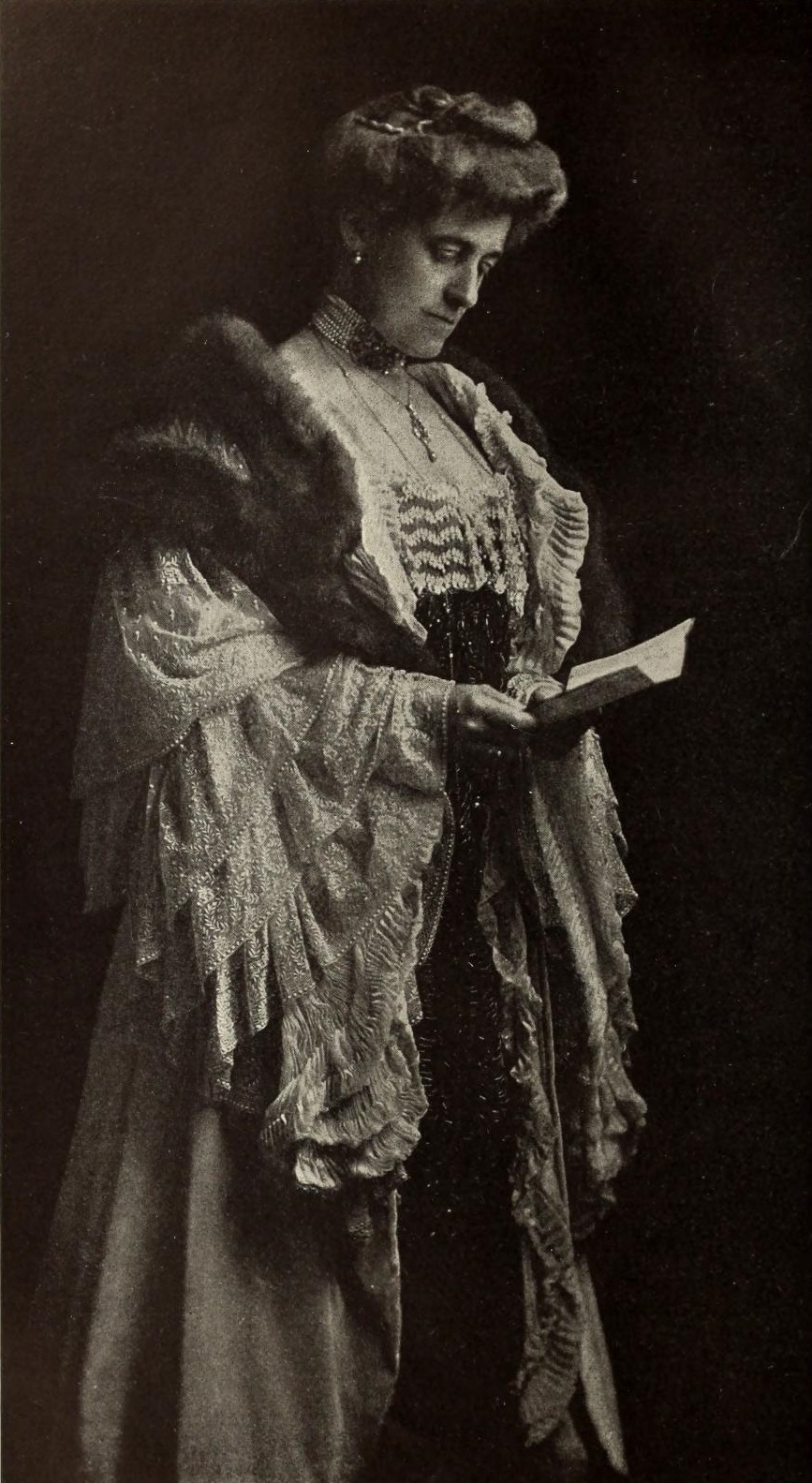
Image context: the cover uses a real archival portrait of Wharton rather than a Fifth Avenue facade or a ballroom still. That choice keeps the comparison centered on one authorial intelligence watching two different female economies emerge from the same social world.[6]
1) Lily Bart lives by delay, and delay is exactly what destroys her
Near the beginning of The House of Mirth, in Lawrence Selden's bachelor flat, Lily defines the trap with almost comic bluntness. Women may enjoy freedom if they are governesses or widows, she says, but not if they are "poor, miserable, marriageable girls."[1] A few lines later she sharpens the arithmetic further: "I am horribly poor - and very expensive. I must have a great deal of money."[1] The force of the novel lies in how much Wharton makes that sentence hold at once. Lily is not only broke. She has been trained into a costly mode of being. Clothes, leisure, social placement, conversational polish, and the management of reputation all belong to the same maintenance bill.[1][3]
That is why Lily's drama never feels like a simple marriage plot. She is not choosing between love and money in the abstract. She is trying to keep incompatible currencies from collapsing into each other. She wants a rich marriage without total surrender, social standing without vulgar pursuit, luxury without the humiliating awareness of dependence, intimacy without a crude bargain written across it.[1][3][5] What kills her is not appetite alone but timing. She hesitates where the world around her rewards quick surrender or quick cynicism.
Wharton keeps showing how expensive that hesitation becomes. Lily misses her chance with Percy Gryce because she cannot fully empty herself into the role required; she entangles herself with Gus Trenor because she wants financial rescue to look like informal help rather than contract; she preserves Bertha Dorset's letters longer than is prudent because moral recoil keeps interrupting tactical action.[1] None of those hesitations makes her pure. They make her late. Lily is always trying to reach the point where self-respect and survival might still touch. The novel's pain comes from how rarely that point exists in the rooms she inhabits.
2) Undine Spragg turns timing into leverage
The Custom of the Country opens from the opposite direction. The narrator tells us early that Undine "never wanted anything long, but she wanted it 'right off.'"[2] That sentence is nearly a manifesto. Undine does not turn desire into reflection or scruple. She turns it into acceleration. When she wants an opera box, she wants it immediately; when she wants Fifth Avenue, Paris, a husband with better name-recognition, or access to a new circle, she treats every obstacle as temporary friction in a transaction already morally authorized by wanting itself.[2][4]
That is why the later novel feels so cold even when it is funny. Lily Bart remains legible to herself as a divided consciousness. Undine experiences consciousness far more instrumentally. Her inner life is not empty, but it is strikingly light on self-interruption. What she wants from rooms, marriages, and social sets is immediate positional gain.[2][4][5] By the time Wharton writes that Undine is at last in possession of "the 'real thing,'" the phrase does not signal discovery in any rich moral sense. It signals acquisition.[2] What matters is that the right witnesses are present and the desired surface has been secured.
Wharton also changes the relation between heroine and environment. Lily is damaged by the codes she has half-internalized. Undine rides those codes like a succession of vehicles. Old New York, nouveau-riche aspiration, Parisian title, divorce law, custody, fashion, and hospitality all become usable mechanisms.[2][4] If Lily is destroyed by the impossibility of preserving value without openly pricing herself, Undine flourishes because she has already accepted that everything worth having will present itself as a convertible form.
3) One heroine still longs for an outside; the other barely needs one
The clearest measure of the difference comes from The House of Mirth's language about enclosure. At Bellomont, Lily sees fashionable society as a "great gilt cage," and Selden's distinction lies in having "never forgotten the way out."[1] Later he offers her his ideal of a "republic of the spirit," a form of success defined by freedom from "money, from poverty, from ease and anxiety."[1] The novel never lets that republic become fully practical, but Lily's tragedy depends on the fact that she can still recognize its appeal. She wants some world in which value would not always arrive indexed to price, spectacle, or matrimonial use.
Undine has no corresponding attraction to an inward republic.[2] She is not interested in preserving a sanctuary against exchange. She wants exchange itself, improved and accelerated. That is why she can keep moving after each marriage or disappointment without much deepening. For Lily, a setback thickens experience. For Undine, it mostly clarifies the next route.[1][2]
This difference also reorganizes how Wharton writes social motion. Lily reads rooms with nervous intelligence. She notices tone, implication, exclusion, and the invisible moment when protection turns into exposure.[1][3] Undine reads rooms for inventory: who matters here, who can transport her elsewhere, what can be extracted from this arrangement before it hardens into boredom.[2][4] Lily's self is porous to atmosphere. Undine's is armored by appetite.
4) What changes in Wharton's satire between 1905 and 1913
Britannica's work pages make the chronology plain: The House of Mirth established Wharton as a major novelist in 1905, while The Custom of the Country arrived in 1913 as an even harder novel of manners.[3][4] The Library of America volume is useful here because it places both books inside the same run of Wharton's strongest fiction and emphasizes the cool modern edge of the later satire.[5] Read in sequence, the shift is striking. The earlier novel still spends enormous energy on the cost of being formed by elite decorum. The later novel treats decorum as one more commodity flow.
That shift does not mean Wharton grows less moral. It means she moves the site of moral pressure. In Lily's book, pressure falls on a woman who cannot quite reduce herself to the terms of the market that governs her.[1][3] In Undine's book, pressure falls on everyone around a woman who has accepted the market's terms so completely that scruple looks like inefficiency.[2][4] The satire widens from social cruelty to social metabolism.
There is also a change in what the novels think beauty can do. Lily's beauty still generates pathos because it is inseparable from waste, exhaustion, and belated awareness.[1][3] Undine's beauty is tactical capital from the first pages. It does not expose vulnerability so much as sharpen extraction.[2][4] Wharton has moved from tragedy with satiric edges to satire with tragic collateral damage.
5) Why this pair remains so clarifying
Read together, the novels explain something central about Wharton. She was never only the chronicler of old New York manners.[3][5] She was a novelist of conversion systems: how feeling turns into credit, how marriage turns into transport, how interiors turn people into rank-signs, how delay can either preserve a shred of dignity or ruin the person practicing it.[1][2] Lily Bart and Undine Spragg stand at opposite poles of that system.
Lily spends herself trying to keep beauty, desire, and self-command from becoming fully legible as price. Undine spends the world by treating every relation as provisional until a better one appears. One heroine makes speed too late; the other makes speed her entire method. Put side by side, they show Wharton discovering that the same society could produce two different female destinies: one tragic because she still wants an inward measure, the other terrifying because she no longer needs one.[1][2][5]
Sources
- Edith Wharton, The House of Mirth. Project Gutenberg HTML edition.
- Edith Wharton, The Custom of the Country. Project Gutenberg HTML edition.
- Britannica, "The House of Mirth."
- Britannica, "The Custom of the Country."
- Library of America, Edith Wharton: Novels - volume page including The House of Mirth and The Custom of the Country.
- Wikimedia Commons, "File:Picture of Edith Wharton.jpg" - source page for the archival portrait used as the article image.