The first scene of The Tempest is easy to remember as pure disorder: thunder, shouting, sailors running at cross-purposes, noblemen panicking, and the apparent promise of a shipwreck before the plot has even settled into names.[1] But Shakespeare builds the opening storm much more carefully than that memory suggests. The scene does not stage chaos for its own sake. It stages panic that already has a form. The boatswain's commands, the courtiers' useless rank, and the scene's abrupt cut to Prospero all teach the audience the play's central rule before Prospero himself explains it: in this world, power works by arranging what looks ungovernable.[1][2]
That is one reason the opening has lasted so well in performance history. Folger's overview places The Tempest among Shakespeare's late romances, full of magic, shipwreck, political injury, and eventual reconciliation.[2] The Shakespeare Birthplace Trust's play guide likewise stresses the play's intertwined concerns with power, betrayal, and restoration.[4] Yet before any reconciliation can matter, the first scene has to make the audience feel a more basic reversal. A king is present, but command does not belong to him. The sea is roaring, but the language that cuts through it is the language of work.
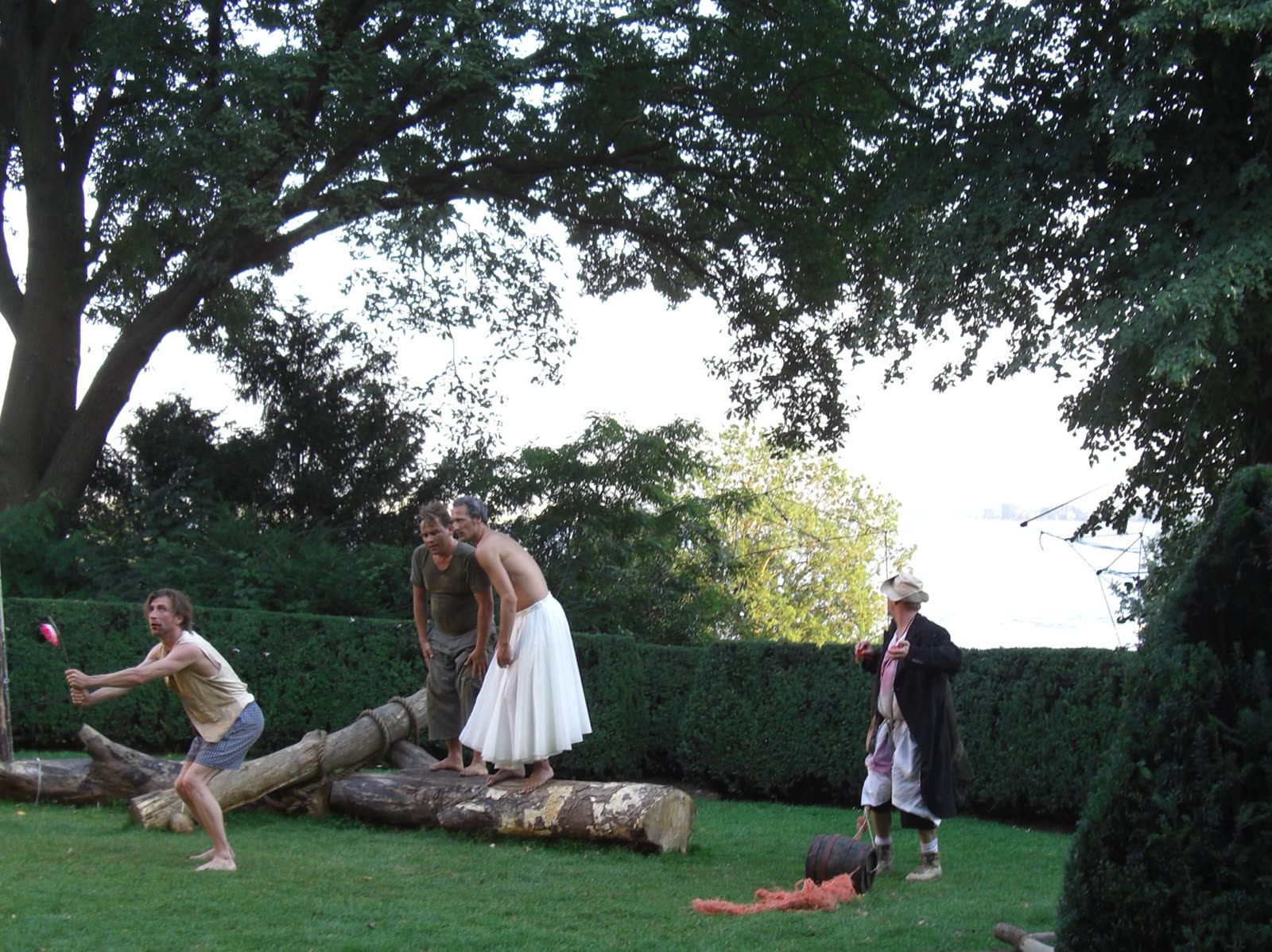
Image context: the cover uses a real production photograph of an outdoor staging of The Tempest in Hamburg rather than a portrait of Shakespeare or a decorative seascape. That is the right match for this essay because the argument is about performance mechanics. The opening storm matters not as abstract weather, but as bodies placed under pressure on a stage where command must be seen as well as heard.[6]
1) The storm opens by redistributing authority
The first lines do not belong to a ruler, a magician, or a tragic hero. They belong to labor. "Boatswain!" comes as an urgent summons, and the boatswain answers with instructions, not deference.[1] Almost immediately the scene teaches the audience a brutal practical truth: on a ship in danger, rank does not disappear, but it loses usefulness. When the king's party interfere, the boatswain's famous rebuke lands with shocking force: "What cares these roarers for the name of king?"[1] The line is memorable because it is insolent. It is more important because it is structurally exact.
For a moment, the storm creates a workplace hierarchy stronger than political hierarchy. The boatswain is not a democrat and not a philosopher of equality. He is simply the only man in the scene whose speech still answers the emergency.[1] Shakespeare uses that fact to make fear legible in social terms. Panic is not just emotional excess; it is the condition in which inherited rank stops organizing the room. The opening storm therefore announces a pattern the whole play will keep revisiting: title alone does not govern events. Authority belongs to whoever can direct action inside the moment's actual constraints.[1][4]
That inversion also helps explain why the scene feels so modern in performance. The language is broken, imperative, efficient. "Down with the topmast!" is not decorative sound; it is work shouted under pressure.[1] Shakespeare does not start with a noble speech about fate. He starts with a crew trying to keep a vessel functional while aristocrats add noise. The play's magical world is introduced through labor management.
2) Shakespeare makes fear audible by breaking the sentence
The scene's language keeps refusing the stable flow of ceremonial speech. Orders are cut short, names are repeated, prayers burst out and collapse, and voices pile on top of one another.[1] Read on the page, the scene can look almost bare compared with the lyrical density later associated with Prospero, Ariel, or Caliban. Onstage, that spareness is the point. The syntax is battered into fragments because the audience has to hear fear as interruption.
This is where close reading matters. Shakespeare does not describe the storm at length. He lets the storm happen through the collision of speech registers: maritime instruction, courtly outrage, and religious desperation.[1] Gonzalo tries to joke and steady the atmosphere; Antonio and Sebastian turn their anxiety outward into abuse; others cry "All lost!" and fall toward prayer.[1] The soundscape becomes the scene's true spectacle. The storm is not only wind and thunder. It is a machine for making social language fail at different speeds.
The Shakespeare Birthplace Trust's overview is useful here because it keeps returning to power and its abuse as one of the play's central organizing concerns.[4] The opening scene is where that theme first becomes audible. Nobody here controls the weather, but everybody reveals his relation to control. The sailors issue commands. The nobles resent not being obeyed. The frightened reach for ritual phrases. By the time the ship seems to break, Shakespeare has already sorted the cast by how they sound under pressure.
3) Prospero's explanation turns chaos into design
The real formal stroke comes only after the storm appears to spend itself. In Act 1, Scene 2, Miranda asks her father whether he has "rais'd the tempest," and Prospero answers by explaining that he has done so "with such provision in mine art / So safely ordered" that no one has been harmed.[1] Those few lines retroactively remake the opening. What looked like exposure to blind natural force becomes an arranged ordeal, frightening by design but bounded in outcome.
That revelation matters for more than plot. It changes the audience's understanding of theatrical spectacle itself. The first scene is not merely the play's loud entrance. It is a demonstration of Prospero's method before Prospero names it: to produce effects so overwhelming that other people reveal themselves inside them.[1][2] The storm is thus the first of several managed events in the play, joined later by Ariel's music, the harpy interruption, and the masque. Prospero governs less by argument than by scenography.
Folger's introduction to the text reminds readers that The Tempest survives in the 1623 First Folio, the earliest printed version of the play.[3] The Internet Shakespeare Editions facsimile reinforces that sense of a scene built for cues, exits, and sharply distributed sound.[5] That print history matters because the storm has always asked readers to imagine performance technique along with verbal texture. Even on the page, the scene feels built for stage effects and coordinated voices. It is one of Shakespeare's cleanest proofs that spectacle and structure are not rivals. The spectacle is the structure.
4) Why the opening still matters after the colonial and political debates
Modern criticism often approaches The Tempest through colonial power, enslavement, dispossession, and the ethics of Prospero's rule, and rightly so.[2][4] Those debates usually gather force once Caliban and Ariel enter the conversation. The opening storm matters to them because it supplies the play's governing model early. Prospero does not simply possess authority; he stages environments in which authority becomes temporarily unquestionable. He controls entry, tempo, visibility, and fear.
That is why the first scene deserves more than summary treatment. It is not just a hook before the "real" play begins. It is the play in miniature. The nobles discover that rank can be suspended. The audience discovers that catastrophe can be manufactured. Prospero's island, when we reach it, will turn out to be a place where command often arrives as atmosphere first and explanation second.[1][2][4]
The storm also keeps one final irony in reserve. Gonzalo, even at sea, notices that the boatswain has the look of a man "born to be hanged" and jokes that hanging rather than drowning may be his destiny.[1] The line is comic relief, but it also captures the scene's tonal cunning. Death seems imminent; comedy still leaks through; authority is unstable; language keeps doing more than one thing at once. Shakespeare begins The Tempest by making disaster playable. That doubleness is the opening scene's real brilliance. It terrifies, but it also announces that terror here will be organized, performed, and watched.
So the opening storm is not simply meteorological throat-clearing before Prospero tells his story. It is Shakespeare's first and sharpest lesson in how this play thinks. Weather becomes theater. Fear becomes arrangement. Rank becomes noise unless it can act. By the time the ship vanishes and Miranda starts asking questions, the audience has already been taught how to read the island's later wonders: not as free-floating magic, but as power that works by composing panic into form.[1][2][4][5]
Sources
- William Shakespeare, The Tempest, Folger Shakespeare Library digital text.
- Barbara Mowat and Paul Werstine, "About Shakespeare's The Tempest," Folger Shakespeare Library.
- Barbara Mowat and Paul Werstine, "An Introduction to This Text: The Tempest," Folger Shakespeare Library.
- Shakespeare Birthplace Trust, "The Tempest" (play guide).
- Internet Shakespeare Editions, The Tempest First Folio facsimile / complete text view.
- Wikimedia Commons, "File:Römischer Garten Sturm.JPG" (production photograph used for the article image).