People often remember A Tale of Two Cities through its biggest surfaces: the French Revolution, the guillotine, the doubled heroes, the famous opening sentence, the even more famous final sacrifice.[1][2] What can get lost in that summary is Dickens's actual method. He does not hold history together by chronology alone. He keeps sending the same kinds of signals back through the novel until private feeling and public upheaval begin to answer one another. A broken cask of wine in Saint Antoine. Footsteps gathering in a house built for echoes. Madame Defarge's knitting. The stubborn language of being "recalled to life," first around Dr. Manette and finally around Sydney Carton.[1][3][4] These are not decorative emblems. They are the novel's operating system.
That is one reason the book still feels tighter than many historical novels that know more history.[2][3] Dickens compresses a huge political catastrophe into repeatable forms that readers can hear, see, and dread in advance. A crowd does not arrive only as a crowd. It arrives first as a stain, a noise, a habit, a repeated phrase. By the time the guillotine dominates the last book, the reader has already been trained to recognize the smaller signals that made such violence imaginable.[1][3]
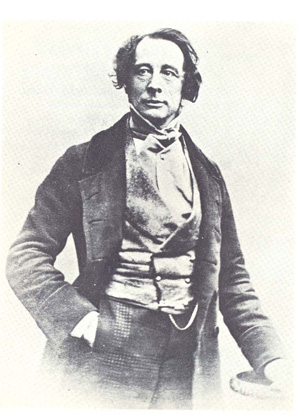
Image context: the cover uses a real Dickens photograph rather than a later film still or an engraved Revolution scene.[5] That choice keeps the essay grounded in authorial craft. The point here is not antique atmosphere. It is the precision with which Dickens turns recurrent objects and gestures into historical pressure.
1. Wine makes hunger visible and blood thinkable
The most famous object scene in the early chapters is still shocking because Dickens refuses to sentimentalize it. "A large cask of wine had been dropped and broken, in the street," and immediately "all the people within reach had suspended their business, or their idleness, to run to the spot and drink the wine."[1] The scene begins almost like slapstick, then becomes something harsher. People scoop wine from stones, squeeze it from rags into infants' mouths, and suck at the soaked fragments of the cask itself.[1] Dickens makes scarcity physical before he makes revolution ideological.
That matters because the scene does more than establish poverty in Saint Antoine. It teaches the novel's symbolic grammar. The wine is festive for a moment, communal even, but it is also desperate, muddy, and impossible to separate from the street that receives it.[1][4] Victorian Web's commentary on McLenan's 1859 illustration is useful because it states the obvious point without flattening it: the spilled wine prefigures later bloodletting, and the man who writes "BLOOD" on the wall turns appetite into prophecy.[4] Dickens is not hiding the foreshadowing. He wants the reader to feel how quickly the crowd's rough play can harden into vengeance.
What gives the motif its power is that wine never stays only symbolic. It remains material: red liquid, mud, mouths, broken wood, public hunger.[1] Dickens does not ask us to decode the scene and move on. He asks us to remember that a revolution will later inherit the emotional force of this first communal scramble. Before the tribunal, before the grindstone, before the executions, there is a street where deprivation has already taught people to lunge together.
2. Footsteps turn private suspense into historical time
If wine is the novel's first public signal, footsteps are its most flexible one. Dickens introduces secrecy early in the Dover road chapters, then deepens it in the beautiful third chapter meditation that calls each human being "that profound secret and mystery to every other."[1] The novel's soundscape matters from the beginning: muffled travel, uncertain arrivals, messages half-heard. But the footsteps motif reaches full shape in Lucie's domestic world. In the chapter "Echoing Footsteps," the house is described as "a wonderful corner for echoes," where Lucie listens to "the echoing footsteps of years."[1]
That phrase is one of Dickens's great inventions because it fuses family time with political time.[1][3] At first the footsteps suggest future children, future happiness, future losses. Then the motif broadens. In one storm scene, "the wonderful corner for echoes resounded with the echoes of footsteps coming and going, yet not a footstep was there."[1] The line feels ghostly, but its real work is structural. History has not yet burst through the door, yet the house is already vibrating with it.
Victorian Web's synopsis of the novel calls footsteps an "ominous foreshadowing," and that is correct as far as it goes.[3] But the footsteps are more than warning bells. They are Dickens's way of showing that public events are first registered as changes in pressure inside ordinary life. Lucie hears them before she can interpret them. Readers do too. By the time the Revolution takes explicit command of the plot, Dickens has already taught us to treat sound as advance notice. History enters the novel as acoustics before it arrives as event.
3. Knitting turns memory into a ledger that cannot be argued with
Madame Defarge's knitting is one of the coldest motifs in Dickens because it looks domestic until you understand that it records sentence rather than comfort. Early on, when Lorry and Lucie first reach the Defarges' wine-shop, "Madame Defarge knitted with nimble fingers and steady eyebrows, and saw nothing."[1] The line is brilliant partly because the last phrase is false on its face. She sees everything. The knitting is a discipline of surveillance disguised as routine.
Later Dickens makes the menace unmistakable. As the road-mender watches her carry her work into public spaces, she answers a man's question about what she is making with one word: "shrouds."[1] Nothing could be plainer, yet the plainness is exactly what makes the motif so unnerving. Knitting usually belongs to patience, continuity, repair, household time. Dickens converts it into revolutionary account-keeping. It becomes a portable ledger, a memory system that can move through crowds, trials, and executions without losing a name.[1][3]
The motif also clarifies the difference between sentiment and implacability in the novel. Lucie's life is repeatedly described through binding and weaving metaphors too: she is the "golden thread" holding damaged people together.[1] Madame Defarge weaves a different fabric. Her thread does not mend. It stores injury and extends it forward. By the time Dickens reaches "The Knitting Done," the phrase itself sounds terminal.[1] What had looked like ordinary female labor has become administrative death.
That transformation is why the motif stays with readers. Dickens does not merely give the Revolution an avenging woman. He gives it a method. Knitting lets private grievance take durable form. The hand keeps moving; the sentence keeps waiting.
4. Resurrection keeps asking what kind of life can come back
The book announces its central metaphor before it gives us any stable person to attach it to. Book One is called "Recalled to Life," and when Lorry's message reaches the ruined Dr. Manette, the language is explicit: "You know that you are recalled to life?"[1] The answer is not triumphant. It is broken, uncertain, almost unwilling.[1] Dickens understands that return is not simple restoration. To be called back into life after eighteen years of living burial is to return damaged, discontinuous, and unsure whether return is even desirable.
That is why resurrection keeps widening as the novel proceeds.[1][2] Manette's recovery is one version: partial, fragile, threatened by relapse. Darnay's reprieves offer another, more procedural version. Carton's ending offers the last and most exalted form, joined to the biblical words "I am the Resurrection and the Life" and to the closing cadence, "It is a far, far better thing that I do, than I have ever done."[1] Dickens could have made the final sacrifice purely heroic. Instead he folds it back into the book's long argument about what can be restored and what cannot.
This motif is the novel's answer to its own violence. Wine and knitting tell you how destruction accumulates. Resurrection asks what survives that accumulation.[1][2][3] Not everything does. The novel does not pretend that prison, class cruelty, or revolutionary terror can be cleanly undone. But it keeps returning to forms of renewal that remain morally imaginable even when history has grown monstrous. That is the emotional counterweight that stops the book from becoming only a machine of revenge.
5. Why the pattern still matters
Read through these motifs, A Tale of Two Cities stops looking like a historical pageant with a few memorable symbols attached.[1][2][3] It looks like a system of conversions. Hunger becomes wine, then blood. Anticipation becomes footsteps, then public catastrophe. Thread becomes knitting, then sentence. Burial becomes recall, and recall becomes sacrifice. Dickens keeps the novel moving by repeating forms across scales. A street scene teaches you how to read a tribunal. A domestic sound teaches you how to read a revolution.
That is the source of the book's peculiar compactness.[2][3] Dickens does not try to explain every historical complexity of the French Revolution. Britannica is fair to call the French scenes vivid rather than deeply analytical in their history.[2] What he does instead is more novelistic and, in some ways, more lasting. He invents a pattern language strong enough to make upheaval feel lived before it feels summarized.
The result is a book whose big set pieces remain memorable because the smaller signals have already prepared them.[1][3][4] When the last pages arrive, Dickens is not suddenly asking for grandeur. He has been building toward it through stains, sounds, gestures, and repeated words from the opening chapters onward. That is why the novel still reads less like a costume drama than like a warning system that never stopped working.
Sources
- Charles Dickens, A Tale of Two Cities. Project Gutenberg HTML text.
- Encyclopaedia Britannica, "Charles Dickens - Last years" (section covering A Tale of Two Cities as a late experiment).
- Philip V. Allingham, "A Synopsis of Dickens's A Tale of Two Cities (1859)," Victorian Web.
- Philip V. Allingham, "Headnote vignette ... 'The Wine-shop' ... 'A large cask of wine had been dropped and broken, in the street,'" Victorian Web.
- Wikimedia Commons, "File:Charles Dickens photo by Antoine Claudet.jpg" (source page for the lead photograph).