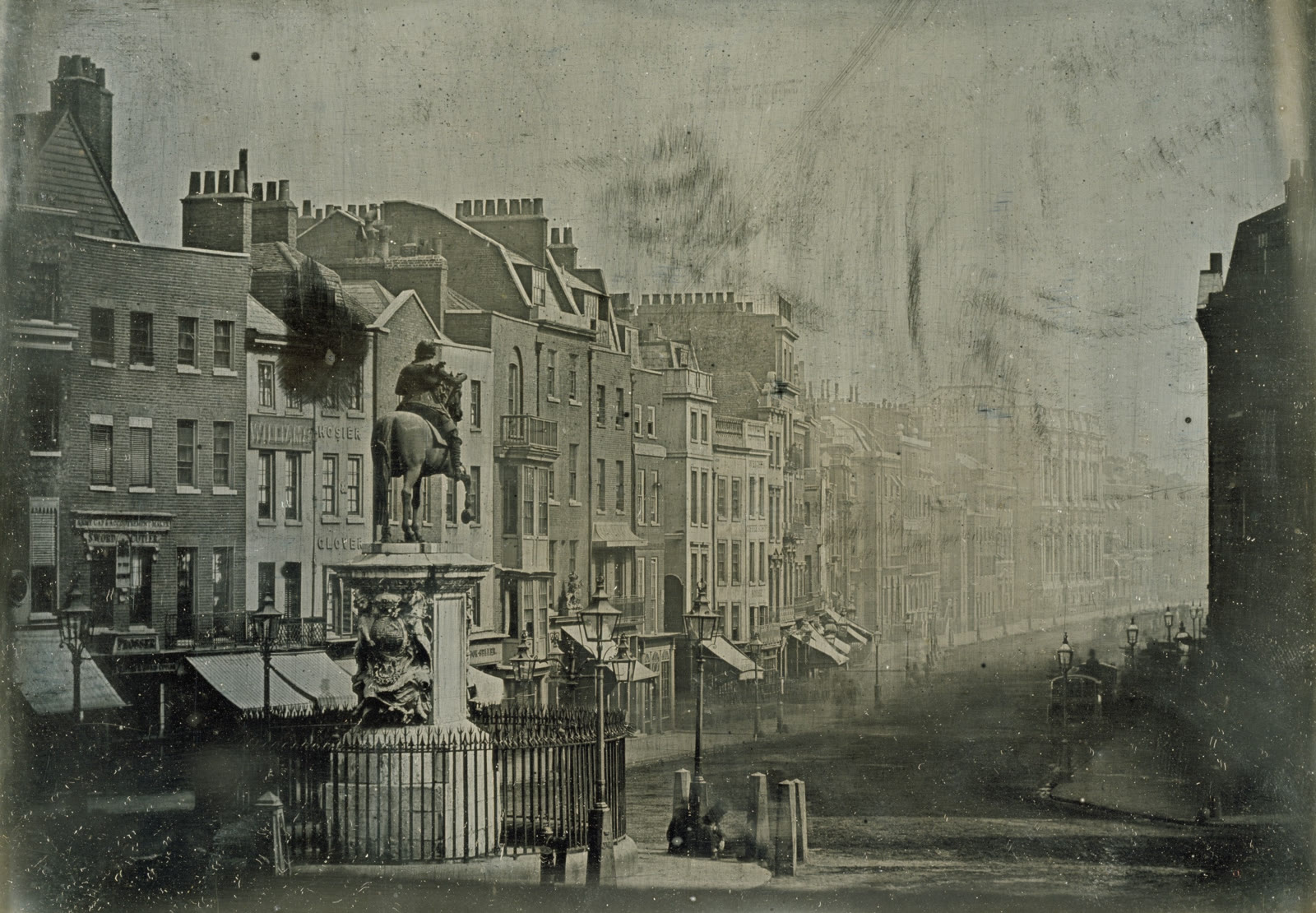
Nathaniel Hawthorne begins “Wakefield” with almost nothing: an old report about a London husband who left home, rented a room one street away, watched his wife for twenty years, and then walked back in. Even the name is provisional—“let us call him Wakefield.” From that scrap, Hawthorne's narrator manufactures a temperament, a marriage, a wardrobe, a private logic, and a moral.[1]
Edgar Allan Poe begins “The Man of the Crowd” with the opposite abundance. From a coffee-house window, a convalescent narrator reads hundreds of passers-by as if London were an open book. Clothes reveal professions; posture discloses rank; faces sort themselves into social types. Then one old man crosses the window and defeats the system. His expression produces incompatible ideas at once, and the narrator rushes into the street to follow him. After a day and a night, the watcher has collected movement without motive. The tale's opening formula has become a human problem: the stranger is a book that “does not permit itself to be read.”[2]
Set beside each other, the stories reverse the same experiment. Hawthorne asks how much personhood a narrator can build from one unexplained act. Poe asks what remains when an observer has every visible detail and still cannot build a person. One watcher invents an interior; the other mistakes pursuit for access. Their London crowd does not merely hide people. It tempts stories into claiming that seeing is knowing.
Hawthorne names the gap and moves into it
“Wakefield” openly admits that its central character is a construction. The remembered anecdote supplies the departure, the nearby lodging, the long absence, and the return. Everything between belongs to conjecture. “We are free to shape out our own idea,” the narrator says, making interpretation sound both hospitable and proprietorial.[1] The invitation is seductive: because the original report lacks motives, narrator and reader may enter the vacancy together.
The story then gives speculation the speed of witnessed action. Wakefield leaves home meaning to stay away for a week. He buys a reddish wig and unfamiliar clothes. He watches an apothecary and then a physician arrive at his old door, understands that his wife is ill, and postpones returning because his appearance might disturb her. Each delay creates the conditions for the next. What began as a whim hardens into a “new system,” and the narrator turns that system into character.[1]
This is not conventional omniscience, because Hawthorne keeps showing the join between evidence and invention. Perhaps, we may suppose, perchance: the qualifying words remain audible even as the scenes grow intimate. Arnold Weinstein's study of the tale stresses how unusually little interpretive security it offers and places its modern afterlife with Borges's admiration for its problems of identity and enigma.[6] The tale's pleasure lies in that unstable bargain. We know the narrator is filling a blank, yet the invented man soon feels more available than the anecdote that supposedly authorized him.
The name performs the trick in miniature. Wakefield begins as a label attached for convenience. Repetition makes it feel inevitable. When the narrator imagines a voice crying the name in the street, or makes Wakefield shout it at himself after meeting his wife, the placeholder becomes a summons. Hawthorne has not recovered the historical stranger. He has made a fictional consciousness answer to the sound of a fictional name.
Poe turns the window into a reading machine
Poe's narrator initially has no such doubts. Illness has lifted, appetite has returned, and the coffee-house window appears to grant an ideal combination of distance and detail. He begins with groups, then narrows to signs: an upper clerk's right ear, trained outward by pen-holding, and a pickpocket's excessive wristband become occupational evidence. Kevin J. Hayes connects this confidence to a nineteenth-century visual culture saturated with physiognomy, phrenology, urban sketches, newspapers, and other systems that promised to translate surfaces into character.[5]
The confidence matters because Poe does not simply oppose a mysterious man to a mysterious city. He first makes classification enjoyable. The prose gathers clerks, gamblers, tradespeople, laborers, invalids, thieves, and exhausted women into a moving catalogue. He treats the crowd as an urban census, as if observation could turn circulation into knowledge.[2] His eye seems powerful precisely because the people below cannot look back through the glass.
The old man breaks that asymmetry. His face suggests malice and merriment, caution and desperation; his clothes combine dirt with fine fabric; a torn cloak seems to disclose both a diamond and a dagger. None of these signs is absent. The problem is that they will not settle into one account. Hayes argues that the narrator's response exposes the failure of a word-based classification system when a visible subject exceeds its available categories.[5]
So the narrator abandons the window and turns reading into pursuit. He follows the stranger through bright commercial streets, poorer quarters, crowds leaving a theatre, and the thinning city at dawn. Yet closeness adds duration, not explanation. When he finally stands directly before the old man, the man fails even to notice him. Poe makes face-to-face encounter less intimate than Hawthorne's admitted invention.
Two crowds, two ways to disappear
Hawthorne's crowd permits a man to vanish while remaining geographically close. Wakefield's second room is only a street from his first, but the short distance becomes “another world” once his wife and acquaintances reorganize life around his absence.[1] London supplies constant cover: he can approach his house, inspect its signs, and withdraw without having to become a hermit. His disappearance is social, not spatial.
That difference becomes brutal when husband and wife collide after ten years. The pressure of the crowd brings their bodies together; its flow then pulls them apart. She pauses, perplexed, but continues toward church. He bolts home to his rented room. Wakefield has spent a decade treating his wife as the fixed audience for his absence. The scene reveals that she has acquired a life in which he can register as a disturbance rather than a husband.
Poe's old man uses the crowd in the reverse direction. He does not hide from a particular relationship; he seems unable to exist without density itself. When shops close and streets empty, he grows anxious. A new crowd revives him. He repeats routes, enters bazaars without buying, and follows urban circulation for its own sake.[2] Hawthorne's crowd lets Wakefield live beside the home he abandoned. Poe's crowd has become the old man's only home.
Andrea Chiurato's direct study of Hawthorne's and Poe's London tales treats the city as an existential labyrinth: Wakefield chooses exile within it, while Poe's stranger is trapped in ceaseless circulation.[7] Antoine Dechêne likewise places both stories in a genealogy of mysteries that turn the urban stroller, the failed quest for knowledge, and the unreadable subject into problems rather than solutions.[8] The comparison clarifies an important distinction within that kinship. Wakefield can be narrated because Hawthorne's speaker converts a social disappearance into causal sequence. Poe's stranger stays unreadable because repetition never becomes cause. A route is not a motive, even after it has been walked twice.
Every watcher produces a second spectacle
Neither story allows observation to remain innocent. Wakefield watches his wife's grief, illness, recovery, and settled widowhood while withholding the fact that would change them. Yet he is also being watched by a narrator who converts that cruelty into an ingenious psychological performance. The tale repeatedly addresses Wakefield as if warning could reach him. It cannot. The apostrophes instead let narrator and reader enjoy the superior position of seeing the watcher fail.
Poe's pursuer looks less secure the longer he follows. Both men stay awake through the night. Both depend on the crowd. Both repeat a route whose purpose the reader cannot verify. The old man may be concealing a crime, but the narrator's evidence never establishes one. His final phrase, “the type and genius of deep crime,” sounds conclusive because the chase has exhausted him, not because the case has closed.[2]
The stories therefore expose two hazards of literary spectatorship. Hawthorne shows imagination overreaching its evidence while acknowledging the overreach. Poe shows observation accumulating evidence until the observer can no longer distinguish facts from the story he wants them to prove. One narrator says, in effect, let us invent. The other says, I have seen enough to know—and becomes less trustworthy at the moment of certainty.
Poe's later response to Hawthorne sharpens the pairing without proving a simple line of influence. “The Man of the Crowd” appeared in December 1840; in an 1842 review of Twice-Told Tales, Poe praised “Wakefield” for the skill with which Hawthorne had worked up a known incident.[3][4] What Poe admired is exactly what his own tale withholds. Hawthorne works the incident up into motives. Poe lets an incident of pursuit refuse that conversion.
The endings stop at different doors
After twenty years, rain drives Wakefield toward the warm fire visible in his former home. He opens the door. Hawthorne does not follow. The original anecdote says he became a loving husband again, but the fictional narration ends at the threshold, just where confirmation would become most necessary. The supposed recovery of his place remains outside the story's knowledge.[1]
Poe's narrator also stops voluntarily. He steps in front of the old man, receives no recognition, and abandons the chase. His concluding maxim repeats the opening idea that some secrets will not be told. Structurally, this resembles a solved case only from a distance: investigator states verdict, subject disappears, narrative closes. The central question—who is this man?—has merely been renamed crime.[2]
That is why the two stories still feel uncannily contemporary without needing to be recruited as prophecies about surveillance. They identify a durable mistake. More access can produce more confidence without producing more knowledge. A location, a face, a route, a wardrobe, even twenty years of visible behavior can support several incompatible lives.
Hawthorne's narrator makes one of those lives coherent and leaves his handiwork visible. Poe's narrator cannot tolerate incoherence, so he converts it into guilt. Read together, the stories make the reader less eager to solve their strange men and more attentive to the watchers beside them. The deepest likeness is not between Wakefield and Poe's old wanderer. It is between the two observers who need a stranger to become a story—and the reader who follows.
Sources
- Nathaniel Hawthorne, “Wakefield,” in Twice-Told Tales, Project Gutenberg HTML edition—primary text for the remembered anecdote, speculative narration, London crowd, and threshold ending.
- Edgar Allan Poe, “The Man of the Crowd,” in The Works of Edgar Allan Poe, vol. 5, Project Gutenberg HTML edition—primary text for the coffee-house taxonomy, pursuit, and unreadable ending.
- Edgar Allan Poe Society of Baltimore, “The Man of the Crowd”—textual and publication history, including the December 1840 printings and later authorized text.
- Edgar Allan Poe, “Review of Twice-Told Tales,” Graham's Magazine (May 1842), transcribed by the Edgar Allan Poe Society of Baltimore—Poe's contemporary appraisal of Hawthorne and “Wakefield.”
- Kevin J. Hayes, “Visual Culture and the Word in Edgar Allan Poe's ‘The Man of the Crowd,’” Nineteenth-Century Literature 56, no. 4 (2002), pp. 445–465—analysis of physiognomic reading, visual signs, and the narrator's classificatory failure.
- Arnold Weinstein, “Hawthorne's ‘Wakefield’ and the Art of Self-Possession,” in Nobody's Home (Oxford University Press, 1993), pp. 13–26—critical afterlife, identity, enigma, and the tale's revisionist standing.
- Andrea Chiurato, “The Outcasts of the Universe: Longing and Belonging in Nathaniel Hawthorne's and Edgar Allan Poe's London Tales,” in Spaces of Longing and Belonging (Brill, 2019), pp. 233–251—direct comparison of London, voluntary exile, and compulsive circulation.
- Antoine Dechêne, Detective Fiction and the Problem of Knowledge (Palgrave Macmillan, 2018)—book framework and paired chapters on Poe's urban pursuit and Hawthorne's “Wakefield” as unreadable, metacognitive mysteries.
- Victoria and Albert Museum via Wikimedia Commons, M. de St Croix, “Parliament Street (Whitehall) from Trafalgar Square,” 1839, daguerreotype, PH.1-1986—source, identification, and public-domain record for the cover photograph.