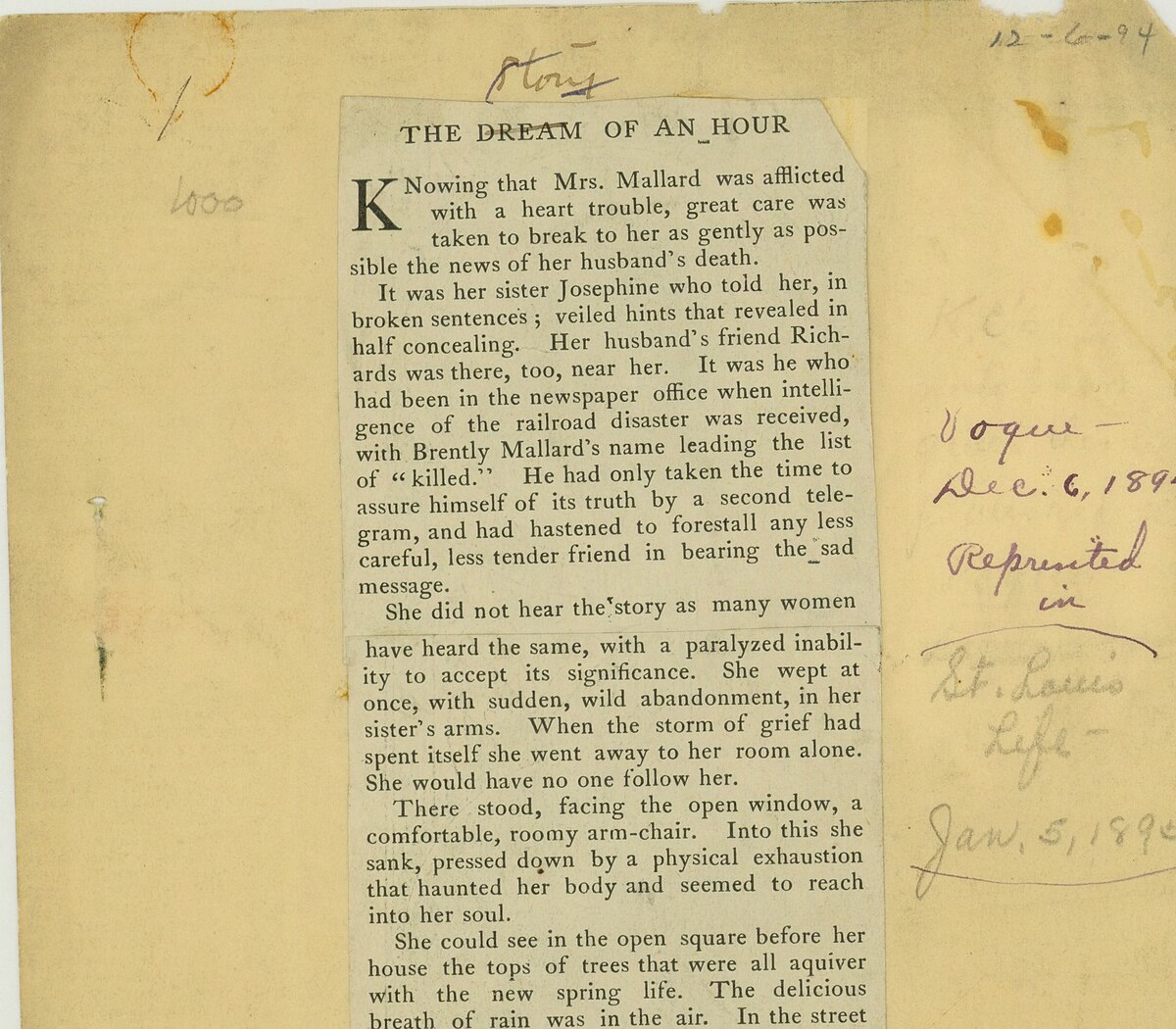
The last sentence of Kate Chopin's “The Story of an Hour” is usually introduced as a twist. Brently Mallard, reported dead in a railroad accident, walks through his own front door; his wife Louise collapses; the doctors decide that she died “of joy that kills.” On a first reading, the returning husband supplies the shock. On a second, the doctors do. Their neat diagnosis is not simply mistaken. It completes a struggle over who gets to describe Louise's life.[1]
Chopin organizes that struggle through voice. The story begins in the language of public knowledge—medical condition, newspaper report, telegram, careful notification. It then slips into Louise's room and allows the world to be felt from her chair, through her eyes, skin, pulse, and newly imaginable future. At the end, it retreats to the hallway, where witnesses and professionals convert an experience the reader has shared into an acceptable social explanation. Pia Masiero describes this movement as an interplay between authorial narration and internal focalization, sharpened by the gap between what the characters know and what readers know.[3]
That gap is the story's real engine. Chopin gives Louise almost no sustained dialogue and no first-person confession. Yet for a few paragraphs, every sentence leans toward her. The achievement is both intimate and cruel: the prose makes her self-recognition unmistakable without giving her a voice that can survive the opening of the door.
Public knowledge speaks first
The opening sentence seems solicitous: “great care was taken” to tell Mrs. Mallard of her husband's death gently. Its grammar is also revealing. The passive construction makes care sound like a procedure already in operation; no single person has to own it. Louise first appears as a marital title and a medical vulnerability, “afflicted with a heart trouble.” Before she sees, says, or chooses anything, other people have defined the conditions under which news may reach her.[1]
The next paragraph extends this public-information chain. A newspaper office receives intelligence of the disaster. Brently's name leads the list of the dead. Richards waits for a confirming telegram and races to prevent a less “careful” friend from delivering the message. These are decent acts, not a conspiracy. But their diction—intelligence, list, telegram, truth—belongs to systems that turn lives into reportable facts. The plot begins because an official-looking fact travels efficiently and happens to be false.[1]
Even the narrator initially speaks with the confidence of that system. We are told what everyone knows, why Richards acts, and how “many women” might receive such news. Then Louise breaks the template: she does not become numb but weeps “with sudden, wild abandonment.” The sentence first places her inside a category and then records her refusal to behave categorically. That is Chopin's early rhythm: public language reaches for a settled account; Louise exceeds it.[1]
Masiero notes that the opening narrator possesses broad informational privilege and frames Louise through familiar signs of weakness: wife, illness, passivity. Yet the framing is double-edged. The narrator also sees “repression” in Louise's face, naming the pressure that the household's kindness cannot name. The voice carries the period's assumptions into the room while quietly exposing their limits.[3]
The room changes who can perceive
Louise closes a door and faces an open window. The famous contrast matters, but Chopin does more than arrange two symbols. She changes the source of the prose. “She could see” the trembling treetops and patches of blue sky; rain has a “delicious breath”; a peddler cries below; a distant song and sparrows reach her. The details are partial and located—faintly, distant, off yonder. We no longer receive the world as a verified report. We receive what can enter one body's field of attention.[1][3]
This is why the outdoor life does not feel like cheerful scenery pasted onto grief. Its mixed signals are more exact than that. Rain and blue sky coexist. The song is too far away to identify. Clouds remain piled in the west while small openings appear between them. Louise is not handed a ready-made emblem of freedom; she notices a world that has suddenly stopped agreeing with the story everyone downstairs is telling about her future.
The syntax slows accordingly. The opening paragraphs hurry through notification and verification. In the room, separate sensations accumulate before Louise can interpret them. Perception precedes proposition. Chopin lets the body register a change that the mind is still afraid to name: a rising chest, quickened pulse, warming blood, relaxed muscles. The style refuses the familiar hierarchy in which reason announces a truth and the body merely illustrates it. Here the body knows first.[1]
The narrator never disappears completely. Louise's stare is described as a “suspension of intelligent thought,” a phrase that can sound patronizing even as the passage moves closer to her. Masiero argues that this audible authorial framing and Louise's internal perspective coexist rather than replacing each other cleanly.[3] That friction is valuable. Freedom does not arrive in a language purified of the culture Louise inhabits. It has to become legible inside a vocabulary already prepared to call a woman's intense feeling irrational.
“It” arrives before “free”
For several sentences, Louise's recognition has no noun. “There was something coming to her.” She waits for “it”; “it” creeps from the sky; “this thing” approaches to possess her. Grammatically, Louise remains the object of an unnamed force. The passivity resembles the opening sentence, but its emotional direction has reversed. Downstairs, care acts upon a fragile Mrs. Mallard. Upstairs, an unclassified possibility acts upon Louise.[1]
Only then does sound condense out of sensation: “free, free, free!” Repetition matters more than eloquence. This is not a polished declaration offered to another person. It is a whispered word tested three times, as though Louise has to hear whether it can exist. The prose immediately returns to her body—eyes, pulse, blood—so that free becomes less a thesis than a new organizing rhythm.[1]
Chopin also prevents that word from becoming a cheap verdict on Brently. Louise expects to weep over his “kind, tender hands” and the face that “had never looked save with love upon her.” She has loved him “sometimes.” The passage does not reveal a secretly monstrous husband. It identifies something more ordinary and therefore harder to dismiss: the “blind persistence” with which men and women believe they may impose a private will on another person. Kind intention does not cancel the imposition.[1]
One disputed word makes the distinction unusually clear. The 1894 Vogue text reads, “There would be no one to live for during those coming years.” The 1895 St. Louis Life version adds her: “There would be no one to live for her.” The Kate Chopin International Society explains that the source of the change—author, editor, or printer—cannot be established with certainty.[2] Without her, the line emphasizes Louise's self-sacrifice; with it, the line emphasizes another will directing her life. The story's larger tension survives either reading, but a single pronoun shifts the balance of power. In a work about a self almost spoken over, textual precision is not pedantry. It is interpretation.
The future tense becomes Louise's room
Once Louise can name freedom, the story opens into a sequence of woulds. She would weep; years would belong to her; she would live for herself. Later, spring days, summer days, and “all sorts of days” would be her own. This future-in-the-past creates a horizon that does not yet exist, but its repetition makes that future briefly habitable. Louise's room expands not through geography but through grammar.[1]
This is where the narration comes closest to her without simply becoming her speech. The third person remains, yet its values and tempo have moved toward Louise's perception. Masiero usefully calls the shift subjectivizing: focalization gives center stage to Louise's embodied experience even though it does not grant her a fully independent narrative voice.[3] That limit explains why the passage feels at once exultant and precarious. Her future is vivid, but it is held in borrowed grammatical space.
Louise's spoken vocabulary remains tiny. She whispers free. Through the closed door she tells Josephine, “Go away. I am not making myself ill.” Josephine, notably, is the first person in the story to call her “Louise” rather than Mrs. Mallard. But the sister hears danger where Louise feels an “elixir of life.” Intimacy does not solve the problem of interpretation. Even a loving voice at the keyhole cannot know what the reader has been allowed to know.[1]
The boundedness of that access matters. Nothing in the text proves that Louise's imagined autonomy would become a durable life, or that her sudden vision resolves every contradiction of love and obligation. Critics have disagreed sharply over whether her self-assertion is liberating, socially impossible, dangerously absolute, or some combination of these.[2] The firmer claim is formal: Chopin places the reader close enough to Louise to understand why the diagnosis at the end cannot describe what happened.
The hallway takes the story back
When Louise opens the bedroom door, the prose becomes visible from outside again. She carries herself “like a goddess of Victory,” clasps Josephine, and descends. The private future turns into a small public procession. Then a latchkey interrupts it.[1]
Brently enters through a sequence of ordinary objects and gestures: grip-sack, umbrella, travel stains, composure. He is not resurrected melodramatically; he is simply back from somewhere else. The plainness is devastating because it restores the household's prior arrangement without argument. Richards tries to screen him, but the terse paragraph—“But Richards was too late”—closes the distance between fact and body.[1]
Then the doctors speak. Their phrase, “joy that kills,” converts Louise's death into confirmation of the opening premise: a wife with a weak heart has been overwhelmed by happiness at her husband's return. The sentence sounds authoritative because it combines medical office with a culturally flattering story of marriage. Yet the reader has occupied the room they never entered. We know that Brently's return does not fulfill Louise's desire; it annihilates the future tense that had just made life seem long.[1][3]
The story therefore ends where it began, with other people managing Louise's heart through expert language. But the repetition is changed by what intervened. Heart trouble first looks like neutral exposition; by the close, heart disease has become an interpretive alibi. Chopin does not tell us to substitute a modern diagnosis, and the text gives no basis for one. She gives us something literary rather than clinical: proof that an explanation can be socially credible, professionally delivered, and completely unable to hear its subject.
From “Dream” to afterlife
Chopin wrote the story on April 19, 1894. After four magazines rejected it, Vogue reconsidered following the success of her collection Bayou Folk and published it on December 6 as “The Dream of an Hour.” It appeared in St. Louis Life the next month; later editors established the title by which it is now known.[2][5] The Missouri Historical Society preserves Chopin's three-sheet clipping from that first publication, including the annotated first sheet reproduced as this article's image.[4]
The title history sharpens the story's question of authority. Dream can pre-classify Louise's freedom as temporary, unreal, or safely sealed inside private fantasy. Story is more neutral, directing attention toward the act of telling and toward the hour's competing accounts.[3] We cannot recover a single decisive intention from the change, especially because the surviving versions complicate attribution.[2] What we can see is that both titles make duration matter: Louise possesses a possible life only in the interval between two public errors.
The story's later classroom and critical prominence has produced incompatible Louises—heroine of selfhood, victim of social confinement, absolutist, ironist's target.[2] Its style survives those verdicts because it never turns her into a slogan. Chopin gives her sensory attention, a repeated word, a corridor of future tense, and a private knowledge the reader must carry after everyone else has named it incorrectly.
That is why the ending remains larger than its trick. Brently's return cancels Louise's imagined future inside the plot. The doctors' sentence tries to cancel her account of it. The reader, having heard the quieter voice inside the room, becomes the only witness who knows the difference.
Sources
- Kate Chopin, “The Story of an Hour,” Kate Chopin International Society—complete text used for passage references and short quotations.
- Kate Chopin International Society, “The Story of an Hour”—composition and publication history, textual variants, title history, and a survey of critical reception.
- Pia Masiero, “Perspectival Strategies in Kate Chopin's ‘The Story of an Hour,’” LEA—Lingue e letterature d'Oriente e d'Occidente 13 (2024), pp. 95–102—peer-reviewed analysis of authorial narration, internal focalization, and reader knowledge.
- Missouri Historical Society Library and Research Center, “Printed short story, ‘The Dream of an Hour,’ by Kate Chopin from Vogue Magazine, December 6, 1894,” D00404—catalog record and provenance for the three-page archival clipping used in the cover image.
- Library of America, “The Story of an Hour,” Story of the Week (January 31, 2014)—context on the story's magazine rejections, resubmission to Vogue, and early publication history.