
N. Scott Momaday gives Robert Redford a sentence that sounds simple enough to become a slogan: “there is only one story, but there are many stories in the one.” In the short American Masters clip, that thought grows out of something domestic rather than theoretical—the Kiowa stories Momaday heard from his father and asked to hear again.[1][5]
The distinction matters. Momaday is not saying that every story is interchangeable, or that cultural difference disappears inside a universal plot. He places plurality inside the sentence itself: many remain present in one. A story survives because another teller, listener, occasion, and memory can enter it without making the earlier telling disposable.
The clip is an outtake from Jeffrey Palmer’s 2019 documentary N. Scott Momaday: Words From a Bear. PBS’s official channel preserves the exchange as a self-contained conversation, while its written interviews extend Momaday’s account of storytelling, language, and landscape.[1][2][6] It is a compact ten-minute entrance to his work because the claim becomes more demanding when placed beside the formal design of The Way to Rainy Mountain: one inherited journey, deliberately told through three voices.
One is not the same as single
Listen first for the scale of Momaday’s claim. He does not say there is only one version. The word “story” can hold a particular bedtime tale, a family’s remembered past, a people’s historical movement, or the human act of giving experience a shape. The line moves between those scales without announcing a hierarchy among them.
That mobility protects the sentence from two bad readings. One would romanticize oral tradition as a perfectly sealed message handed down unchanged. The other would treat variation as corruption, as though every retelling were a damaged copy of an absent original. Momaday’s own account offers a different model. In a 2010 oral-history interview, he remembered requesting his father’s stories “again and again and again” and said he understood only later how fragile they were.[5] Repetition is therefore both pleasure and preservation. The child asks for the known story; the next telling makes it present under new conditions.
The video’s conversational form quietly demonstrates that process. Redford does not receive a finished lecture and file it away. He prompts a recollection; Momaday revoices an idea he says he has written elsewhere; the official upload gives that telling another audience.[1] The medium changes from family speech to recorded interview to embedded video, but the story’s continuity depends each time on an act of attention.
Three voices, no final referee
The Way to Rainy Mountain makes this listening ethic visible on the page. The publisher of the fiftieth-anniversary edition describes its three voices as legendary, historical, and contemporary. Together they trace the journey of the Kiowa people and Tai-me, the sacred Sun Dance figure, while also following Momaday’s pilgrimage to his grandmother’s grave.[3]
The arrangement is more radical than a history followed by illustrative folklore. A legendary account does not appear merely to be corrected by documentary fact. Historical commentary does not get the final word because it sounds objective. Personal memory does not dissolve the other two into autobiography. The voices sit in relation, and the reader has to carry images and tensions among them.
This is where Momaday’s “one story” becomes a formal principle rather than an inspirational phrase. The one is made by adjacency. Legend can disclose the imaginative terms through which a people knows its world; historical record can establish pressures, movements, and encounters; memory can show how both become intimate in one later life. None is sufficient alone, and none has to impersonate the others.
The method also creates an ethical limit for interpretation. A reader may notice resonance among the voices, but resonance is not proof that they say exactly the same thing. Momaday builds connection without demanding merger. The white space among passages is therefore active: it gives the reader room to hear correspondence while preserving the sources’ different claims to knowledge.
Landscape is a sounding board, not scenery
In the book’s introductory description of Rainy Mountain, Momaday writes, “Loneliness is an aspect of the land.” The plain isolates hill, tree, and person in the eye; scale wavers; imagination wakes. The Library of Congress preserves this passage in its exhibition on literary landscapes of the American West.[4] It is a precise example of place doing more than supplying atmosphere.
The sentence begins with visual separation, yet the prose turns separation into relation. A lone object becomes legible against distance. The observer does not master the scene by measuring it; proportion fails, and imagination becomes the faculty through which the place can be encountered. Landscape is not blank territory waiting for story to decorate it. It changes what seeing and telling can mean.
Momaday later called landscape a “sounding board for the oral tradition” and described the two as inseparable.[2] A sounding board does not invent the voice that reaches it. It receives, carries, and alters resonance. That metaphor clarifies the structure of Rainy Mountain: historical movement, ancestral narrative, and personal return sound through the same places, but their differences remain audible.
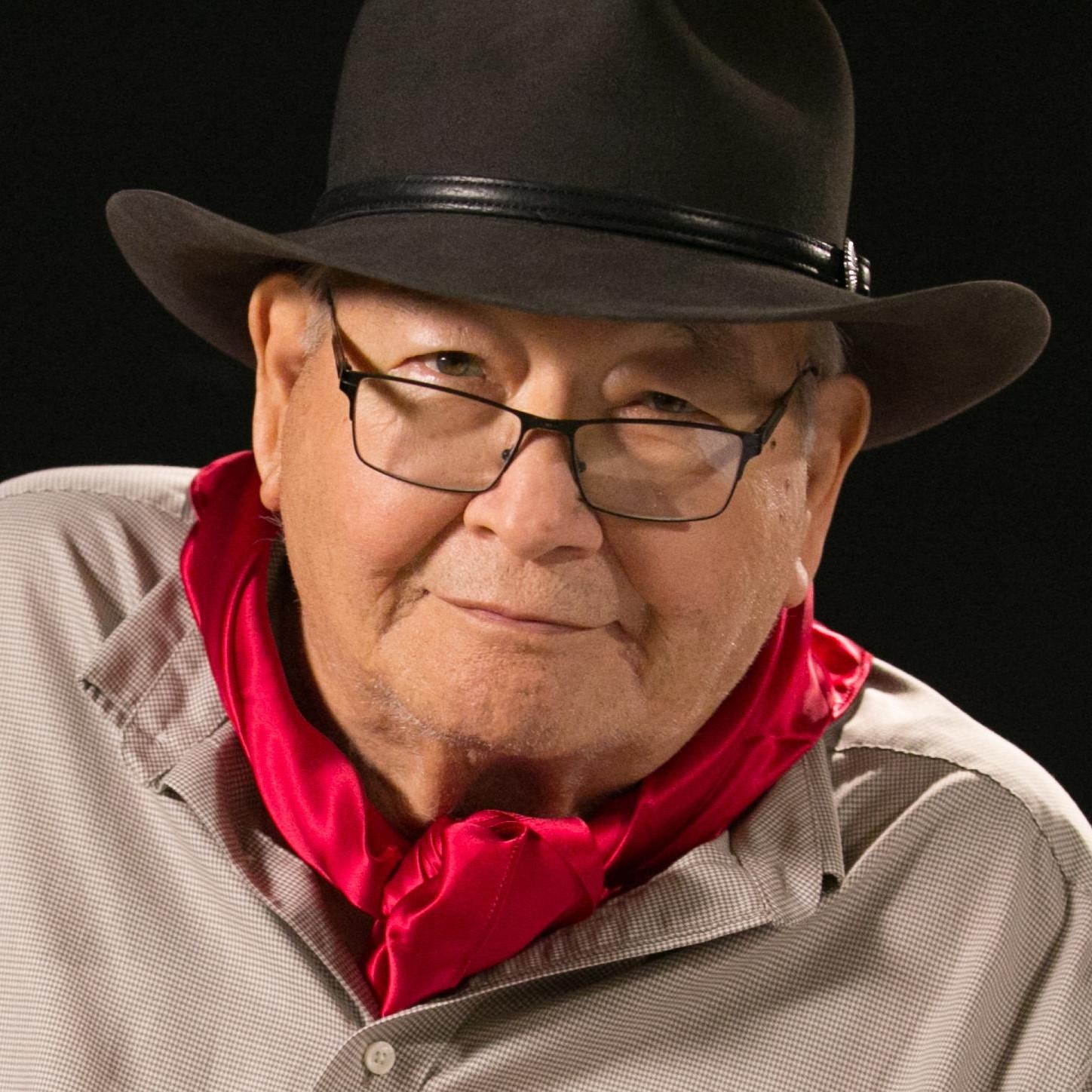
It also helps explain why the cover portrait belongs here. PBS’s photograph shows the actual writer rather than substituting a generic prairie, tipi, or stack of books for Kiowa literary history.[6] The image gives us a person and a material face; the article’s prose must still do the work of placing voice, book, and landscape in responsible relation.
The Pulitzer is context, not permission
Momaday received the 1969 Pulitzer Prize in Fiction for House Made of Dawn, published the previous year—not for The Way to Rainy Mountain.[7] The distinction is worth stating because prizes can distort chronology and authority. The award expanded Momaday’s public visibility, but it did not confer legitimacy on Kiowa oral tradition, which preceded the institution that honored him.
What the prize can tell us is how abruptly literary institutions had to widen their field of recognition. House Made of Dawn brought ritual language, fractured postwar experience, and multiple cultural frames into a form judged as American fiction. The Way to Rainy Mountain, appearing in the same pivotal period, made the question of form still more explicit: what if a book did not ask oral tradition, historical documentation, and memoir to become one another before they could share authority?
That question is part of Momaday’s afterlife. His achievement is sometimes summarized as moving Native storytelling into print. The phrase is useful only if “moving” does not mean freezing. Print in Rainy Mountain becomes another occasion for telling, one designed to retain turn, return, juxtaposition, and the pressure of a listener’s memory.
Rewatch for the act of handing on
On a second viewing, do not treat Momaday’s “one story” as the clip’s detachable moral. Attend to the sequence around it: an interviewer opens space, a father’s remembered voice enters, an older writer speaks an idea again, and a listener receives responsibility for what comes next.[1][5]
The written work supplies the deeper lesson. A story is kept alive neither by reducing it to one authorized statement nor by celebrating endless variation without accountability. It endures through careful relation: teller to listener, legend to record, memory to place, one voice to the voices it refuses to erase. Momaday’s three-part form does not solve those relations. It makes reading practice them.
Sources
- American Masters PBS, “Robert Redford and N. Scott Momaday on Oral Tradition,” YouTube video.
- PBS American Masters, “7 questions for N. Scott Momaday on writing, sovereignty and storytelling,” December 12, 2022.
- University of New Mexico Press, The Way to Rainy Mountain: 50th Anniversary Edition, official publisher page and synopsis.
- Library of Congress, “The West,” Language of the Land: Journeys Into Literary America, including Momaday’s introductory Rainy Mountain passage.
- Voices of Oklahoma, “N. Scott Momaday: Oklahoma Writer, Artist, and Teacher,” oral-history interview and transcript recorded December 21, 2010.
- PBS American Masters, “N. Scott Momaday,” subject collection, documentary credit, and portrait source.
- The Pulitzer Prizes, “N. Scott Momaday,” official record for the 1969 Fiction Prize awarded to House Made of Dawn.