Paul Verlaine's Chanson d'automne is short enough to invite bad habits. Because the poem is only three stanzas long, English versions often treat it as portable melancholy: a little violin music, a little autumn weather, a dead leaf, then done. But the original lyric in Poemes saturniens is harsher and more exact than that summary allows. Verlaine breaks feeling into clipped units, lets sound arrive as injury, and turns recollection into a bodily condition before it becomes reflection.[1][4]
That compression helps explain the poem's unusually public afterlife. The U.S. Army's campaign history of Normandy notes that German intelligence learned the BBC would transmit lines from a Verlaine poem to signal the French Resistance before D-Day, and the opening of Chanson d'automne became memorable enough to function as code precisely because it already moves in charged fragments.[5] Translation matters here because the poem is not only sad. It is sharp, breathless, and acoustically damaged. If English smooths those qualities away, Verlaine stops sounding like Verlaine and starts sounding like generic autumn mood.
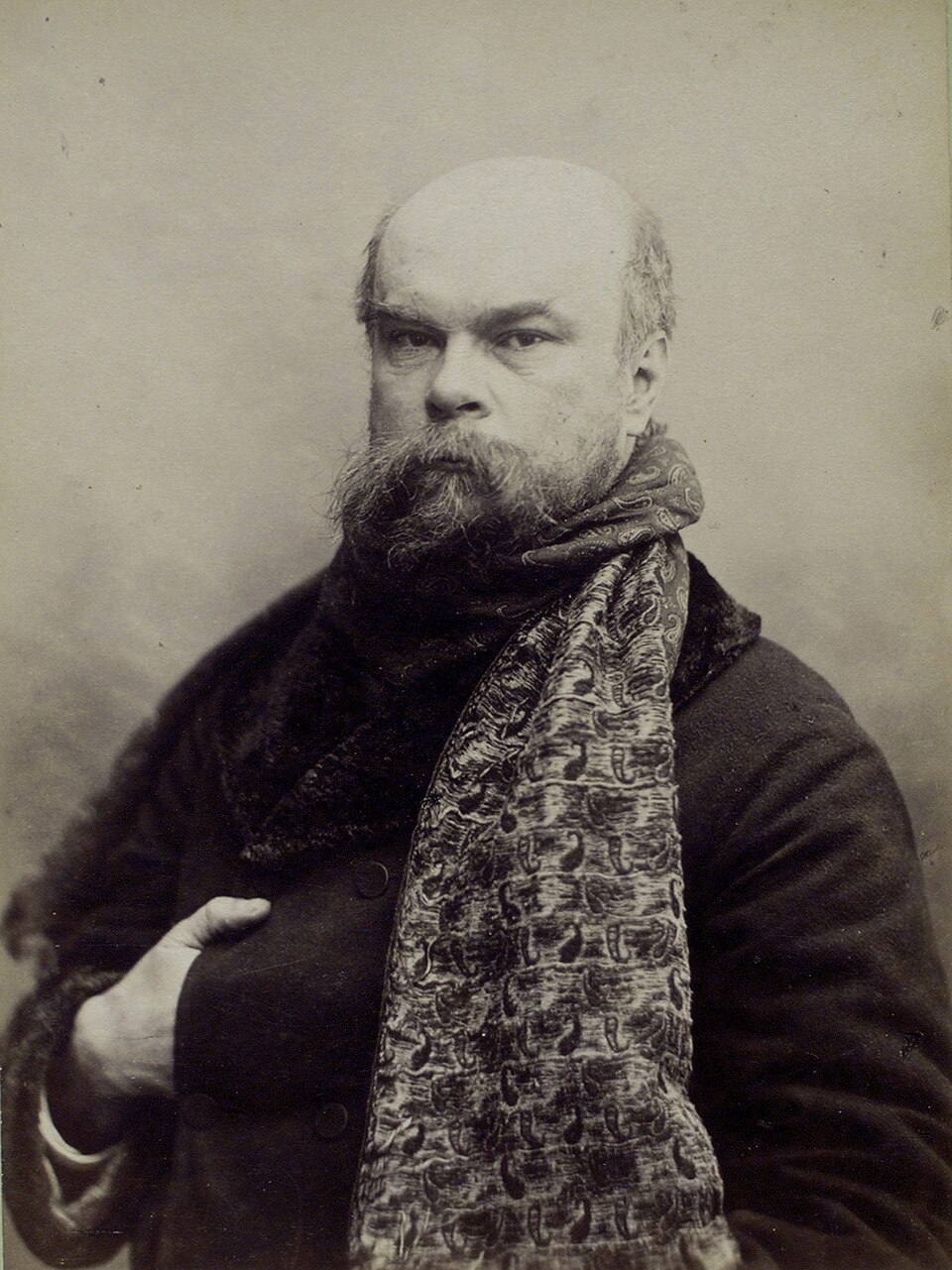
Image context: the cover uses Otto Wegener's real 1893 portrait photograph of Verlaine rather than an illustrated book cover or seasonal filler image. That choice fits a translation-notes essay because the poem depends on tension between polish and abrasion. The scarf, coat, and formal pose suggest finish; the face and the poem both carry fatigue under the surface.[6]
1) The opening has to stay cut into short blows
The first translation problem is already visible in the first six words: "Les sanglots longs / Des violons / De l'automne."[1] Their force depends on sequence and on the narrowness of the line breaks. The sound comes first as sobbing, then as violins, then as autumn. Verlaine does not begin with scenery and then add emotion; he begins with an aural wound and only gradually tells you whose season it belongs to.[1]
That is why Gertrude Hall's public-domain version is so revealing. Her "Leaf-strewing gales / Utter low wails / Like violins" is musical in its own way, but it rewrites the mechanism.[2] The violins become simile instead of source, the weather moves to the front, and the poem opens in atmosphere rather than in pain. Richard Stokes keeps closer pressure in "With long sobs / The violins / Of autumn," because the syntax still arrives in steps and the strings remain the thing that is grieving.[3] A translation does not need to imitate the French syllable count exactly. It does need to preserve the staggered arrival by which music first enters the poem.
2) "Langueur monotone" is bodily, not decorative
The next hinge is "Blessent mon coeur / D'une langueur / Monotone."[1] The crucial verb is violent. The violins wound; they do not merely surround, color, or accompany the speaker. And the noun phrase after the wound matters just as much. "Langueur monotone" is not elegant sadness arranged on a shelf. It is fatigue that keeps repeating itself until it becomes a condition of the body.
Here Hall's version again shows the cost of drift. When she writes that the music's "creeping dole / Stealthily wins," she catches infiltration but loses impact.[2] The heart is no longer struck; it is gradually occupied. Stokes's "Wound my heart / With languorous / Monotony" sounds stiffer in English, yet that stiffness is useful because it keeps the original friction between sensation and repetition.[3] The poem is not asking for prettiness. It is asking for a mood heavy enough to injure.
That choice matters for Verlaine's literary position as well. Poetry Foundation's biographical note places him within Symbolism and the Decadent movement, but Chanson d'automne works because its music never floats free of physical consequence.[4] The sound is refined, yet the body pays for it.
3) The middle stanza must keep its pallor and its bell-strike
The second stanza turns even more visibly physical: "Tout suffocant / Et bleme, quand / Sonne l'heure."[1] The speaker is out of breath and drained of color before memory finishes taking shape. Then the hour sounds. That detail is easy to flatten, but it matters. Verlaine does not say simply that time passes or evening falls. He gives the stanza a strike, almost a bell or clock impulse, and that audible moment tips the speaker into recollection.[1]
Hall partially keeps the bodily pressure with "Choking and pale," but "In such hour, I" turns the sounding hour into a vague setting.[2] Stokes's "The hour sounds" is plain, almost literal, and therefore better.[3] It leaves the mechanism intact. The poem does not drift into nostalgia on its own. Something strikes, the body contracts, memory opens, and tears follow. The line of causation is brief, but it is real.
That brevity is one reason the lyric remains so memorable. Its emotional sequence is built from tiny pushes rather than from broad statement: constriction, pallor, sound, remembrance, weeping.[1] A translator who generalizes that sequence into wistful mood loses Verlaine's exact control over onset.
4) The last stanza is about passive drift under pressure
The closing movement is also easy to sentimentalize. "Et je m'en vais / Au vent mauvais / Qui m'emporte / Deca, dela, / Pareil a la / Feuille morte."[1] English versions often want to make the speaker sound wistfully itinerant, as if the poem ended in romantic wandering. It does not. The speaker is carried. The bad wind acts; the self is acted upon.
Hall's "Harsh and unkind" adds emotional color to the wind and gives the stanza some propulsion, but the last image, "Like the dead leaf," is where she recovers Verlaine's severity.[2] Stokes takes a different route: "Where ill winds blow, / Buffeted / To and fro, / Like a / Dead leaf."[3] "Buffeted" usefully restores passivity, and "dead leaf" is stronger than any softened seasonal substitute. A falling leaf is picturesque. A dead leaf has already crossed into mortality.
That final image is the poem's true scale change. Until this point the lyric has lived inside sound and body: sobs, wound, pallor, tears. The dead leaf widens the frame, but it does so without granting freedom.[1] The self has become light enough to be driven, thin enough to be carried, and late enough in the season to resemble debris. Translation has to keep that helplessness.
5) Why the poem survived as signal
The D-Day afterlife should be handled carefully. It does not reveal the poem's hidden original purpose, and it should not be allowed to militarize the lyric after the fact. But it does illuminate one formal truth. The U.S. Army's Normandy history records that the BBC planned to transmit lines from Verlaine's poem as warning to the French Resistance, and those lines were effective because they were already compact, memorable, and acoustically marked.[5] Verlaine had written a lyric whose first movement arrived in short, unmistakable cuts.
That is the standard English translation has to meet. The poem does not need to become stiffly literal at every point. It does need to keep the opening fracture, the wound in the heart, the struck hour, and the final dead-leaf passivity.[1][2][3] Once those pressures remain, Chanson d'automne regains its strange double life: an intimate lyric of exhaustion that also proved portable enough to enter history as signal. When those pressures vanish, only a tasteful autumn sadness is left, and Verlaine's broken music closes up too neatly.
Sources
- Paul Verlaine, "Poemes saturniens (1866)/Chanson d'automne." Wikisource French text.
- Paul Verlaine, Poems of Paul Verlaine, translated by Gertrude Hall. Project Gutenberg.
- Oxford International Song Festival, "Chanson d'automne" - text with Richard Stokes translation.
- Poetry Foundation, "Paul Verlaine" - biographical note on the poet, Symbolism, and Poemes saturniens.
- U.S. Army Center of Military History, Normandy - campaign history noting the BBC use of lines from Verlaine's poem before D-Day.
- Wikimedia Commons, "File:Paul Verlaine.jpeg" - source page for the 1893 Otto Wegener portrait used as the article image.