Many readers remember The Picture of Dorian Gray as a story about hidden corruption: a beautiful man keeps his face, locks the evidence away, and is finally punished when the secret returns.[1][2] That outline is true but still too simple. Wilde's stranger achievement is to imagine corruption not as something merely concealed, but as something deliberately transferred. Dorian does not want vice without consequence in the abstract. He wants youth to stay on the body while time, guilt, and self-knowledge move elsewhere.[1] The portrait is therefore not just a Gothic device. It is a theory of how a person might try to live if conscience could be outsourced.
That theory belonged to Wilde's moment. Britannica describes the novel's 1890 magazine publication and the expanded 1891 book version as central to the scandal around Wilde's art, while its later notoriety was sharpened again when the novel was used against him in 1895.[2][4] The surrounding language of Aestheticism matters here too. Britannica's overview of the movement frames it through "art for art's sake," beauty, and the refusal of crude moral utility.[3] Wilde does not simply reject that world. He stages its most intoxicating temptation: the dream that a life could become pure surface, style without remainder, sensation without ethical drag. The novel becomes terrifying because it shows that such a life would not eliminate the soul. It would make the soul visible in another medium.
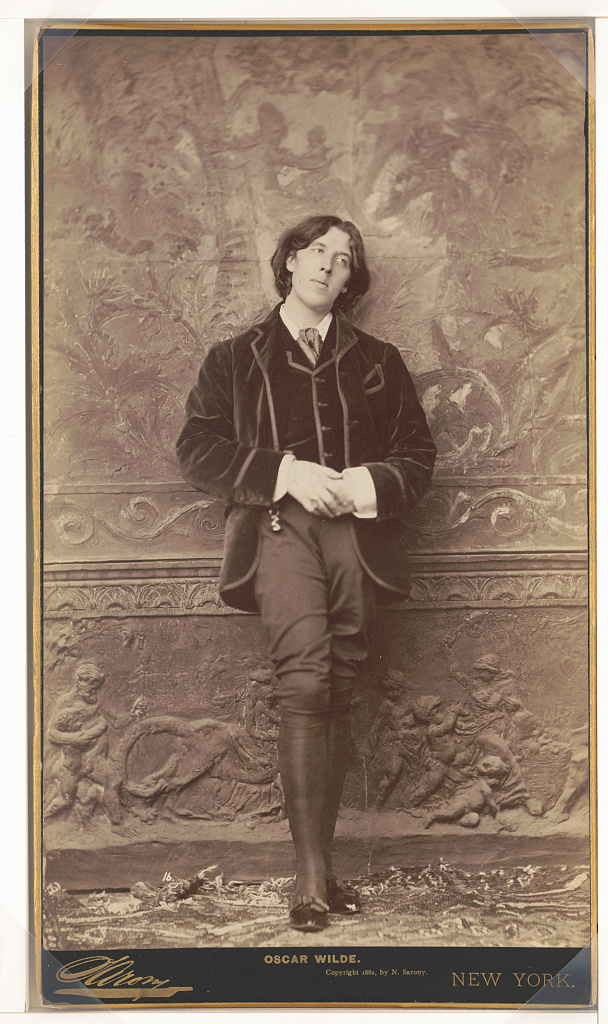
Image context: the lead image uses a real Library of Congress portrait of Oscar Wilde rather than a book cover or later film still. That choice suits the argument because the novel keeps asking what a surface can hold, what a pose can conceal, and when style becomes a form of self-division.[5]
1. The wish does not suspend morality. It relocates it.
The decisive scene arrives before Dorian has done very much at all. He sees Basil Hallward's painting, hears Lord Henry's talk about youth, and wishes that the portrait would grow old in his place.[1] This is more specific than an ordinary Faustian bargain. Dorian does not ask for limitless power, money, or pleasure. He asks for asymmetry. Let beauty remain public, and let damage become representational.
That is why the portrait matters philosophically. It is not a hidden diary of crimes in the simple sense. It is an externalized moral body. Wrinkles, sneers, stains of cruelty, and later something worse than age itself collect there because Dorian needs somewhere to put the history he does not want written on his own face.[1][2] Wilde's great perversity is to make the visible self less truthful than the artwork. Usually painting flatters or idealizes. Here painting becomes the one medium that refuses flattery once the wish has been granted.
The novel's preface is famous for provocation, but the fiction itself is less evasive than readers sometimes assume. "No artist has ethical sympathies," Wilde writes there, yet the novel keeps showing that a human life cannot become ethically blank simply by becoming beautiful.[1] Dorian's face remains lovely because the portrait has accepted the burden of recording consequence. Moral truth has not vanished. It has been displaced.
2. Lord Henry offers a philosophy of surfaces, and Dorian turns it into a way of living
Lord Henry is often treated as if he were the novel's deepest thinker, but Wilde is subtler than that. Henry is the supreme talker, the producer of brilliant half-truths. His most notorious doctrine, "The only way to get rid of a temptation is to yield to it," sounds like liberation because it converts restraint into bad taste.[1] Dorian hears such lines not as performance but as method.
That mistake is crucial. Henry mainly lives through aphorism; Dorian tries to live through application. Under Henry's influence and under the spell of the "yellow book," Dorian begins organizing life as a sequence of cultivated sensations, collecting perfumes, jewels, fabrics, music, and moods as if personality could be built from exquisite surfaces alone.[1][2][3] Wilde makes this seductive on purpose. Dorian's education in decadence is not described as coarse appetite but as refined arrangement, a training in how to turn the self into a gallery.
Yet the arrangement always depends on collateral damage. Sibyl Vane is the clearest case. Dorian loves her while she is pure theatrical medium, a succession of Juliets and Rosalinds and Imogens.[1][2] The moment she acts badly because she has begun to feel sincerely, he turns on her. This is one of the novel's harshest recognitions: a person committed to surface may love style, voice, image, and sensation, yet fail the instant another human being asks to be more than an aesthetic experience. Dorian does not merely choose cruelty. He chooses a world in which other people can be consumed as extensions of taste.
3. The locked room turns self-knowledge into delayed visibility
Once the portrait begins to change, Dorian hides it behind a locked door.[1] The secrecy matters, but it is not the deepest point. Hiding the painting does not erase judgment. It gives judgment architecture. The schoolroom and then the locked upper room become spaces where Dorian can visit the evidence without integrating it into daily life. He creates a system of delayed recognition.
That delay explains why the novel feels more modern than its Gothic machinery first suggests. Dorian does not deny that the portrait is changing. He compartmentalizes the knowledge. Outward life continues: dinners, reputation, beauty, conversational ease. Inward evidence accumulates elsewhere, where it can be consulted privately and then shut away again.[1][2] Wilde understood that self-deception often works like this. People do not always believe their innocence. They simply learn how to keep incompatible records in different rooms.
Basil Hallward's murder makes the structure impossible to sentimentalize. Basil painted the original surface and loved Dorian through it; when he finally sees what the portrait has become, he becomes intolerable to Dorian because he is now looking at the transferred conscience directly.[1] Basil is killed not because he knows a secret in the abstract, but because he stands in the room with the evidence and names it as soul.
4. The novel's morality lies in failed outsourcing
This is why Dorian Gray is not finally a sermon against beauty, nor a simple caution against pleasure. Its moral force comes from a narrower and more devastating idea: the self cannot permanently export its ethical history. Dorian can move the marks of corruption off his face for years, but he cannot escape relation to those marks. The portrait remains his life rendered legible.[1][2]
That is also why the ending works. When Dorian stabs the painting, he is trying to destroy not art in general, nor even evidence in the legal sense, but the division that has allowed him to keep calling one surface "me" and the other "not me."[1] The act is both confession and refusal. He wants the split to end, but only by killing the witness. Wilde gives him no such exit. Once conscience has been made visible, destroying the image means destroying the life that required the image.
The novel still feels alive because modern people remain tempted by versions of Dorian's experiment. Curated identity, managed appearance, private damage sent elsewhere, public beauty protected at all costs: the materials have changed, but the fantasy has not.[2][3][4] Wilde's answer remains severe. Surface can borrow time. It cannot abolish consequence. The portrait is conscience made visible because Dorian spent a lifetime trying to keep conscience from his own skin.
Sources
- Oscar Wilde, The Picture of Dorian Gray. Project Gutenberg ebook 174.
- Encyclopaedia Britannica, "The Picture of Dorian Gray" - publication history, plot, controversy, and legacy.
- Encyclopaedia Britannica, "Aestheticism" - movement overview and the "art for art's sake" context around Wilde.
- Library of Congress, "Oscar Wilde: Topics in Chronicling America" - timeline and historical context for Wilde's fame, controversy, and 1890s reception.
- Library of Congress, "Oscar Wilde" - source page for the lead portrait photograph.