On February 20, 1966, National Educational Television aired the fifth installment of USA: The Novel, an interview with Ralph Ellison built around a deceptively simple promise: here was the author of Invisible Man discussing fiction and then reading from a work still in progress.[1][2] That premise gives the clip a special archival charge now. Most public Ellison footage gets pulled toward the completed legend of Invisible Man, or toward the melancholy fact that the second novel remained unfinished in his lifetime. This recording catches him in a more useful tense. The later book is not yet a symbol of failure. It is still a live compositional problem.
That problem, as Ellison presents it, is larger than plot management or writerly delay.[1] Very early in the interview he says that anyone trying to write fiction about the United States has to get a large enough cut of the country to register its diversity and variety, and he ridicules the fantasy that one could simply import a European novel of manners into American conditions.[1] The archival value of the clip starts there. Ellison is not speaking as though America were a settled background waiting to be described. He is treating plurality itself as a formal difficulty. Before the second novel became an editorial recovery project called Juneteenth, it was already being imagined as a machine big enough to hold competing registers, regions, rhetorics, and identities without simplifying them.[1][4]
That is why the clip still matters inside literary history rather than only television history. Ellison had already published Invisible Man in 1952, won the National Book Award, and by 1964 had gathered his major essays in Shadow and Act.[3][5][6] He was no longer proving he could write a major novel. He was trying to explain what the next American novel would have to survive: too much scale, too many available stereotypes, too much pressure to become a representative voice instead of a fiction maker.[1][3][6]
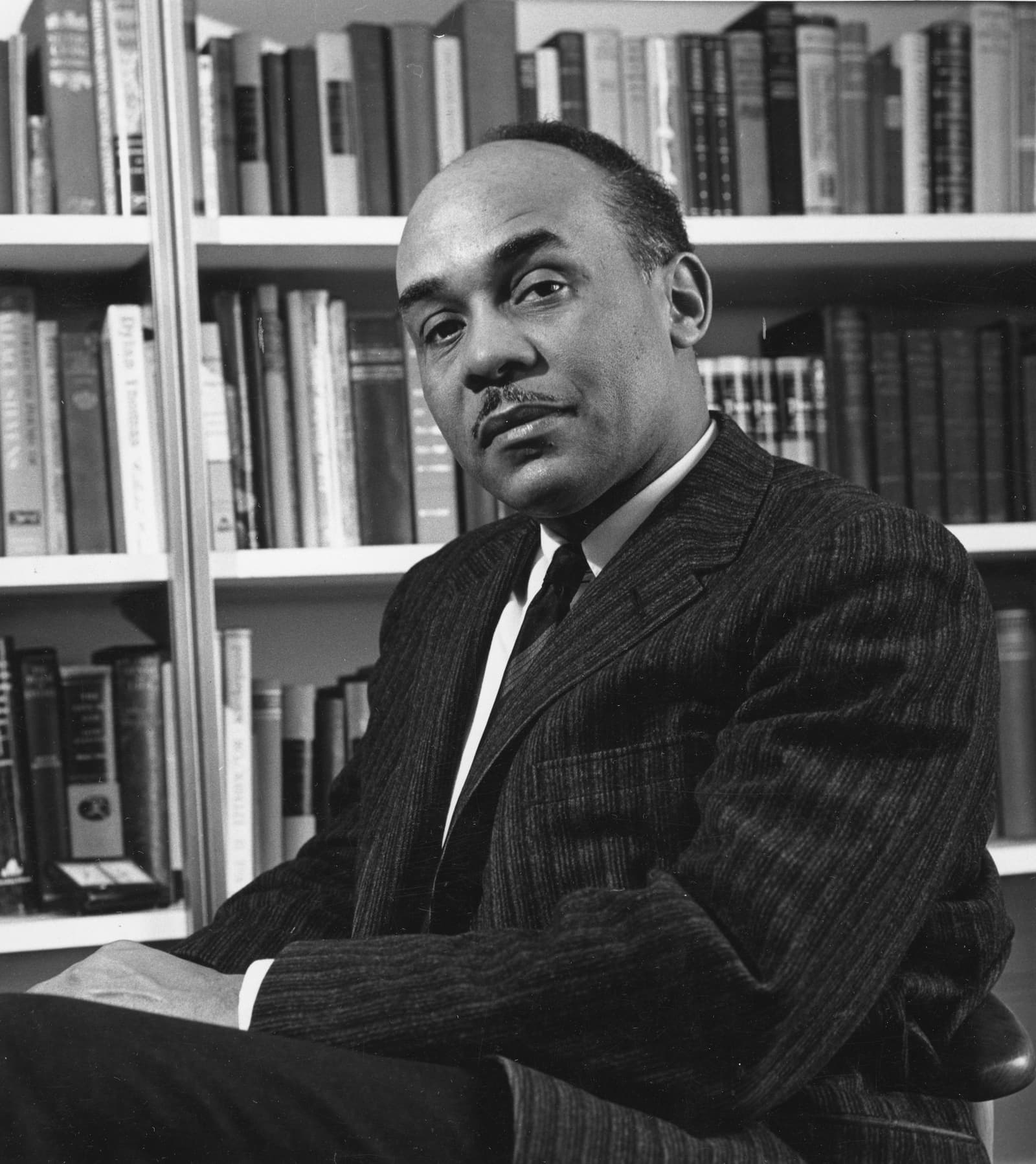
Image context: the cover uses a real 1961 photographic portrait from Wikimedia Commons rather than a jacket collage or a synthetic illustration. That choice keeps the article close to the type of evidence the video supplies. The point here is Ellison as a public literary intelligence in historical time, seated and speaking, with authority carried by cadence and argument rather than iconography.[7]
Historical context: by 1966 Ellison was writing after triumph, essaying after triumph, and still refusing reduction
The standard outline of Ellison's career can make 1966 sound like an awkward afterword to a great first success. The sources suggest something more interesting. The National Book Foundation's profile places Invisible Man at the center, but it also emphasizes Ellison's larger career as novelist, essayist, critic, and teacher.[5] Penguin Random House's pages for Shadow and Act and Juneteenth sharpen the sequence from inside the books themselves: Shadow and Act gathers the essays through which Ellison thought publicly about race, music, language, and American identity, while Juneteenth preserves one later editorial path through the immense second-novel materials he left behind.[3][4] The Oklahoma Historical Society's encyclopedia entry keeps the historical arc plain. Ellison won immense recognition early, published Shadow and Act in 1964, and never completed the second novel during his lifetime.[6]
What the 1966 interview changes is the emotional meaning of that unfinishedness. It refuses the lazy story in which a writer peaks once and then stalls. Ellison keeps returning to questions of continuity, scope, and method.[1] He talks about how Invisible Man emerged, about the responsibilities and distortions of teaching, about the danger of being interpreted only through racial identity, and about the kind of eloquence he wanted to bring into fiction from Black expressive traditions.[1] In other words, the archive preserves a writer who sounds structurally busy, not spiritually exhausted.
The American Archive of Public Broadcasting record is especially important here because it identifies the original program context rather than only the later YouTube circulation.[2] It dates the interview to 1966-02-20, ties it to USA: The Novel, and frames it as a television conversation in which Ellison discusses the function of the writer in society, the making of Invisible Man, and the work in progress from which he reads.[2] That provenance matters. This is not an extracted clip assembled later by admirers. It is a mid-1960s broadcast artifact built while the second novel was still open.
Video provenance
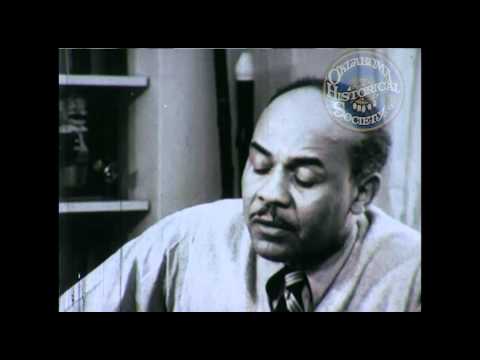
The embedded video is the Oklahoma Historical Society's YouTube upload of USA: The Novel; 5; Ralph Ellison on Work in Progress.[1] Its description identifies the footage as a rare black-and-white interview, credits National Educational Television as creator, and notes that Ellison concludes with a reading from a work in progress and hopes for publication.[1] The American Archive of Public Broadcasting catalog page supplies the fuller archival record: the program was broadcast on February 20, 1966, linked with Thirteen/WNET, and cataloged as part of the public-broadcast historical record.[2] Together those two institutional records give the clip the provenance an archival spotlight needs: original series context, date, producing network lineage, and preservation afterlife.[1][2]
Close reading: what the archive makes newly audible
The opening minutes are the key to the whole recording. Ellison says the challenge is to get a large enough slice of the United States to register its minimum diversity and variety, then mocks the wish for a neat imported "novel of manners" in a country like this.[1] The point is not merely patriotic scale. He is defining form against simplification. American fiction, in his account, cannot behave as though the nation were socially homogeneous, rhetorically uniform, or morally coherent. That helps explain why the unfinished second novel grew so large in retrospect. The archive shows him reaching toward largeness on purpose.
Around the 2:27 mark, he sharpens the claim by saying there is no single United States "out there" waiting to be captured whole.[1] That sentence matters because it strips away a common misunderstanding of Ellison. He is sometimes filed as a writer of symbol and national allegory, as though the nation in his work were a unified stage on which representative conflicts get played out. The interview says otherwise. The nation is fractured, plural, and hard to totalize. If a novel is going to feel truthful, it has to discover structure inside that plurality rather than pretend the plurality has already been solved.
The clip then pivots to a second warning. Around 5:17, Ellison says that when a writer becomes a political spokesman, he speaks out of context.[1] That line can be misheard as withdrawal from politics. In the interview it means something stricter. Ellison is defending the discipline that fiction imposes on public speech. A spokesperson can float on publicity. A novelist has to answer to scene, voice, contradiction, and consequence. The article's larger claim grows from that distinction: Ellison is not arguing that writers should avoid history. He is arguing that fiction handles history badly when the writer starts talking as if literature could be replaced by official representative posture.
His comments on teaching deepen the point instead of interrupting it. Asked whether he enjoys teaching, Ellison says the classroom is one of the few places where he can stay in touch with younger people, especially while teaching literature and advising younger writers.[1] That answer matters because it returns literary seriousness to exchange rather than proclamation. Teaching gives him access to how younger readers formulate questions and misunderstand their problems.[1] In this archive, the public writer is not posed above the next generation. He is listening for pressure points in language and perception.
The last major movement of the interview is the most revealing. Near 23:50, Ellison says that what he brings to fiction from his Black background is not simply "folk material" but a tradition of eloquence rooted in the Black church.[1][3] A little later, around 25:46, he adds that this eloquence is valuable to fiction because it can present something new and fresh to readers who do not share that experience, while also carrying its own rhetorical shape.[1] This is one of the best reasons to keep the clip alive. Ellison is not reducing Black expressive culture to sociological content. He is treating it as a formal inheritance, a resource of cadence, expansion, repetition, manipulation of feeling, and public address that the novel can transform without flattening.
That claim also links the archive back to the unfinished second book. At the close of the interview, Ellison says he tries not to keep to a direct line of continuity because that allows the imagination to be free and to give reality to concepts in unexpected ways.[1] Read after Juneteenth, the line sounds almost prophetic.[4] The second novel's afterlife is full of discontinuity, blocks, fragments, and editorial reconstruction. In 1966, though, discontinuity is not defeat. It is method. The archive lets us hear Ellison giving himself permission to build in great blocks, to keep the line fluid, and to let plurality reshape design from within.[1]
Why this archive still matters
This recording matters now because it rescues Ellison from two equally thinning legends: the single-book genius and the writer defeated by his second novel. The 1966 clip offers a third image. Ellison appears as a novelist who understood that American scale, Black eloquence, public pressure, and fictional structure were all bound up together.[1][2][3] The unfinished book is present here, but not yet as ruin. It is a wager that the American novel has to be large, discontinuous, and rhetorically mixed if it is going to sound like the country without lying about it.
That is why the archival footage still teaches so much. It returns literary ambition to craft decisions: how much plurality a book can bear, how a writer resists spokesperson logic, where teaching and listening enter composition, and why eloquence is not a decorative extra but a structural resource. Ellison's second novel remained open. This interview shows that openness was not only biographical misfortune. It was also one name for the form problem he chose to face.[1][4][6]
Sources
- OHS Film and Video Archives, "USA: The Novel - Ralph Ellison on Work in Progress 1966," YouTube video.
- American Archive of Public Broadcasting, "USA: The Novel; 5; Ralph Ellison on Work in Progress" (catalog record, broadcast date February 20, 1966).
- Ralph Ellison, Shadow and Act. Penguin Random House book page.
- Ralph Ellison, Juneteenth (Revised). Penguin Random House book page.
- National Book Foundation, "Ralph Ellison" author profile.
- Oklahoma Historical Society, "Ellison, Ralph Waldo" in The Encyclopedia of Oklahoma History and Culture.
- Wikimedia Commons, "File:Ralph Ellison photo portrait seated.jpg" (source page for the lead photograph).