Many first-time readers come to Nostromo expecting one of two books. Either they expect an adventure novel with a buried hoard, daring boat work, and a charismatic hero at the center, or they expect a solemn "political masterpiece" whose fictional South American republic should be decoded into thesis before it can be enjoyed.[1][2][4] Both approaches catch something real, but both can make the opening feel harder than it is. The cleaner way in is to read the novel as a machine for turning visibility into misreading. Conrad keeps showing you weather, harbours, uniforms, titles, public roles, and local talk long before he lets you see what power is actually doing underneath them.[1][2]
That method is one reason the book still feels startlingly modern. Britannica treats Nostromo as one of Conrad's strongest works, and the recent Cambridge critical edition description goes further by calling it his modernist masterpiece and a durable portrait of politics under global economic pressure.[2][4] You do not need to carry those verdicts like homework. They matter because they point toward the book's real scale. Nostromo is not only about one stolen cargo of silver. It is about how wealth, prestige, journalism, foreign capital, and revolutionary rhetoric keep manufacturing public truth while quietly deforming private judgment.[1][2][4]
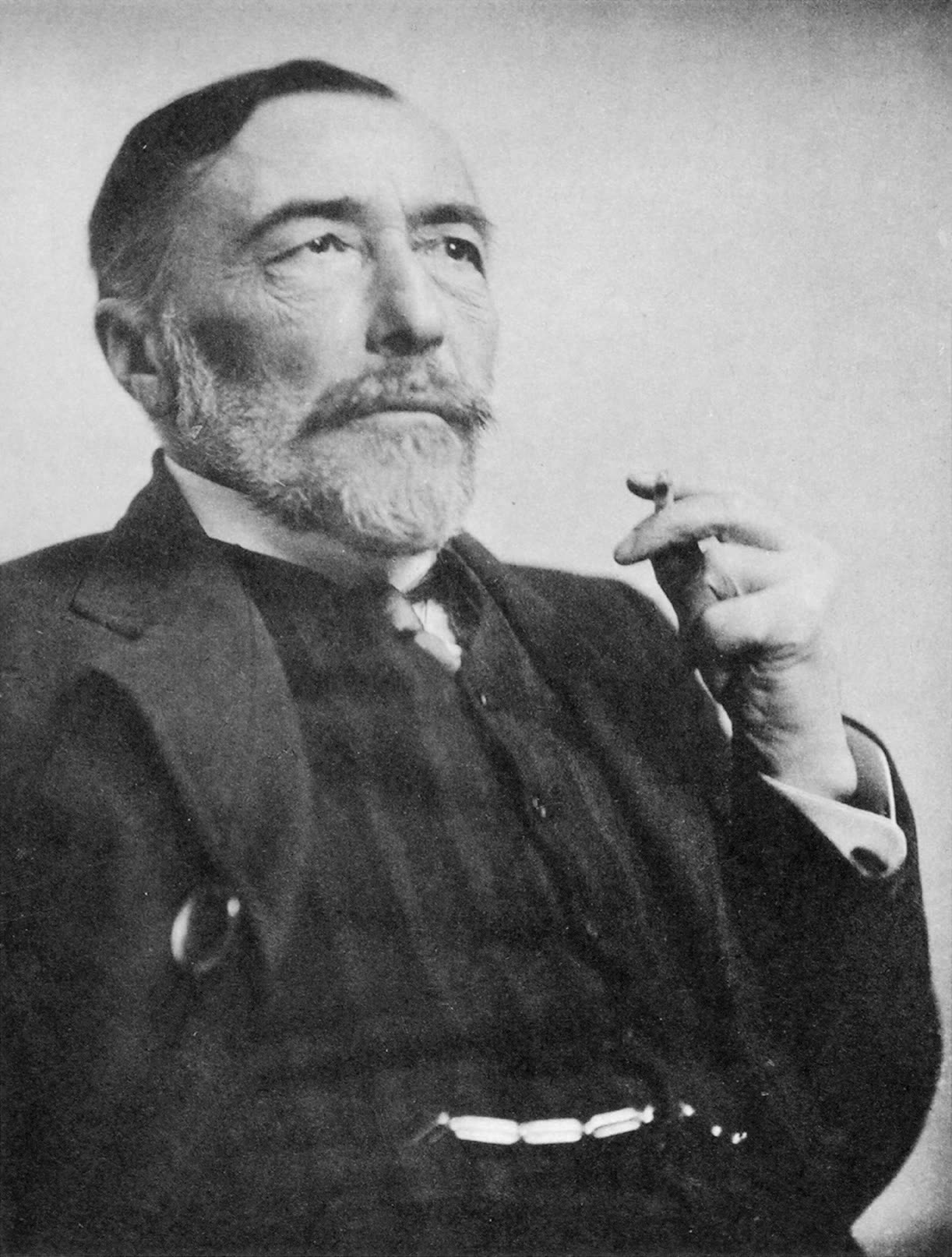
Image context: the cover uses a real Conrad photograph rather than a map or invented revolutionary tableau.[5] That choice keeps the guide near authorial method. This novel works by making readers judge through surfaces first and revise later, so a face from 1916 is a better threshold than an explanatory graphic.
1) Start with Sulaco as atmosphere before you force it into allegory
The opening pages go better if you let Conrad teach you how Costaguana feels before you ask what it "stands for." The gulf, the cloud bank, the mountains, the black poncho of night, the harbour opening cut "as abrupt as if chopped with an axe": all this arrives before stable plot possession does.[1] That is not ornamental delay. It is the novel's first argument. Sulaco is a place where distance, haze, and sudden enclosure shape what can be known at all.[1][2]
Readers sometimes stall here because they think the description is a gate to get through before the "real story" begins. The real story has already begun. Conrad is building a republic out of weather and approach routes. Steamships, isolated harbours, the mountain barrier, and the calm gulf matter because politics in this book always has a logistical body.[1][2] By the time the San Tome mine dominates the action, you have already been taught that this world runs on channels, bottlenecks, and difficult visibility rather than on abstract ideology alone.[1]
So the first practical rule is simple: read the geography as pressure, not scenery. Mark every place where the novel cares about access, concealment, and delayed arrival. That habit will make the later revolutions, telegrams, and silver movements feel continuous instead of suddenly overcomplicated.
2) Treat the silver as a force that reorganizes everyone around it
It helps to stop thinking of the San Tome silver as a MacGuffin. Conrad tells you repeatedly that the mine is not just an object people want. It is an institution, a gravity field, and eventually a moral solvent.[1] One of the Penguin edition's best short descriptions of the novel says that everyone associated with the mine becomes somehow tainted by it.[3] That is exactly the right scale of attention for a first reading.
The treasure plot is exciting, but the book is richer when you watch what silver does before it is stolen and after it disappears.[1] It changes newspapers, local prestige, foreign interest, military calculation, and the emotional weather of marriage. It gives Charles Gould purpose, but it also narrows his imagination until the mine begins to stand between him and his wife.[1][2] It gives the province a rallying point and a developmental dream, but it also makes every political actor start thinking in terms of leverage, seizure, and protection.[1][4]
That is why the phrase "material interests" matters so much.[1] Conrad does not use it as a neutral economic category. In Nostromo, material interests promise order while spreading a colder kind of domination. If you track every moment when a person speaks as if silver will stabilize the republic, you begin to see the novel's bleak joke: the thing that looks most solid is also the thing that makes public life more vulnerable to capture.[1][2]
3) Read Nostromo himself first as a reputation, only later as a man
The title can mislead you if you rush to psychologize the hero. At first, Nostromo exists less as an inward consciousness than as a circulating legend: Capataz de Cargadores, indispensable seaman, man of daring, "incorruptible" favourite of Sulaco, worker who can always be sent where nerve is needed.[1] The point is not that the legend is false in a simple way. The point is that the legend comes first and begins doing political work before the man underneath it has been fully tested.[1][2]
That is one of the novel's great pleasures. Conrad understands charisma as a public technology. People need Nostromo to mean reliability, action, and popular legitimacy.[1] His glamour crosses class lines because he looks usable to everyone: dockworkers, Europeans, journalists, merchants, and the Gould circle all read into him a version of the republic they would like to trust.[1][2] If you read him too quickly as either pure hero or secret opportunist, you flatten the long tragic process by which a public role hardens into temptation.
For a first reading, stay with the asymmetry. Notice how long you hear about Nostromo before you can finally weigh his interior conflict against the legend attached to his name.[1] The book is teaching you that celebrity, honour, and usefulness can become traps no less binding than greed.
4) Do not mistake Charles Gould's seriousness for moral steadiness
Many readers instinctively reach for Gould as the corrective to volatility. He seems disciplined where the republic is theatrical, efficient where politics is noisy, modern where local power is archaic.[1][2] Conrad wants you to feel that appeal. But he also keeps showing that Gould's language of order is inseparable from obsession. The mine gives him a civic mission, yet it also shrinks his field of feeling until everything starts answering to the needs of the concession.[1]
This is where the book becomes more unsettling than a simple anti-revolutionary fable. The danger does not come only from caudillos or mobs. It also comes from the respectable conviction that an extraction system backed by foreign credit, reliable shipment, and disciplined administration can stand outside politics while secretly remaking politics in its own image.[1][2][4] Cambridge's description of the novel as a portrait of global economics and politics is useful because it catches this double movement: the mine is at once local infrastructure and international pressure point.[4]
Read Gould, then, not as the healthy opposite of disorder but as the most civilized form of capture in the book. His tragedy is not hypocrisy. It is devotion turned structural. He believes he is defending the conditions for public life, and Conrad keeps asking what kind of public life remains once silver becomes the measure of reality.[1][2]
5) Let gossip and backstory accumulate; they are the narration's real engine
Another reason readers bounce off Nostromo is that they expect a straight line once the action begins. Conrad refuses that gift. He moves by retrospective explanation, local anecdote, shifting vantage, and bursts of panoramic history.[1][2] At first this can feel like side traffic. In fact it is how the book teaches political knowledge. Nobody in Costaguana possesses the whole truth at once. The novel therefore cannot honestly proceed as if one mind did.
This is why Captain Mitchell, Decoud, the Sulaco notables, the Viola household, and all the newspaper-like retellings matter so much.[1] They do not merely decorate the central action. They build the public medium through which events are known, distorted, and put to use. A revolution in Nostromo is never only a battle. It is also a story whose ownership is contested while it is still happening.[1][2]
The practical payoff is that you should not panic when Conrad doubles back. Each return usually changes scale: a private motive becomes public history, or a public episode suddenly acquires intimate cost. If you read for narrative control alone, the book can feel evasive. If you read for how rumours, speeches, and retrospective accounts manufacture legitimacy, the form snaps into focus.
6) A route through the book that works now
If you are opening Nostromo for the first time, keep four questions beside you:
- What is being made visible in this scene, and what is still being hidden by weather, prestige, or delay?
- Is the silver acting here as treasure, as institution, or as argument about the future of the republic?
- Am I reading a person directly, or am I first receiving that person through somebody else's admiration, resentment, or need?
- Which voice in this passage sounds most certain, and what material interest might that certainty be protecting?[1][2][3][4]
Those questions keep the novel from shrinking into either an adventure yarn or a political lecture. Conrad gives you both pleasures at once: sea-risk, secrecy, loaded boats, conspiracies, and reversals on one side; on the other, a relentlessly modern study of how money and reputation reorganize public life.[1][2][4] Once you accept that double register, the novel stops feeling overgrown. It starts reading like what it is: a book about the way whole societies learn to worship what they claim merely to use.
Sources
- Joseph Conrad, Nostromo: A Tale of the Seaboard (Project Gutenberg HTML edition, full text).
- Encyclopaedia Britannica, "Nostromo".
- Penguin, Nostromo by Joseph Conrad (edition page and synopsis).
- Cambridge University Press, Nostromo: A Tale of the Seaboard (critical edition description).
- Wikimedia Commons, "File:Joseph Conrad 1916.jpg" (lead image source page).