Captain Wentworth's letter in Chapter XXIII of Persuasion is one of the most quoted passages in English fiction, and for obvious reasons. "I can listen no longer in silence. I must speak to you by such means as are within my reach." A few lines later come the words most readers remember: "You pierce my soul. I am half agony, half hope."[1] Yet the force of the note does not lie in quotability alone. Austen makes the letter feel earned because it arrives at the exact point where overhearing turns into authorship. Wentworth writes only after Anne Elliot has finally spoken in a way the novel cannot withdraw.[1][2]
That placement matters all the more because Persuasion was Austen's last completed novel, published posthumously in 1817, and its ending is one she notably revised.[2][3] JASNA's work page and Susan Allen Ford's essay on the revised ending both stress that Austen rewrote her original conclusion after finding it insufficiently strong.[3][4] The result is not a tidier version of the same event. It is a different artistic solution. Instead of stumbling Anne and Wentworth into reunion by contrivance, Austen builds a room in which listening becomes action, a woman's spoken argument becomes the turning point, and a letter briefly restores the old epistolary intimacy the novel has otherwise refused.[1][4][5]
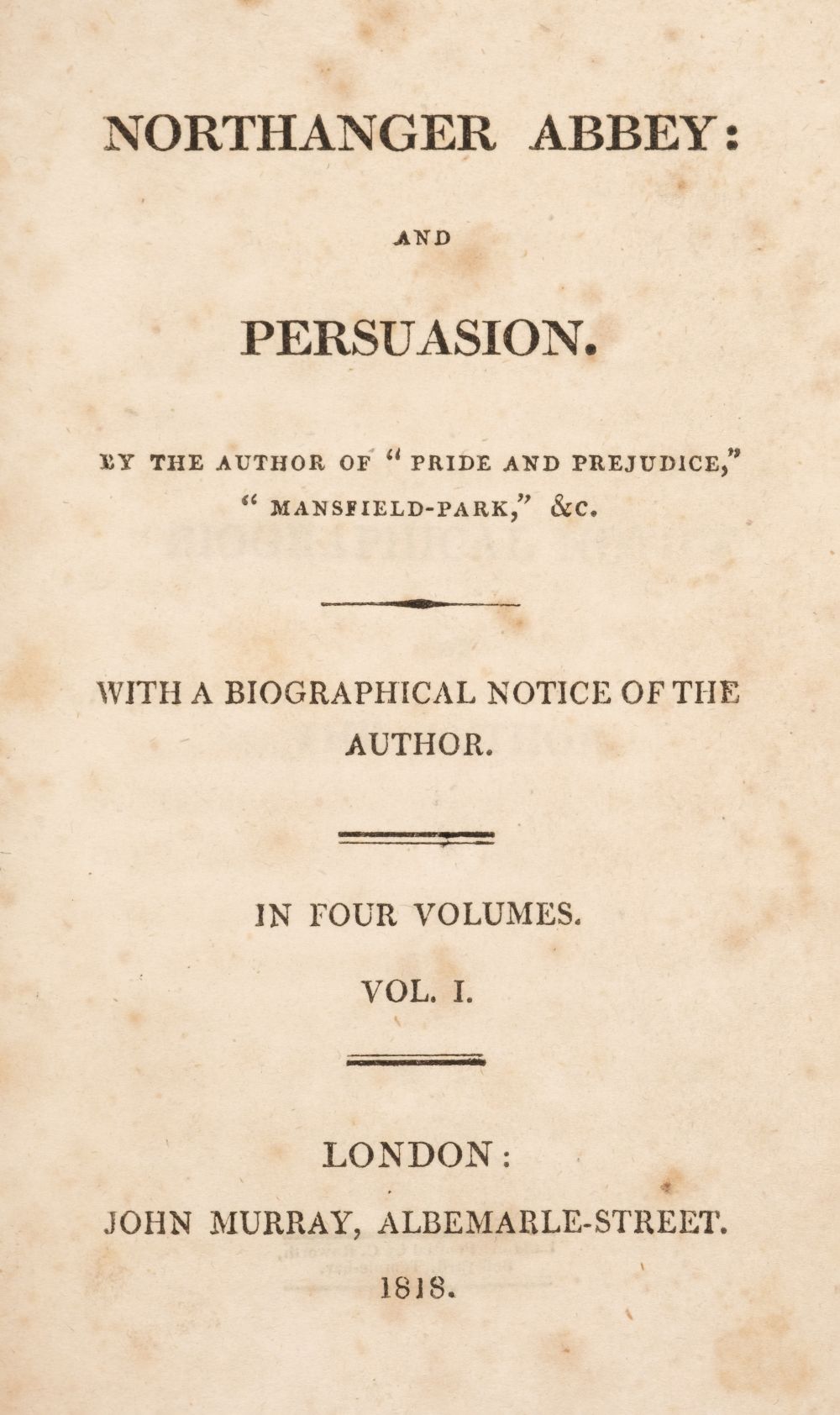
Image context: the cover uses the 1818 first-edition title page rather than a later film still or generic Regency illustration. That choice keeps the essay close to publication history. The passage at issue is inseparable from Austen's act of revision: the scene survives because she decided the novel needed a better printed ending than the one she first drafted.[3][6]
1) The letter begins before Wentworth writes a word
The White Hart inn scene is often remembered as if the letter drops out of nowhere, a miracle of compressed desire.[1] Austen actually prepares it with almost mathematical care. Anne enters a crowded room already charged by delay, weather, and unsettled social business. Then she is drawn into Captain Harville's debate about whether men or women love longest.[1] Harville appeals to precedent and reading: "All histories are against you, all stories, prose and verse."[1] Anne answers with one of Austen's boldest late sentences: "Men have had every advantage of us in telling their own story. Education has been theirs in so much a higher degree; the pen has been in their hands. I will not allow books to prove anything."[1]
That speech changes the scene's voltage. For most of the novel Anne has been the great listener: the quiet daughter no one consults, the former beloved who must absorb other people's chatter about Captain Wentworth, the woman trained by family life to let stronger personalities occupy the air.[1][2] Susan Allen Ford's account of the revised ending is useful precisely because it notices that Austen lets Anne become the speaker she has been growing into since Lyme.[4] Laura Clerx's JASNA essay pushes the same point from another angle. It treats the scene as a confrontation over reading and authorship, where Anne refuses to let inherited books serve as the final court of judgment on female constancy.[5]
So Wentworth's letter does not merely answer a private feeling. It answers Anne's public emergence into argument. She speaks about love, memory, and who gets to tell the story of endurance. He overhears not just affection, but authority.
2) Wentworth's note is a written act of listening
One of Austen's finest technical choices is that she does not give Wentworth an immediate spoken interruption. She gives him a pen.[1] Anne notices, in one of the scene's sharpest transitional moments, that while she is speaking with Harville, "Captain Wentworth's pen ceased to move"; then he listens, turns, and eventually folds up a letter "in great haste."[1] The physical business matters. The note is not an ornamental substitute for speech. It is the form speech must take in a room where open declaration would still be socially clumsy, theatrically public, and possibly unbelievable.
That is why the opening line is so exact. "I can listen no longer in silence" makes listening the cause of writing.[1] Wentworth does not write despite Anne's speech; he writes because of it. The letter registers that he has heard her say what the novel has been testing for chapters: that constancy is not passivity, that memory can remain active without becoming self-dramatizing, and that a woman's interior truth need not wait for male narration to validate it.[1][5]
This is also why the note feels more adult than the letters and misunderstandings in Austen's earlier fiction. It does not establish a new flirtation. It confirms an already shared history under revised terms. Wentworth's phrase "with a heart even more your own than when you almost broke it" compresses eight years of resentment, pride, endurance, and surviving attachment into one sentence.[1] The old injury remains inside the new offer. Nothing in the letter pretends they are beginning from innocence.
The passage's famous intensity therefore comes from economy under pressure. Austen gives Wentworth only the means "within [his] reach," and those means are enough because Anne has already made the governing claim aloud. The letter reads like a sudden blaze, but structurally it is a reply note written in the margin of Anne's argument.
3) Revision is what turns the scene from convenient to inevitable
Knowing that Austen revised the ending helps explain why the printed chapter feels so clean. JASNA's publication history notes that Austen completed a first draft in July 1816, then wrote two new chapters for the final version completed in August.[3] Ford's essay is even more pointed: the cancelled ending is weaker because it depends on awkward management and because it pushes Anne backward into a more passive role.[4] In the printed version, by contrast, the inn scene lets the decisive movement come through Anne's own speech and Wentworth's act of listening.
That difference is not a scholarly footnote. It is the real reason the passage lasts. A lesser ending could have reunited the couple while leaving Anne essentially rewarded for patience alone. Austen's final ending does something harder. It reunites them only after Anne has become publicly articulate about experience, history, and the asymmetry of authorship.[1][4][5] Wentworth's reply is emotionally overwhelming because it is also formally just. He does not rescue Anne from silence. He hears her out of it.
Britannica's summary of the novel calls Anne a woman of quiet strength who receives a second chance at love.[2] That is true, but the letter scene shows what that strength consists of. It is not prettified suffering. It is the ability to speak without self-display, to argue without theatricality, and to hold feeling steady long enough that another person must either answer or admit he has failed to hear.
4) Why this passage still feels modern
The letter scene still lands because it knows that love is partly a question of timing and partly a question of who gets to make meaning out of the past. Harville reaches for "histories" and "stories"; Anne refuses their monopoly; Wentworth, overhearing, takes up the pen and writes a counter-history in miniature.[1][5] The note is private, but the argument behind it is not. Austen stages a romance that turns on literary authority, gendered narration, and the risk of speaking before one knows whether speech can still alter anything.
That is why "half agony, half hope" remains more than an elegant line.[1] The agony belongs to all the lost years and misread pride. The hope belongs to the fact that Anne has at last become audible in her own right. Austen revised the novel until this relation between speech and answer came clear. The result is a passage that feels at once thrillingly immediate and retrospectively exact: a love letter written at the moment when listening becomes belief.
Sources
- Jane Austen, Persuasion (Project Gutenberg HTML text; Chapter XXIII letter scene and surrounding dialogue).
- Encyclopaedia Britannica, "Persuasion" (publication context, plot outline, and Anne Elliot overview).
- Jane Austen Society of North America, "Persuasion" (publishing history, first draft and revised ending timeline).
- Susan Allen Ford, "Persuasion: Why the Revised Ending Works So Well," Persuasions Online (JASNA).
- Laura E. Clerx, "Worlds of Literature: The Status of Reading in Persuasion" (JASNA essay contest entry on reading, authorship, and Wentworth's letter).
- Wikimedia Commons, "File:NorthangerPersuasionTitlePage.jpg" (source page for the 1818 first-edition title page image used as the article image).