Content note: This essay discusses slavery, racial caricature, and blackface performance.
Harriet Beecher Stowe does not let Uncle Tom's Cabin finish when its plot does. The families have been separated or reunited, Tom has died, and George Shelby has freed the people enslaved on his Kentucky estate. Then the novel begins again in another key. Its final chapter drops the shelter of character and addresses the reader directly: Stowe asks the “men and women of America” whether slavery can be passed over “in silence.”[1]
That voice is intrusive, repetitive, morally coercive—and essential to the book's design. Stowe keeps breaking the story's frame to tell readers how to judge what they have seen. When George Aiken's enormously successful stage version began circulating in the 1850s, it inherited the scenes but not that continuous narrator. A play could retain Stowe's dialogue and incidents; it could not so easily reproduce a voice that stops the action, argues with an imagined audience, and turns sympathy into a demand.[2][3]
The stage filled the vacancy with things an audience could see at once: an Ohio River crowded with moving ice, an auction arranged as a “picture,” songs under suffering, whips lifted at the edge of a tableau, and a final heaven made from light, clouds, and a flying child. That translation gave the novel extraordinary mobility. It also moved interpretive power away from Stowe's narrator and into scenery, performers, managers, and spectators. The afterlife of Uncle Tom's Cabin begins in that transfer: the story became easier to show, easier to revise, and eventually easier to detach from the argument that had first organized it.
The voice that will not stay inside the story
Stowe's chapter titles already announce a narrator who refuses neutrality. Enslaved people become “living property”; a man who escapes is said to have entered “an improper state of mind.” The irony is not whispered. It forces the legal vocabulary of ownership against the human conduct the chapters actually reveal.[1]
The novel also alternates two kinds of action. Eliza's flight with her son makes coercion spectacular: pursuit, river, ice, bodily risk. Tom's resistance is less kinetic but more sustained. On Simon Legree's plantation, he refuses to beat another enslaved person and later refuses to reveal where Cassy and Emmeline have gone. Stowe's evangelical structure presents his death as victory, a choice that has generated justified argument about whether spiritual triumph consoles readers too readily for material defeat. Yet within the plot, Tom is not compliant with Legree's central demand. He withholds his labor as an instrument of violence and his knowledge as an instrument of capture.[1]
The narrator determines how those strands meet. Eliza's leap is not merely an exciting escape, and Tom's death is not merely a martyr scene. Both are evidence in a case the concluding remarks prosecute against law, commerce, church, and reader. Feeling is meant to cross a boundary into conduct.
This does not make the novel innocent. Its antislavery appeal works through racial paternalism, sentimental hierarchies, rendered dialect, and an authorial voice confident that it may interpret Black suffering for a largely white readership.[1] But those limits are part of a specific literary mechanism. The narrator exposes herself to judgment because she states the mechanism aloud. Once the story moves to the stage, the same material can acquire force while its argumentative frame grows less audible.
Aiken turns syntax into scenery
Aiken's published six-act script understands that an adaptation needs visual verbs. Eliza does not simply report that she crossed the Ohio. One scene places the river behind a tavern window; the next opens to the “entire depth of stage,” fills it with floating ice, and sends Eliza and Harry slowly across while pursuers occupy one bank and rescuers the other.[2] Stowe's rushing paragraph becomes a machine for depth, motion, suspense, and applause.
Again and again, the script closes a scene on what it calls a “picture.” At the auction, Tom and Emmeline sink to their knees while Legree stands above them. When Tom refuses to whip Emmeline, the action freezes with her pleading, Legree's whip raised, and Tom being dragged away. These tableaux make relations of power legible across a crowded theater. A spectator need not catch every word to see who stands, who kneels, who owns the whip, and who is being sold.[2]
Crucially, Aiken preserves Tom's decisive refusals. Ordered to disclose the women's escape, he answers: “I know, mas'r; but I can't tell anything. I can die!”[2] The line is brief enough to survive the machinery around it. Tom's body can be beaten and displayed, but the plot still turns on information he will not surrender.
Then the adaptation changes registers. After Tom dies, clouds conceal the plantation and open onto “gorgeous clouds, tinted with sunlight.” Eva appears on a white dove while St. Clare and Tom gaze upward.[2] Stowe also frames Tom's death through Christian victory, but her book continues into consequences and accusation. Aiken gives the audience a slow curtain.
That difference is more than an omitted chapter. The novel's ending asks what the reader will do after crying. The stage ending makes crying itself the last communal action. Spectacle has not erased the antislavery story, but it has supplied a place where moral pressure can dissolve into aesthetic completion.
The picture takes to the road
The transformation was not the work of one definitive script. The Harry Ransom Center's finding aid describes many unauthorized adaptations and identifies Aiken's version, written for George C. Howard's company, as the first and most popular. Its archive holds photographs, playbills, acting editions, music, and company records—the paper trail of a novel becoming an industry.[3]
The Library of Congress traces stage performances across roughly sixty-five years and notes that touring companies were still doing business in 1913.[4] Repetition changed the meaning of fidelity. A road show needed recognizable episodes, portable scenery, comic relief, music, animals, and attractions that could be advertised town after town. Eliza on the ice, Little Eva's death, Legree's plantation, and Tom's apotheosis became modules: durable enough to identify the property, flexible enough to be enlarged or rearranged.
This is why adaptation here is not a clean line from novel to play. It is a branching system. The Ransom Center notes that scholars have argued that more people encountered the story onstage than on the page.[3] Even without turning that claim into a precise head count, the implication is large. For many spectators, the adaptation was not a commentary on a familiar novel. It was Uncle Tom's Cabin.
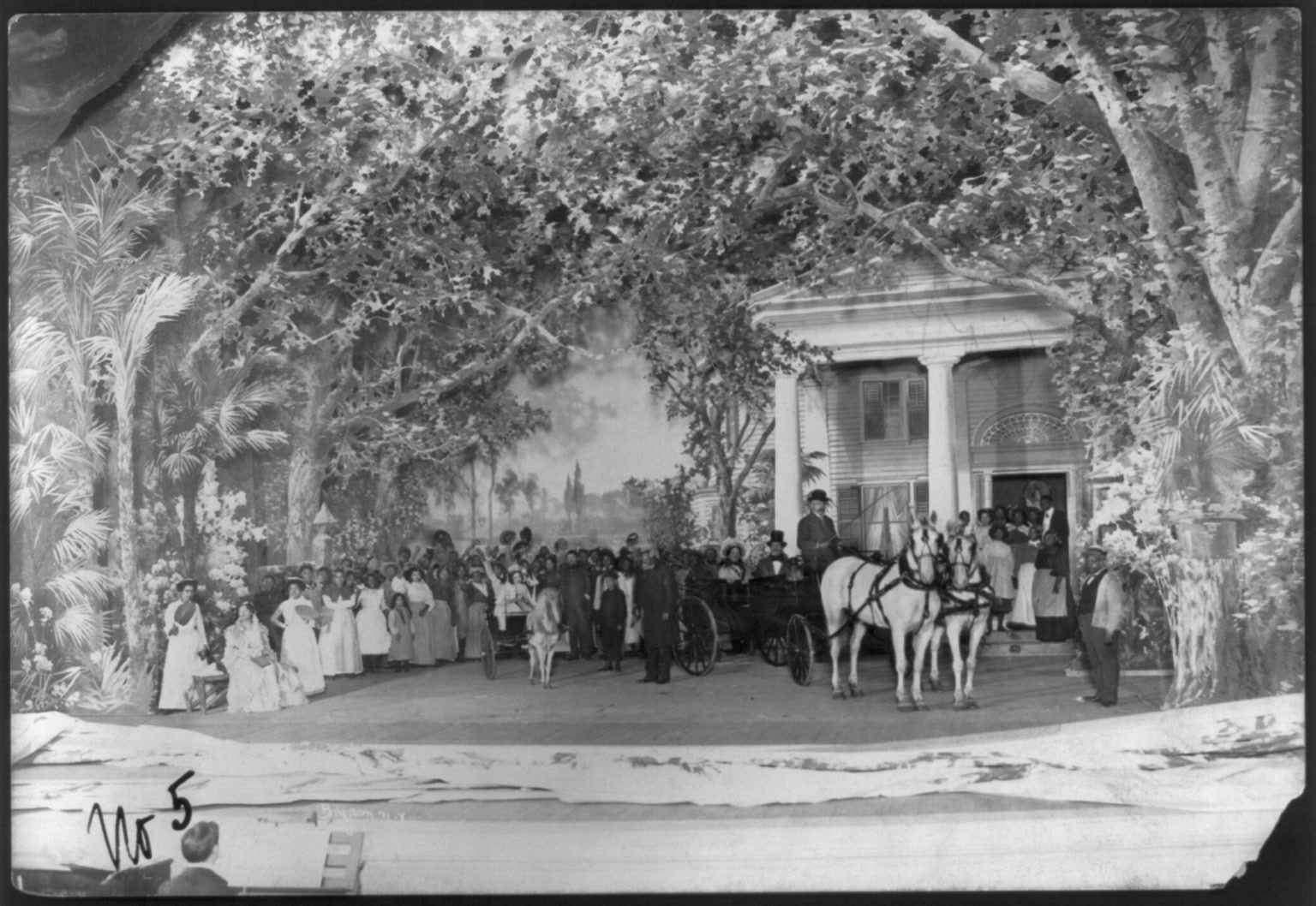
The 1901 photograph used above records that industrial scale. A plantation façade occupies the rear; a pony cart and a carriage widen the playing area; a large ensemble is distributed across the set.[7] The photograph cannot tell us how any scene moved or sounded, and the Library of Congress cautions that the old caption data are unverified. What it does preserve is abundance. This is not a reader confronting a narrator. It is a company manufacturing a whole visible world.
When spectacle becomes permission
Visual power is not politically stable. By the late nineteenth century, many touring versions had absorbed the conventions of minstrelsy: white actors in blackface, degrading dialect comedy, song-and-dance interpolations, and racial caricatures that could work against the novel's abolitionist purpose. The Library of Congress notes both this widespread distortion and a more complicated performance history in which Black actors and singers also entered some productions.[4]
A surviving set of painted wagon panels at the Smithsonian's National Museum of American History makes the commercial system tangible. Built to advertise an early-twentieth-century traveling show, the panels joined racial imagery to the logistics of touring entertainment. The museum's conservation account describes the Tom show tradition not as harmless theatrical folklore but as part of the way white supremacy shaped American popular culture.[5]
The stage did not invent every problem. Aiken's own script contains racist language and comic business that reduce Black characters even while its central action condemns slavery.[2] Stowe's novel had already made Black life available through white-authored sentiment.[1] Adaptation amplified those contradictions because it divided authority among producers who could retain a famous scene while changing its tone, interrupt suffering with a comic routine, or market spectacle after the antislavery emergency of 1852 had become historical memory.
The result was not simply dilution. It was reversal. A story built to make slavery intolerable could be packaged through a performance tradition that made racial domination entertaining. Once the narrator's demand had become optional, recognition no longer guaranteed argument.
Tom and “Uncle Tom” separate
The sharpest evidence of that reversal is the distance between Stowe's character and the stereotype that inherited his name. The National Museum of African American History and Culture describes the later “Uncle Tom” caricature as innately submissive and hungry for white approval. It contrasts that figure with the novel's physically powerful protagonist, who gives up his chance to escape and dies protecting other enslaved people.[6]
That distinction should not become a rescue operation for Stowe. Tom's characterization remains bound to a white evangelical imagination, and readers may reasonably find that forgiveness and martyrdom place an unbearable burden on the enslaved character. The useful distinction is narrower: passivity does not describe what Tom does at Legree's command. He refuses to strike, refuses to inform, and accepts the cost of both refusals.[1][2]
The stereotype removes precisely that conflict. It keeps the name, age, piety, and posture while discarding the acts that make obedience impossible. In other words, the caricature is itself an adaptation: not a careless misreading but a selective performance that preserves a recognizable shell and replaces the moral engine.
This helps explain why the story's stage history matters to literary reading. The meaning of a character is not secured forever by sentences in a book. Repetition can build a rival text out of poses, jokes, publicity, casting conventions, and images. Eventually the afterlife may become more socially available than the original.
What survives after the curtain
The stage gave Uncle Tom's Cabin something the novel alone could not possess: simultaneous bodies in a shared room. It could make an auction's hierarchy visible, turn an icy river into collective suspense, and let Tom's refusal land before an audience rather than inside a reader's imagination. Those are not trivial gains.
But every gain changes custody. Stowe's narrator tries to govern response by returning, explaining, and finally addressing the nation. The theater redistributes that authority. Scenery can argue, but it cannot police the use of its own argument. A tableau can expose domination in one production and aestheticize it in the next. A touring company can carry a protest story farther than its author ever traveled, then carry a caricature under the same title.
The 1901 photograph therefore deserves more than nostalgia. Its crowded frame shows adaptation as material abundance and interpretive risk. Somewhere behind the stillness lies the lost sequence: actors entering, music beginning, an audience deciding when to laugh, a picture closing, a curtain falling. The novel's final voice asks readers not to let that fall become silence. The stage afterlife shows how difficult—and how necessary—that request was.
Sources
- Harriet Beecher Stowe, Uncle Tom's Cabin (1852), Project Gutenberg edition — primary text, especially chapters VII, XXXVIII, XL, XLIII, and XLV.
- George L. Aiken, Uncle Tom's Cabin; or, Life Among the Lowly: A Domestic Drama in Six Acts (Samuel French acting edition), Internet Archive scan — primary stage text and directions.
- Harry Ransom Center, “Uncle Tom's Cabin: A Preliminary Inventory of the Collection” — Aiken/Howard production history and archival scope.
- Library of Congress, “Today in History — June 5” — publication, touring-stage, casting, and early-film afterlife.
- Stephanie Guidera, “Conserving Pieces of the History of Uncle Tom's Cabin,” National Museum of American History (2021) — traveling-show wagon panels and the racist entertainment context of Tom shows.
- National Museum of African American History and Culture, “Popular and Pervasive Stereotypes of African Americans” — the textual Tom and the later submissive caricature.
- Library of Congress Prints and Photographs Division, “Scene from stage production of Uncle Tom's Cabin, 1901” — catalog record and source image.