Content note: This essay discusses murder, suicide, sexual violence, and forced marriage, and it reveals the novel's ending.
When a novel becomes a classic, its publication history is often compressed into a clean itinerary: written in Arabic, translated into English, admitted to world literature. Tayeb Salih's Season of Migration to the North took no such innocent route. It first appeared in 1966 in the Beirut magazine Hiwār, a journal attached to the Paris-based Congress for Cultural Freedom. By then that organization had been exposed as part of a covert cultural network funded by the CIA. Elizabeth M. Holt's archival study records the unnerving double response in the Arabic press: critics recognized a major novel while lamenting the institution that had carried it.[2]
The contradiction should not be tidied away. A Sudanese novel about the damage left by empire entered print through a magazine implicated in a newer imperial competition. The English translation by Denys Johnson-Davies appeared three years later in Heinemann's African Writers Series, an enormously consequential but still London-centered channel for making African books travel. A later edition made the novel an NYRB Classic. Each stage widened the readership. Each also supplied a new frame.[1][3][4]
None of those frames owns the novel. That is precisely why the route matters. Season of Migration to the North became durable not because it escaped compromised institutions, but because its form keeps exposing what institutions do to stories: select them, translate them, package them, and mistake one passage through the world for the whole map.
A masterpiece arrived with bad company
Holt's account does not reduce Salih to a Cold War instrument. It reconstructs a publishing environment. Hiwār belonged to a constellation of journals through which the Congress for Cultural Freedom tried to influence intellectual life across Africa and Asia after the 1955 Bandung Conference had given new force to Afro-Asian solidarity and nonalignment. The magazine's language of cultural freedom was therefore shadowed by a sponsorship structure its readers had not been allowed to judge openly.[2]
That distinction is essential. Covert funding shaped the conditions of publication; it does not prove that a handler dictated Salih's sentences, that the novel endorses American power, or that admiration for it was manufactured. Treating writers as puppets would repeat the condescension that a decolonizing literary culture was resisting. But ignoring the funding would make “world literature” look like frictionless recognition rather than a contest over magazines, translation budgets, prestige, and routes of circulation.
The novel is unusually equipped to survive this knowledge because it distrusts clean origins. Its unnamed narrator returns from Europe to a village on the Nile and discovers that another traveled man, Mustafa Sa'eed, has already occupied the position he imagined was his alone. Mustafa's life arrives as confession, performance, legal testimony, rumor, and papers locked in a private room. The narrator can collect these forms without securing a final version of the man. Publication history adds one more enclosing frame: before readers debate Mustafa's story, they should notice who built the room in which they first encountered it.
Translation changed the shelf
The English afterlife was personal before it was institutional. Johnson-Davies had known Salih at the BBC Arabic Service in London and had published and translated his early fiction. In his recollection of Salih's start, he describes receiving the unpublished story “A Handful of Dates,” placing it in the Arabic magazine Aswat, and translating it for Encounter—another magazine in the Congress for Cultural Freedom orbit.[2][7] Translation here was not a faceless relay. It grew out of offices, magazines, friendship, editorial judgment, and a bilingual literary scene.
The paper trail became substantial. The University of Reading's Heinemann archive catalogs 91 items in the file for Season of Migration to the North: editorial and production correspondence from 1967–74, letters involving Johnson-Davies, reader reports, blurb drafts, a cover proof, printing orders, and a royalty summary. The book appeared in English in 1969 as part of the African Writers Series.[3][4]
Those details turn the word “translated” into physical work. A title had to be chosen, a manuscript assessed, a cover designed, printers contracted, sales discussed, and a book positioned for readers who might know neither Sudan nor modern Arabic fiction. The African Writers Series gave such books visibility and a shared shelf. It also risked encouraging readers to treat very different works as cultural evidence from a single continent before treating them as formally singular novels.
The current NYRB edition continues the productive reframing. It names Johnson-Davies as translator, carries an introduction by Laila Lalami, and presents the book simultaneously as African literature, international literature, and a pinnacle of modern Arabic writing.[1] These are useful doors. They are not neutral descriptions. “African,” “Arabic,” “postcolonial,” and “world” each gathers a different history around the same 168 pages.
The Othello frame traveled well
One reason the novel moved so powerfully into English-language criticism is that it seems to reverse a familiar colonial journey. Instead of sending a European narrator upriver into a darkened Africa, Salih sends Mustafa north into London. Mustafa weaponizes the Orientalist fantasies of British women, turns seduction into the language of conquest, and casts his murder trial as a grotesque reckoning between empire and its subject.
The comparison with Conrad's Heart of Darkness and Shakespeare's Othello is not imposed from nowhere. Salih places European literature inside Mustafa's self-dramatization, then has him reject the most tempting role on p. 95: “I am no Othello. Othello was a lie.”[4] The line is a warning against critical efficiency. Calling Mustafa a returned Othello or an avenging Kurtz can reveal the European scripts he exploits, but it can also let those scripts take command again.
The “empire writes back” account travels well because it supplies a legible duel: South against North, colonized man against imperial metropolis, Arabic novel against English canon. Yet Mustafa is not the novel's reliable representative of Sudan, and London is not its only theater of domination. His cultivated myth of anti-colonial revenge depends on women becoming symbols, victims, and proof. The narrator is fascinated enough by that myth to keep giving it narrative oxygen.
Waïl Hassan's study of gender and imperialism offers a crucial correction. It treats colonialism, racism, and patriarchy not as separate topics but as structures that produce unstable forms of masculinity together.[5] Read through that lens, Mustafa's violence cannot be redeemed simply because he performs it against the colonizer's world. The novel shows how an injured masculine subject may reproduce the same logic of possession he claims to reverse.
Hosna breaks the north–south map
The sharpest challenge to the traveling-man interpretation remains in the village. After Mustafa disappears, his widow Hosna bint Mahmoud is pressured to marry the much older Wad Rayyes despite her explicit refusal. The narrator understands the danger, has accepted responsibility for Mustafa's sons, and still leaves. The forced marriage ends in killing and suicide.
Hosna's story is sometimes handled as a local tragedy that follows the grand colonial drama. Structurally, it is the test of whether anyone has learned from that drama. Mustafa turned British women into scenery for his legend; the village men turn Hosna into property through which custom, age, and masculine entitlement will be confirmed. The narrator can analyze empire at length but cannot convert Hosna's stated will into protection. His education and mobility do not absolve him. They make his failure harder to excuse.
This is where a reception dossier changes the reading. A syllabus organized around Salih answering Conrad may devote its most alert attention to London, Mustafa, and literary reversal. The novel's center of moral gravity then drifts north even while the criticism celebrates decolonization. Hassan's gender argument restores the continuity: domination does not stop at the border or belong to one civilization.[5]
The ending refuses to let interpretation become shelter. On p. 169, caught in the Nile, the narrator chooses life and cries, “Help! Help!”[4] It is the book's smallest and most social language. He cannot narrate himself onto the bank. Survival requires an answer from other people—the answer Hosna asked for and did not receive.
Canonization is another migration
By the time Salih died in 2009, the novel had been translated into more than thirty languages, generated an immense critical literature, and been declared the most important Arabic novel of the twentieth century by the Arab Literary Academy in Damascus in 2001. It had also been briefly banned in Sudan. Jamal Mahjoub's obituary stresses that this longevity rests on Salih's refusal of simple anti-Western verdicts and on his equal attention to village parochialism and the hardships imposed on women.[6]
The same year brought the NYRB Classics edition. That coincidence makes a neat endpoint—death, commemoration, canonical reissue—but the novel's life resists endpoints. Its Arabic prestige, English classroom career, Sudanese controversy, translator-mediated style, and Cold War publication history are overlapping receptions, not steps toward one final correct audience.[1][2][6]
The useful question is therefore not whether the book's compromised first venue invalidates its status. It is what kind of classic becomes visible when that venue is remembered. Hiwār shows that cultural freedom can be advertised by institutions withholding the truth about their power. Heinemann's archive shows that international recognition is made from reports, covers, print orders, and editorial choices. The Conrad comparison shows how a brilliant interpretive frame can become a narrowing habit. Hosna's fate shows what that habit may leave at the edge.
Read with all those routes visible, Season of Migration to the North becomes more—not less—free. The CIA-backed network does not get to claim its meaning. The English translation does not become the original's destination. The postcolonial canon does not close the case. The novel keeps moving because every structure that carries it also becomes something it can teach us to read.
Sources
- New York Review Books, Season of Migration to the North by Tayeb Salih, translated by Denys Johnson-Davies with an introduction by Laila Lalami—current edition details and positioning.
- Elizabeth M. Holt, “Al-Ṭayyib Ṣāliḥ's Season of Migration to the North, the CIA, and the Cultural Cold War after Bandung,” Research in African Literatures 50, no. 3 (2019), pp. 70–90—archival account of Hiwār, covert cultural funding, and the novel's first reception.
- University of Reading Special Collections, Heinemann Educational Books: African Writers Series, Part 1—catalog entry HEB 01/08 for the novel's 1967–74 editorial, production, sales, cover, printing, and royalty records.
- Google Books record for Tayeb Salih, Season of Migration to the North (Heinemann Educational, 1969)—bibliographic record and searchable text for Johnson-Davies's African Writers Series translation, including the quoted passages on pp. 95 and 169.
- Waïl S. Hassan, “Gender (and) Imperialism: Structures of Masculinity in Tayeb Salih's Season of Migration to the North,” Men and Masculinities 5, no. 3 (2003), pp. 309–24—University of Illinois research record and abstract on colonial, racial, and patriarchal gender structures.
- Jamal Mahjoub, “Tayeb Salih,” The Guardian (February 20, 2009)—obituary on the novel's Arabic and international reception, translation history, brief Sudanese ban, and critical longevity.
- Denys Johnson-Davies, “How Tayeb Salih Got His Start,” ArabLit (July 14, 2014)—the translator's account of meeting Salih at the BBC, publishing his early Arabic fiction, and translating it for an English-language magazine.
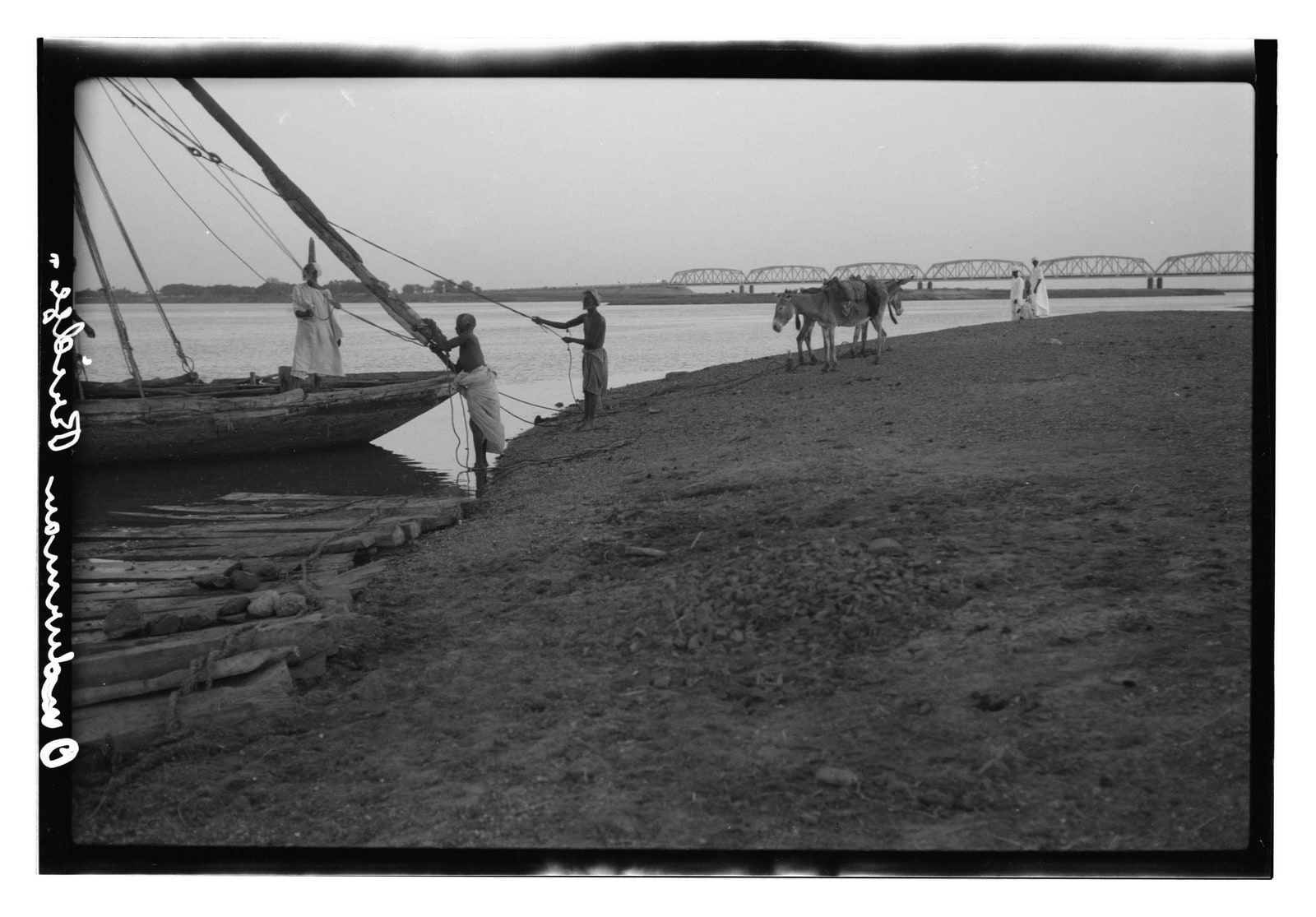
- Library of Congress Prints and Photographs Division, “[Men with boat on shores of the Nile River, with Omdurman Bridge in background, Sudan]” (1936)—Matson Photo Service archival photograph, digitized from the original nitrate negative, with no known restrictions on publication.