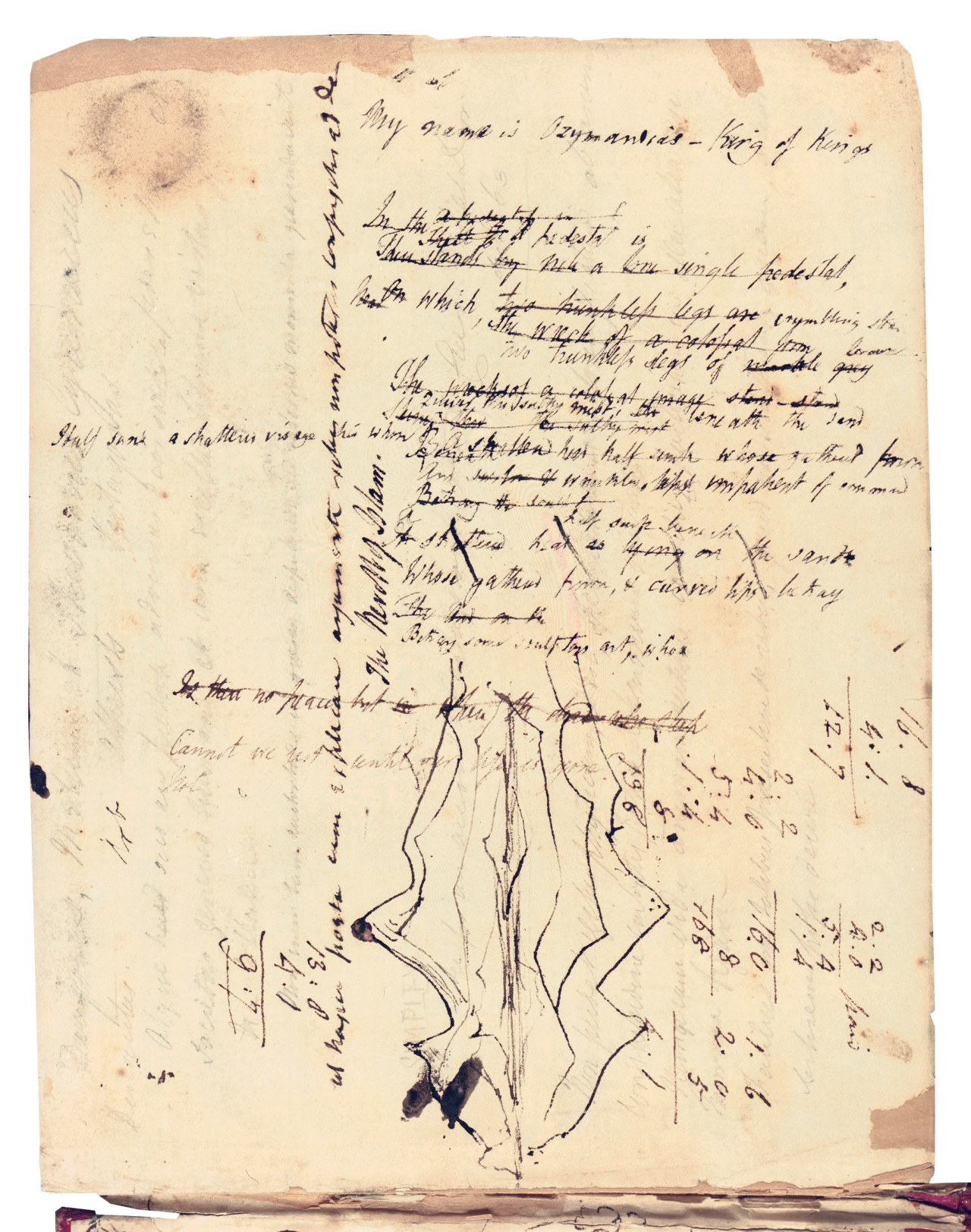
Most readers meet one “Ozymandias.” There were two. During the winter of 1817–18, Percy Bysshe Shelley and his friend Horace Smith wrote sonnets from the same ancient account of a ruined Egyptian monument. Shelley's appeared in The Examiner on January 11, 1818; Smith's followed in the same paper on February 1.[1][4][5] The modern publication record is lopsided: scholarly editions lead with Shelley's poem while supplying Smith's in notes, companion texts, or direct comparisons.[1][3][5]
That hierarchy can hide what the pairing offers. Smith's poem is not merely a blurred rehearsal of Shelley's. Read side by side, the sonnets disagree about how a ruin should move through time. Shelley passes the monument through nested voices until a king's command becomes a quotation stranded inside an empty horizon. Smith lets the stone speak almost at once, then turns abruptly toward a future in which London itself has become an unrecorded wilderness. Shelley makes power small by surrounding it with sand. Smith makes the reader's own city the next object someone will fail to understand.
One sonnet asks what survives a ruler. The other asks who gets to believe that the warning belongs only to the past.
A monument already made of words
The poets' common starting point was not an untouched statue. It was a description in Book I of Diodorus Siculus's Library of History, where the historian inventories the Ramesseum and reports an inscription in which Ozymandias challenges anyone who wants to know his greatness to surpass one of his works.[2] By the time Shelley and Smith encountered the passage, the king was already mediated: Egyptian ruler, Greek name, reported monument, translated inscription. Their poems do not begin with archaeological possession. They begin with language that has outlived the scene it claims to master.[1][2]
Both writers preserve the central joke. A ruler orders posterity to measure itself against his works, while posterity finds only ruins and fragments. The poems have been compared directly in scholarship for decades.[3] Yet treating Smith as a mere foil misses what his plainer method can do. He uses explicitness to redirect the poem's force. His London ending does something Shelley's desert deliberately refuses to do.
Shelley makes the reader assemble a broken authority
Shelley's first line, “I met a traveller,” immediately withdraws the poem from direct sight.[1] The speaker did not see the statue. The traveller did, and the king's own words arrive inside the traveller's account. Authority is therefore nested before it is mocked: poet, speaker, traveller, sculptor, inscription, king. Ozymandias once expected his command to cross time intact, but the poem makes that command depend on a relay of other people.
The body is relayed in pieces too. Legs stand without a trunk. A face lies apart in the sand. The pedestal carries the words. No single fragment contains the king, so the reader has to reconstruct him from stance, expression, and boast. Even then, what comes back is not sovereign presence. It is a “sneer of cold command” as read by a sculptor and then read again by a traveller.[1]
The difficult grammar around the “passions” that survive intensifies the displacement. Representative Poetry Online notes that “survive” reaches forward to the sculptor's hand and the ruler's heart: the expression lasts beyond both maker and subject.[1] Yet survival here is not victory. The artist preserves the king by turning him into an object that can be judged. The familiar doubleness of “mocked”—made a likeness of, but also exposed to ridicule—lets representation serve and undo authority in the same gesture.
Shelley also makes the boast visibly textual. The words “appear” on the pedestal; the stone does not speak by itself.[1] That distinction matters because writing can remain while its intended force reverses. “Look on my Works” survives, but the works do not. The command reaches the reader with perfect grammatical confidence and catastrophic practical failure.
Then three quiet words break the spell: “Nothing beside remains.”[1] Shelley does not replace the missing city with a modern example or a stated moral. He pulls the view backward. “Boundless and bare,” then “lone and level,” the final landscape expands while the ruler shrinks. The paired alliterations slow the close into an acoustic horizon. Ozymandias keeps his name, his title, and even his imperative; what he loses is the world that could make any of them effective.
Smith lets the stone speak—and the present disappear
Smith begins not with a traveller but with a scene: “Egypt's sandy silence,” one gigantic leg, one enormous shadow.[1][5] His fragment has no face. There is no sculptor whose reading competes with the king's self-image. Instead, the object speaks: “‘I am great Ozymandias,’ saith the stone.”[1] Where Shelley turns the boast into an inscription quoted through a witness, Smith briefly grants the monument a theatrical voice.
That voice fails faster. The stone claims a mighty city; the narrator answers, “The City's gone,” and calls its site a “forgotten Babylon.”[1][5] Smith is less interested in recovering a ruler's psychology than in showing how little material is needed to provoke an act of historical imagination. The leg and its inscription supply a name and a claim; observers still have to imagine the city erased around them.
The sonnet's decisive move comes with “We wonder.”[1] The pronoun recruits the reader into the present act of reconstruction, then the poem leaps forward to repeat it. Some future hunter, pursuing a wolf through the wilderness “Where London stood,” encounters “fragments huge” and stops to guess what “powerful but unrecorded race” lived there.[1]
The poem gives the hunter no sign that he knows he is standing where London stood, and Smith describes no surviving inscription that names Britain, Parliament, empire, commerce, or poet. The hunter has matter without a readable archive. Smith therefore imagines a more complete historical defeat than Shelley does. Shelley's king remains embarrassingly legible. Smith's metropolis has lost even the privilege of being correctly named within the scene.
The wolf matters as much as the fragments. It replaces streets, institutions, and crowds with a chase through reverted land. Civilization has not merely fallen; another ecology has occupied its grammar. The future hunter's “wonder” mirrors ours before the Egyptian leg, but the symmetry is hostile. A London reader who comfortably classifies ancient ruin is made into the unknowable ancient.
Two endings, two theories of survival
Shelley's reticence is part of his sonnet's portability. Because he does not name London, Britain, or a contemporary ruler, the blank desert can surround any political boast the reader brings to it. The poem's layers also prevent a single voice from delivering a schoolroom moral. We infer the judgment by measuring the command against the view.
Smith gives up some of that openness and gains a sharper reversal. His future London refuses the safe distance on which the usual ruin meditation depends. Egypt cannot remain an exotic warehouse of lessons for a modern capital. The capital is placed under the same deep-time pressure, and its imagined observer cannot recover the story London tells about itself.
The difference appears most clearly in what each poet allows language to save. In Shelley, the king's name and challenge endure, although time converts triumph into irony. The sculptor's act of reading endures too: expression survives the body that produced it. In Smith, no readable name accompanies the future fragments as described. The hunter can only guess at a powerful, unrecorded race. Shelley shows language escaping intention. Smith imagines intention, language, and identity disappearing together.
That contrast also describes the poems' different theories of transmission. Shelley's sonnet makes its own passage between readers part of the drama. Every recitation becomes another traveller carrying the boast, and every printed copy reenacts the survival of words whose meaning time can change. The Bodleian's rough draft makes that paradox tactile: the page is worn, crowded, and revised, but the king's name remains plainly visible near its top.[6] Smith's poem, by contrast, performs the obliteration it predicts. Its best image is an archive that is no longer there.
The comparison does not need to dethrone one poem in order to rescue the other. Smith makes Shelley's familiar ending strange again. Beside Smith's future hunter, Shelley's traveller looks less like a neutral guide and more like the fragile human link that keeps a ruin interpretable. Beside Shelley's inscribed pedestal, Smith's unnamed future fragments look more terrifying because no voice can stabilize them.
Shelley asks us to hear a boast that the landscape has defeated. Smith asks us to notice that we are already speaking from inside the next ruin.
Sources
- University of Toronto Libraries, Representative Poetry Online, “Ozymandias” — edited Shelley text, Horace Smith's companion sonnet, publication notes, manuscript variants, and line commentary.
- Diodorus Siculus, Library of History, Book I, chapter 47, translated by C. H. Oldfather — ancient description of the Ramesseum and Ozymandias inscription that supplied the poets' shared premise.
- M. K. Bequette, “Shelley and Smith: Two Sonnets on Ozymandias,” Keats-Shelley Journal 26 (1977), pp. 29–31 — an early focused comparison of the paired poems.
- University of Virginia, Literature in Context, “Ozymandias” — transcription from Shelley's first printing in The Examiner, with editorial and page-image context.
- Romantic Circles, “Horace Smith, ‘On a Stupendous Leg of Granite’” — edited companion text with composition and publication context.
- Bodleian Libraries, “Ozymandias 200” — collection note and archival image of Shelley's manuscript draft, MS. Shelley e. 4.