If you ask what a pirate looks and sounds like in modern mass culture, a surprising amount of the answer still routes back through Treasure Island. The buried map, the mutinous ship, the black spot, the one-legged sea-cook, the shoulder parrot, and the cry of "Pieces of eight!" feel older than any one book because Stevenson's novel made them feel modular.[1][2][3] Later films, stage versions, comics, television series, and games did not have to preserve the whole structure of the novel to remain legible. They only had to pick up enough of that kit.
That distinction matters. Treasure Island is not merely an influential pirate story. It is a story that turned pirate fiction into an interface: portable props, body cues, and speech fragments that can be detached from Stevenson’s exact plot and still carry instant recognition.[1][3]
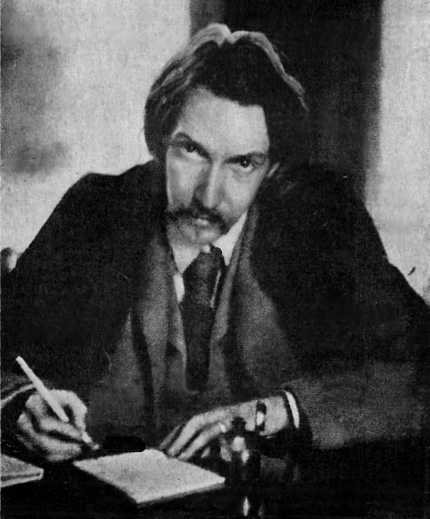
The lead image matters for that reason. A plain 1885 photograph of Robert Louis Stevenson is a useful corrective because the novel's afterlife is so visually loud that the author himself can vanish behind it.[4][5] The picture returns the article to the maker before the peg leg and parrot became near-universal cultural shorthand.
The novel's real genius is not "pirates," but usable signals
The original text does not open with a generic pirate swarm. It opens by planting a few hard signals and making each of them consequential. Billy Bones fears "the seafaring man with one leg"; the black spot operates as a ritualized summons and threat; the packet Jim takes from the sea chest contains Flint's map; and the whole plot starts moving because these objects and rumors are easy to carry, hide, pass, and misunderstand.[1][2]
This is why the book adapted so well. Stevenson did not build pirate atmosphere out of vague salt spray and shouting. He built it out of highly legible narrative devices. A map is both picture and promise. A black spot is both prop and verdict. A one-legged man is both backstory and silhouette. The novel gives each item dramatic function before later culture turns it into decoration.[1]
The Stevenson site's summary page is useful here because it shows how compactly the plot can still be retold without losing the line of force: Bones fears the man with one leg, Flint's map passes into Jim's hands, Long John Silver enters as the hired cook, and the parrot keeps the dead captain's presence alive in sound.[2] That is already the afterlife machine in miniature.
Long John Silver is the book's most adaptable invention
The strongest single component in that machine is Long John Silver. In the novel, Silver is not frightening because he is visually monstrous in a crude way. He is frightening because he is socially gifted. Jim first encounters a figure who appears warm, efficient, and theatrically hospitable. In one of the novel's most durable passages, Silver welcomes Jim into the galley and the parrot rattles off "Pieces of eight!" while the cook's space stays "as clean as a new pin."[1] The character arrives as managerial competence plus performance charm.
That combination explains why Silver outlived the rest of the plot so easily. A treasure map is memorable, but a great actor can do more with Silver than with almost any other figure in Victorian adventure fiction. He talks, jokes, recruits, excuses himself, pivots, and flatters. He is a role built for adaptation because he lets performers swing between paternal warmth and threat without needing to rewrite the whole story.
The Stevenson biography page on Wikipedia also preserves an old but still useful piece of afterlife context: W. E. Henley, the poet with a wooden leg, is often treated as part of the character’s inspiration.[4] Whether one leans on that connection heavily or not, it helps clarify the point. Silver is not just a plot obstacle. He is a body made memorable by gait, voice, and staging. That makes him easy to cast again and again.
The afterlife keeps the props and trims the narrative uncertainty
What tends to get lost in adaptation is the exact narrative shape that makes the novel more interesting than its iconography. Treasure Island is not simply a parade of pirate emblems. It is also a first-person boy’s account structured around overhearing, misreading, delayed recognition, and unstable adult authority. Jim does not begin with mastery. He begins by catching fragments, then trying to decide which adults are trustworthy enough to interpret them.[1]
That part is harder to preserve when a work moves outward into visual media. A film or stage version can show the map, the crutch, the cutlass, the stockade, and the parrot immediately. It is less natural for it to keep the same degree of narrated uncertainty that the novel gets from Jim’s limited perspective and gradual comprehension. So the afterlife repeatedly keeps the pirate kit and shortens the epistemic fog.
This is one reason the novel became so endlessly recyclable. Wikipedia’s publication and adaptation overview is blunt about the scale: first serialized in Young Folks in 1881-82 under a different title, published in book form in 1883, then adapted over and over across film, television, radio, stage, comics, and games.[3] That history is not just proof of popularity. It is evidence that the book ships with extractable parts.
Why the pirate kit stayed bigger than the novel
The portable parts were also unusually friendly to parody and family entertainment. Once Long John Silver, the map, and the parrot became independent memory units, later culture could use them seriously, nostalgically, or mockingly without losing recognizability. The very features that make the novel exciting for children also make it easy to quote out of context: clear objects, crisp threats, strong vocal tags, and bodies you can identify at a glance.[1][3]
That helps explain a paradox in Stevenson's afterlife. Many people know Treasure Island intimately without having read it. They know the one-legged pirate, the buried treasure, the mutiny, the black spot, the chest, the cry of "Pieces of eight!" The novel succeeds so completely at organizing pirate signs that later culture can consume the signs while skipping the pages that first gave them structure.[1][3]
The book still matters because the signs originally meant something
The best way to read Treasure Island now is not to complain that popular culture reduced it to costume. The stronger move is to notice that Stevenson designed the costume system exceptionally well in the first place. In the novel, every famous piece of pirate equipment still has labor to do. The map directs action. The chest stores contested history. The black spot formalizes collective threat. Silver’s missing leg is inseparable from how he manages space, sympathy, and menace. The parrot is not random garnish; it is an audio device that turns pirate memory into something that can interrupt a room.[1][2]
That is why the book remains more than a museum ancestor of pirate movies. It is a lesson in how literary afterlives get built. A work survives repeated adaptation when its most memorable images are not superficial ornaments but compressed story functions. Stevenson made pirate iconography do narrative work first. The culture has been reusing the result ever since.[1][2][3][4]
Sources
- Robert Louis Stevenson, Treasure Island (Project Gutenberg text).
- Robert Louis Stevenson website, "Treasure Island, 1883."
- Wikipedia, "Treasure Island."
- Wikipedia, "Robert Louis Stevenson."
- Wikimedia Commons, "File: Robert Louis Stevenson, 1885.jpg" (lead image provenance).