
Maya Angelou's December 9, 1971 appearance at the 92nd Street Y survives on YouTube as a forty-minute reading, but the recording is more than a clean archival keepsake.[1] It catches Angelou at a particularly important hinge in her career: I Know Why the Caged Bird Sings had already made her a major public writer, and Just Give Me a Cool Drink of Water 'fore I Diiie had just established that poetry, not memoir alone, was central to how she wanted to sound in public.[2][3] The event matters because Angelou does not present poetry as a refined private art. She presents it as a social instrument: a way a people preserve dignity, turn pain into rhythm, and keep language alive under pressure.[1][2]
That claim arrives almost immediately, and with unusual bluntness. Angelou opens by saying she has been told poetry is supposed to be "mystical, magical, musical and lyrical," then revises the whole category in one stroke: the greatest poetry in the United States, she argues, comes out of the Black experience.[1] The rest of the program is not an abstract lecture explaining that thesis from above. It is a demonstration. She moves from spirituals to Paul Laurence Dunbar, from bus-stop observation to signifying, from satire about Black bourgeois aspiration to a more explicit account of rhythm and poetic vocation.[1]
The result is why this footage is worth revisiting now. Later public memory often reduces Angelou to a few high-profile civic moments: the inaugural poem, the television appearances, the quotable elder authority.[5] The 1971 92Y recording restores a sharper figure. Here she sounds like a working poet building an argument in real time about oral tradition, survival strategy, sound, race, class, sexuality, and moral aspiration. The archival video matters because it preserves that argument as performance rather than slogan.[1][5]
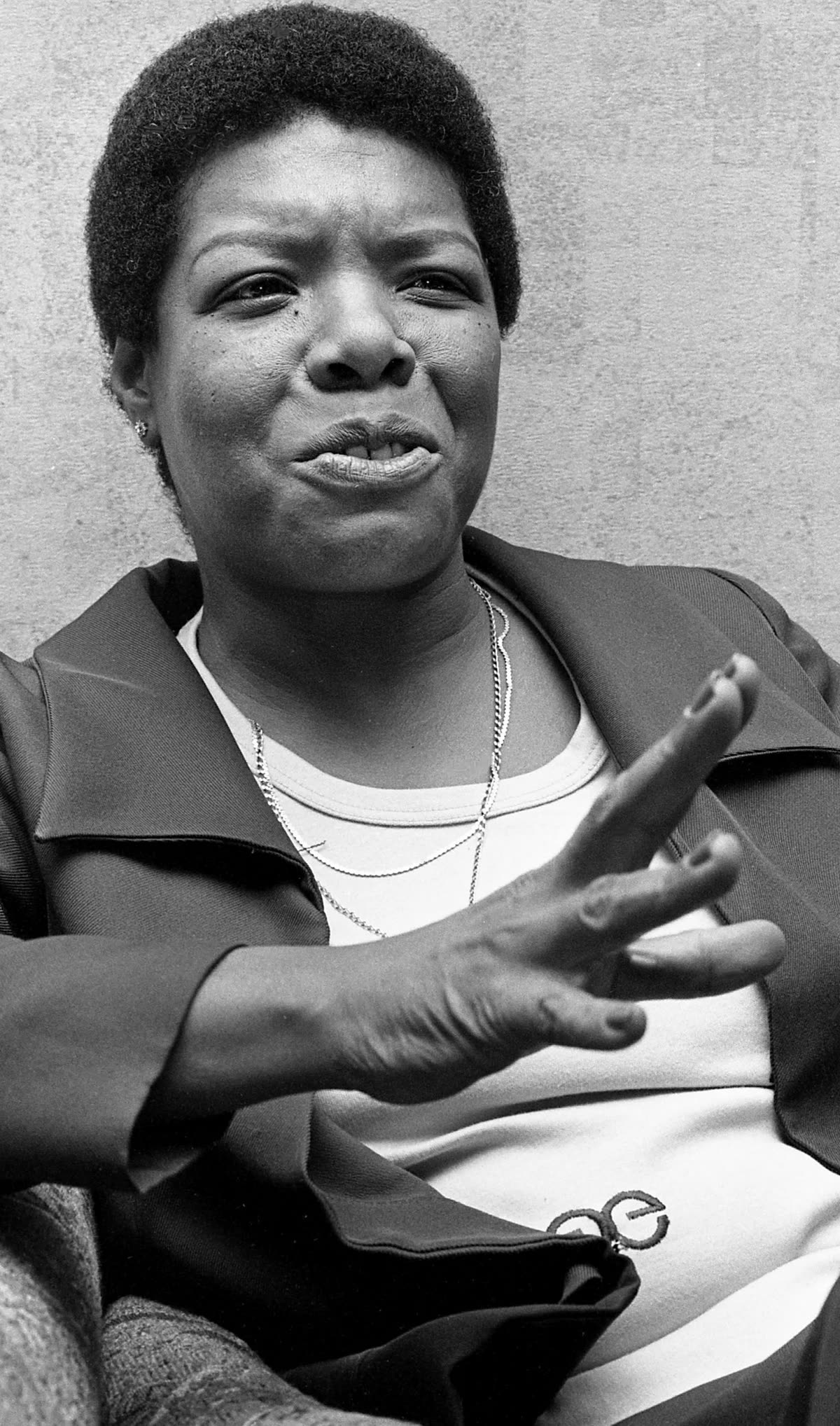
Image context: the cover uses a real 1978 portrait photograph of Angelou from Wikimedia Commons rather than a book jacket or illustration. That choice fits this piece because the video is fundamentally about public bearing: how Angelou uses posture, timing, and voice to make literature feel spoken to a room rather than printed for abstraction.[6]
Historical context: where Angelou stood in 1971
By late 1971 Angelou was not an emerging poet testing a first room. She was already a writer whose public identity had widened fast across memoir, performance, journalism, and activism.[2][5] The Academy of American Poets biography summarizes the span well: Saint Louis childhood, Arkansas upbringing, work across theater and music, civil-rights organizing, and a literary career that refused one narrow lane.[2] What the 92Y recording adds is scale and emphasis. It lets you hear which part of that career Angelou wanted foregrounded when she stood before an audience and chose her own materials.
The timing of the event matters because Just Give Me a Cool Drink of Water 'fore I Diiie had appeared the same year.[3] Penguin Random House's publisher page notes the collection's place in Angelou's bibliography, and the San Francisco State Poetry Center archive shows that she was publicly reading from and commenting on the book during 1971.[3][4] That means the 92Y program is not a random later retrospective. It belongs to the moment when Angelou was actively making the case that poetry could carry the same authority as her prose memoir, while sounding more compressed, more musical, and more immediately communal.
This context also clarifies the pressure of her opening remarks. Angelou is not simply praising Black poetry as one noble strand within an already settled national canon.[1][2] She is re-centering the canon's source code. Spirituals, blues, wit, mask, irony, survival speech: these are not regional supplements in her account. They are the forms that kept people alive long enough to make an American literature worth naming.[1][2][5]
Video provenance
The embed below is the official 92NY Plus upload of Angelou's program. The channel description identifies it as a recording made before a live audience at New York's 92nd Street Y on December 9, 1971, and the video itself opens with a slate confirming that provenance.[1] That combination gives the footage strong archival footing: institutional host, original venue, and date preserved in the upload metadata and in the recording's own introduction.
What the archive shows first: poetry is a survival system, not an ornament
The program's most important move happens in the opening two minutes. Angelou begins with the expected adjectives, then dislodges them.[1] Yes, poetry may be lyrical and musical, but she insists that its American greatness lies in Black experience, and then immediately connects that claim to heroes, spirituals, and the internal life of a people.[1] The point is not decorative ethnic inclusion. It is functional. Poetry matters because it organizes endurance. In her telling, a people live in direct relationship to the heroes they have, whether those heroes are flesh-and-blood figures or figures carried by song and verse.[1]
That is why her example from the spiritual lands so quickly. She quotes the line about green trees bending and "poor stands" trembling, then praises the line for refusing explanatory overkill.[1] A weaker public speaker might have used this opening to paraphrase Black tradition into sociology. Angelou does the opposite. She protects compression. Poetry's power, for her, lies partly in how it refuses to flatten itself into prose explanation. It can imply fear, weather, danger, and bodily experience without converting them into a lecture note. The archive preserves not only the proposition, but the pleasure she takes in that economy.
This is also where the clip begins separating Angelou from the later motivational simplification that often surrounds her reputation.[5] In the footage she is funny, certainly, but she is also formal in a deep sense. She is building a theory of literary value. Black poetry, blues lyrics, and spiritual language are not merely emotionally moving; they are structurally intelligent. They know how to compress social experience into memorable speech, which is one reason they survive public repetition.[1][2]
Around 5:00 and 9:00, strategy becomes form
The middle of the recording proves that Angelou means "survival" literally as well as aesthetically. After citing Paul Laurence Dunbar's "We Wear the Mask," she calls masking a strategy, not a shameful failure of authenticity.[1] That distinction governs the room. Instead of romanticizing pure self-expression, Angelou shows how Black expressive culture learned to work through disguise, tonal double-coding, and social performance. The anecdote about the woman on the Eighth Avenue bus, followed by "When I Think About Myself," pushes the point further.[1] Laughter, deference, and surface brightness are rendered as tactics shaped by labor and racial hierarchy, not simply as personality quirks.
Then she shifts into signifying. This is one of the recording's richest stretches because Angelou does not define the term in academic distance; she performs the social need that produced it.[1] In her account, signifying is an African retention, a way of saying exactly what one means without always stating it in punishable direct form.[1] That matters for literary history because it turns wit into infrastructure. The joke is not a garnish added after meaning. It is the delivery system meaning had to invent.
What text alone cannot fully preserve, the video does. Angelou lets the room feel the turn from explanation into performance. Her pauses stretch just long enough for the audience to hear the approaching punch line; then the poem lands with comic snap and a trace of threat.[1] The archive records how literary intelligence becomes social timing. That is the central reason to treat this footage as more than a reading: it documents the oral mechanics by which poem, anecdote, and vernacular analysis feed one another.
Around 15:00 and 30:20, public satire opens into craft statement
The fashion-show passage is another key moment.[1] Angelou recounts being invited to an event where a moderator kept announcing what "me lady" would wear to the country club, and from that scene she builds "The Sepia Fashion Show," a poem that cuts through performance, aspiration, class mimicry, and anti-Black respectability politics.[1] In print, the poem is already barbed. In the room, its mockery becomes more precise because Angelou modulates it line by line. She does not shout the satire; she lets it sharpen itself. The audience laughter matters, but so does the way she controls it, never allowing the scene to dissolve into stand-up.
Later, at roughly the half-hour mark, Angelou says something even more valuable for literary readers. She explains that in writing poetry she tries first to understand the content and then to find the rhythm, because everything has rhythm.[1] She goes on to say that trying to be a poet is like trying to be a Christian, or trying to grow up: not a completed status, but an ongoing moral effort.[1] This is one of the clearest statements in the archive about her method. Rhythm is not a cosmetic layer placed on top of meaning. Rhythm is the form that lets meaning arrive with bodily force.
That admission reframes the earlier comic and satiric materials. The bus woman, the signifying poem, the shoe-shine boy, the fashion show, the Harlem hopscotch children: these are not random scenelets gathered for applause.[1] They are tests of whether a poem can honor the complexity of ordinary Black speech without tidying it into genteel literary neutrality. Angelou's answer is that poetry must stay close to lived cadence if it wants to remain ethically true.
Why this footage still matters
The closing section of the program broadens from racial survival toward a harder human claim, ending in lines about learning the words of love: mother, father, brother, sister, lover.[1] The crucial thing is that Angelou does not arrive there by abandoning the Black specificity of the evening's opening. She gets there by passing through it. Universal language, in this archive, is not a shortcut around history. It is something earned after history has been spoken in its own rhythms.
That is why the 92Y recording still matters in 2026.[1][2][5] It preserves Angelou before later canonization softened her edges into uplift. Here she insists that poetry emerges from strategy, labor, laughter, insult, rhythm, and witness. She treats Black expressive culture as the engine room of American poetry, then proves the claim through performance rather than through abstract prestige. The clip lasts because it lets us hear literature as public craft: a voice making form carry survival, and making survival audible as form.
Sources
- 92NY Plus, "Maya Angelou: Mystical, Magical, Musical and Lyrical at 92Y in 1971" (official YouTube upload; description and opening slate identify the original event date as December 9, 1971).
- Academy of American Poets, "About Maya Angelou."
- Penguin Random House, Just Give Me a Cool Drink of Water 'fore I Diiie by Maya Angelou (publisher page).
- San Francisco State University Poetry Center Digital Archive, "Maya Angelou reading and commenting from Just Give Me a Cool Drink of Water 'fore I Diiie" (October 14, 1971 recording).
- Library of Congress, National Library Service for the Blind and Print Disabled, "Maya Angelou: Author and Poet."
- Wikimedia Commons, "File:Portrait photograph of Maya Angelou by Jimmy Ellis, April 25, 1978.jpg" (photographic source page).