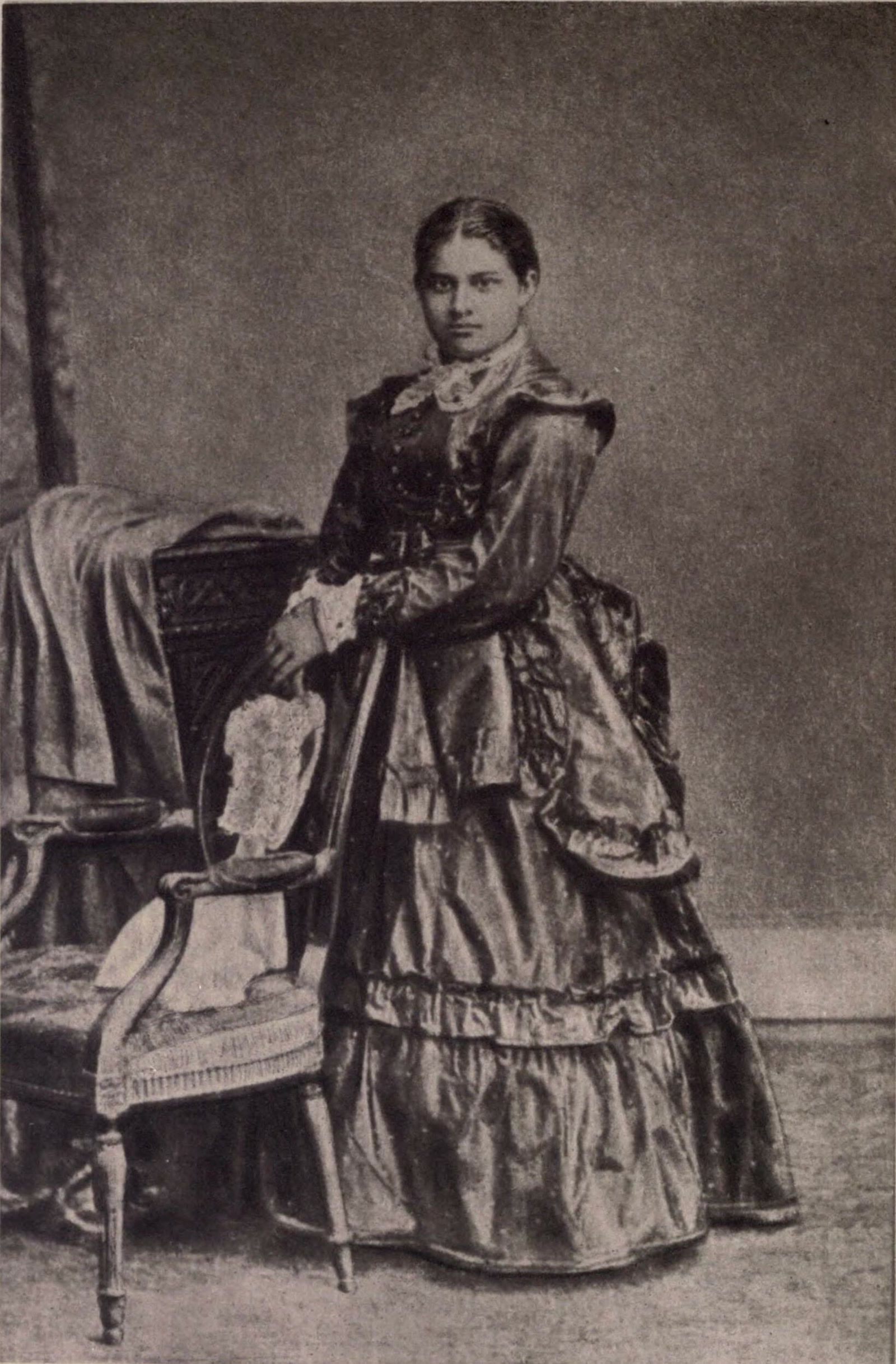
Toru Dutt's life is often introduced as a feat of compression. Born in Calcutta in 1856, she lived in France and England as a teenager, wrote in English and French, studied Sanskrit after returning to Bengal, published one book at twenty, and died of consumption at twenty-one. The facts are astonishing. Arranged too neatly, however, they turn a working poet into a display of precocity: three countries, several languages, one tragically short life.[2]
Her poems ask for a more active profile. Dutt did not merely stand where cultures happened to meet. She chose what crossed between them, altered its pace, and decided where it would arrive. A French sower enters English verse in a book printed in Bengal. Sita moves from a mother's evening song into an English lyric without losing the room in which the story was heard. A casuarina tree in a Calcutta garden takes its place beside Wordsworth's yews—not as a colonial copy, but as another tree poetry has been charged to keep alive.[1][3]
Translation, in this body of work, is not the apprentice stage before “original” poetry begins. It is the craft that joins the career. Dutt made every literary home face another country, then made the idea of home answer for what it could remember.
The first sheaf was already a theory of authorship
Dutt's first book, A Sheaf Gleaned in French Fields, appeared in 1876. Its agricultural title is modest: the poet seems to be gathering what grew in somebody else's ground. Yet the scale gives that modesty an edge. The volume contained 165 translations from French writers—eight by her sister Aru and the rest by Toru—selected and carried into English by two young Bengali women whose European education had included school in Nice and lectures for women at Cambridge.[2]
The book is not interesting only because Dutt knew enough French to make it. An anthology is an argument made through attention. Someone must decide which poets travel, which poems represent them, and how a voice sounds after its meter and syntax have crossed a language. Dutt's “The Sower,” translated from Victor Hugo's “Saison des Semailles: Le Soir,” shows those decisions in miniature.[3]
Hugo's poem watches an old laborer continue sowing as daylight fades. Dutt preserves the five-quatrain movement from twilight toward near-mythic enlargement, but her English repeatedly tightens the scene into strong stresses. “Black and high, his silhouette / Dominates the furrows deep!” places height, darkness, and command at the front of the sentence. The translation is faithful to the figure while sounding out its own English gait. Later, “precious grain” makes the seed's future value immediate; the sower is not simply scattering matter but trusting a harvest he cannot yet see.[3]
There is a temptation to turn that sower into an easy symbol for Dutt herself. The poem does not require it. The more useful point is material: a French lyric about labor and futurity becomes part of a “sheaf” assembled in Bengal. Translation changes who can gather the crop. Dutt's first publication was already asking readers to see literature as circulation rather than national property.
The family dimension matters too. Aru's eight translations keep the collection from fitting the romance of the solitary prodigy. The sisters had studied, read, traveled, and made music together. Aru died in 1874; Toru completed the volume after that loss. Calling the book a sheaf therefore names more than a miscellaneous bundle. It preserves collaboration inside a publication whose title page carries only one sister's name.[2]
Returning to India changed the traffic's direction
The usual career story divides Dutt's work into two phases: first European translation, then a mature return to Indian material. Her posthumous Ancient Ballads and Legends of Hindustan can seem to authorize that sequence. It moves through figures and stories including Savitri, Lakshman, Sita, Dhruva, and Prehlad; its English forms carry narratives associated with Sanskrit texts and with the songs Dutt heard from her mother.[1][2]
But “return” is too clean a word. Dutt did not leave European form behind when she wrote Indian legend in English, nor did Bengal suddenly reappear after an absence. It had been the place from which she selected French poetry in the first book. The direction of travel changes; the translating intelligence remains.
“Sita” makes that continuity visible by refusing to begin inside the epic. Its first scene is “Three happy children in a darkened room!” They are watching nothing material. A mother sings, and her song makes a forest, a hermitage, and Sita's grief appear before the children's open eyes. When the song stops, the landscape dissolves; the poem closes by mourning the family gathering that cannot happen again.[1]
The three children invite an autobiographical recognition of Toru, Aru, and their brother Abju, both siblings dead before Toru. That recognition should remain an inference, not a claim that the poem merely copies an evening from life. Its greater formal achievement lies in keeping the frame around the legend. Dutt does not present Sita as content lifted from one tradition and deposited into another. She shows a story being sung, pictured, shared, and remembered. The mother's voice is part of the text's meaning.[1][2]
That choice complicates the language of possession. Is Sita “Indian material,” a family memory, a religious inheritance, a performance, or an English poem? Dutt's answer is structural: the poem can be all of these because it records the route between them. Translation is not a border checkpoint where a story surrenders one identity to acquire another. It is the darkened room in which several forms of belonging become visible at once.
The casuarina tree reverses the journey
“Our Casuarina Tree” is Dutt's clearest demonstration that cosmopolitan writing need not blur local detail. The poem begins with a creeper wound around a scarred trunk, then opens the garden at dawn: a grey baboon on the crown, its young on lower branches, kokilas calling, sleepy cows moving toward pasture, water lilies bright on the tank below. This is not scenery labeled “India” for a distant audience. It is a working habitat observed closely enough that different species occupy different heights and hours.[1]
Only after establishing that physical world does the poem disclose why the tree matters. It holds the memory of the speaker's lost companions. Its murmur travels beyond the garden, sounding again beside the shores of France and Italy, until distance makes the local tree more rather than less distinct. Europe does not replace Baugmaree; it becomes another listening station from which Baugmaree can be heard.[1]
The final stanza then places the casuarina among the “deathless trees” of poetry, specifically the yews at Borrowdale associated with Wordsworth. In a weaker poem, that reference might ask an English canonical landmark to certify an Indian one. Dutt reverses the authority. Her tree has already earned its scale through animal life, family play, grief, and remembered sound. Wordsworth supplies a literary neighbor, not a passport.
The closing wish, “May Love defend thee from Oblivion's curse,” defines poetry as preservation without pretending preservation is automatic. Trees die; houses change; siblings vanish; manuscripts depend on survivors. Love requires a form if it is to outlast the people who felt it. The poem becomes that form, and its English address expands rather than dilutes the Bengal garden.[1]
This is why the best word in the title may be our. It can name the Dutt children, the family household, a future community of readers, or everyone willing to inherit the tree through the poem. The possessive grows by being shared.
Publication made another family archive
Dutt did not live to arrange most of this afterlife. Ancient Ballads appeared in 1882, five years after her death, through manuscripts preserved and published by her father. Harihar Das's 1921 Life and Letters of Toru Dutt later gathered biography, correspondence, and family material into a substantial documentary record; the volume also reproduced the portrait used with this article.[2][5][6]
Those acts of preservation were indispensable, but they also shaped the author readers received. Early introductions emphasized youth, illness, linguistic wonder, and the judgment of European reviewers. The vocabulary could make Dutt seem like an exceptional visitor admitted into English literature. Even praise risked presenting Europe as the place where literary value became official.
Modern scholarship has redrawn that map. Tricia Lootens argues that Dutt's cultural presence requires connecting Bengal, Britain, and France, and that reading her helps move the geography of Victorian poetry beyond Britain and beyond English alone.[4] That critical widening is valuable because it follows the poems' actual routes. It also prevents “hybridity” from becoming another elegant cage. Dutt was not a smooth mixture of three national essences. She was a writer making particular choices under unequal conditions: which French poets to select, how an English line should move, where a mother's song belongs, and what kind of fame might protect a tree in Bengal.
The archival portrait helps correct the same abstraction. Commons can identify its reproduction in the 1921 biography, but not the original photographer or sitting date.[6] The missing provenance is a useful caution: an image may preserve a face while losing the circumstances around it. Dutt's poems do the opposite. Again and again, they keep the circumstances—the garden, the listening children, the sister's contribution, the route between languages—attached to the voice.
Give the profile back its verbs
Toru Dutt's biography will always contain startling nouns: Bengal, France, England, English, French, Sanskrit, poet, novelist, translator. The work comes alive through verbs. She selected, translated, compared, framed, remembered, and consecrated. She turned reading into a form of movement and movement into a test of what could still be called home.
That is also why her short career should not be read mainly as unrealized promise. The lost future matters, but so does the finished method. In A Sheaf Gleaned in French Fields, literature crosses toward Bengal. In Ancient Ballads, inherited stories cross into English while retaining the voices and rooms that carried them. In “Our Casuarina Tree,” a Bengal garden enters an international company of remembered landscapes without giving up its cows, birds, water, or grief.
Dutt did not resolve the tensions among colonial education, family memory, religious inheritance, and literary ambition. Resolution would have made the poems smaller. She built forms in which those pressures could travel together—and taught every place that received them to look back toward another shore.
Sources
- Toru Dutt, Ancient Ballads and Legends of Hindustan. Project Gutenberg eBook no. 23245—primary text for “Sita,” “Our Casuarina Tree,” the volume's contents, and its 1882 introductory publication record.
- University of Toronto Libraries, Representative Poetry Online, “Dutt, Toru”—biographical chronology, European education, the 165 translations in A Sheaf Gleaned in French Fields, Aru Dutt's contribution, Sanskrit study, and posthumous publications.
- University of Toronto Libraries, Representative Poetry Online, “The Sower”—Dutt's English text, bibliographic record, and identification of Victor Hugo's “Saison des Semailles: Le Soir” as its French source.
- Tricia Lootens, “Bengal, Britain, France: The Locations and Translations of Toru Dutt,” Victorian Literature and Culture 34, no. 2 (2006), pp. 573–90—critical framework for Dutt's multilingual literary geography and place in Victorian poetry.
- Harihar Das, Life and Letters of Toru Dutt. Oxford University Press, 1921—Open Library record and Internet Archive access to the biographical and correspondence collection.
- Wikimedia Commons, “File:Toru Dutt portrait.jpg”—source page, dimensions, publication provenance, and rights record for the archival portrait used as the article image.