“The Song My Paddle Sings” begins with equipment that will not work. The sail hangs idle because the west wind ignores every appeal. The sailor waits, woos, and orders—“Blow, blow!”—but nothing happens. Then, in line 10, E. Pauline Johnson’s speaker changes the voyage by changing the method: “I stow the sail, unship the mast.”[1]
That sentence is less glamorous than the weather around it. Its verbs are compact, practical, and exact. A failed romance with the wind becomes a sequence of tasks. The speaker does not conquer the element or keep pleading with it. She removes the gear that has made progress depend on somebody else’s favor and takes up the paddle.
The poem’s central passage, lines 19–53, follows the consequences of that decision. Seven five-line stanzas carry paddle, canoe, and speaker from an August drift into quickening water, through a rapid, and back into a lullaby. In every stanza, a short third line repeats a verb: “Drift, drift,” “Dip, dip,” “Swirl, swirl!” “Dash, dash,” “Reel, reel.” “Sway, sway,” and finally “Swings, swings.”[1] The pattern is easy to remember and satisfying to recite. It is also a remarkably precise way to distribute motion. Not every verb belongs to the paddler. The poem’s competence lies in knowing which force is moving now.
First, stop waiting for the wind
Before the seven quintains begin, Johnson gives the speaker two nine-line stanzas in which to abandon sail power. The first is built around petition. The wind is addressed as a possible helper, then as an indifferent beloved: the speaker has “wooed” it without receiving a favor. The repeated “Blow” is a command without leverage. Sound can call, but it cannot fill the lateen.
“Stow” and “unship” break that dependence. Unship does not mean wreck or discard; it means remove something from its working position. The distinction matters. The speaker’s answer to an uncooperative condition is neither heroic defiance nor defeat. It is reconfiguration.
The rhetoric changes at once. The wind that would not obey is told to sleep, while the paddle takes over the lullaby: “For soft is the song my paddle sings.”[1] On the page, the boast sounds almost too gentle for the water ahead. In performance, however, it establishes a beat that the later stanzas can stretch and stress. The title’s “song” is not decorative music laid over a canoe trip. It is the recurring measure by which the trip becomes legible.
That technical confidence had a material context. Johnson spent long hours canoeing on the Grand River in her youth and remained an accomplished paddler; the Dictionary of Canadian Biography describes canoeing as a lifelong source of pleasure and solace.[3] Her poem does not have to be treated as disguised autobiography, and it never names this river as the Grand. But its gear and decisions are not generic wilderness ornaments. They belong to a writer who knew what it meant to change propulsion.
The short third line works like a stroke
Each of the seven passage stanzas has the same basic shape. Two longer lines establish the condition; the third contracts into a doubled verb; two more lines take up its rhyme and carry the motion forward. “Drift” is answered by “uplift” and “swift.” “Dip” draws “flip” and “slip” behind it. “Dash” releases “crash” and “splash.”[1]
The rhyme scheme, broadly AABBB, helps explain the physical sensation. The first couplet gives the eye and ear enough room to survey sky, river, eddies, or waves. Then the brief repeated line acts as a hinge. Its white space is part of its force: after two full statements, two monosyllables look and sound like a pair of strokes. The final couplet does not merely describe the result. It seems to ride the little push supplied at the center.
Johnson varies pressure without abandoning the template. “Drift” lets consonants fall away; “Dip” closes sharply at the lips. “Swirl” prolongs the turn it names, while “Dash” begins and ends hard. At the rapid, the third line’s impact runs into a last line crowded with separate actions: the waves “seethe, and boil, and bound, and splash.”[1] The repeated unit has opened into turbulence.
The poem therefore accelerates by recurrence rather than by breaking form. A lesser rapid scene might signal danger through irregularity alone—shorter lines everywhere, fractured syntax, a meter that simply collapses. Johnson keeps returning to the same five-line vessel. What changes is the energy pushed through it. The stanza holds because the canoe must.
The verbs keep changing owners
Read only as a list of imperatives, the doubled words can make the speaker look like commander of the entire scene. Read in sequence, their grammar is more interesting. “Paddle, canoe and I” drift together. The paddle dips. Eddies swirl around the bow. Rapids dash and crash. Canoe and occupants reel on a trembling keel. After the rapid, the craft sways. In the last stanza, a fir tree swings against the sky.[1]
Agency moves from traveler to tool to water to vessel to tree. Even where the command seems clearest, the action resists ownership. “Be strong, O paddle! be brave, canoe!” addresses objects as partners capable of courage; the next line concedes that the waves are something “you must plunge into.”[1] The speaker can choose the entry and keep the craft aligned, but cannot make the rapid stop being a rapid.
This is why “never a fear my craft will feel” sounds more complex than a simple claim of fearlessness. The keel is already “trembling.” Confidence is spoken over a physical response the poem does not hide. Skill here is not the absence of instability. It is the capacity to continue while boat and water announce it.
The point should not be enlarged into a claim that the poem is a canoeing manual. Its rhymes are too polished, its personifications too playful, and its route too neatly arced for that. Johnson’s approximately twenty-five canoeing essays, published from 1890 to 1897, give fuller evidence of her practical outdoor writing.[4] McMaster’s E. Pauline Johnson fonds preserves clippings for pieces including “Canoeing,” the four-part “Canoe and Canvas,” “Forty-Five Miles on the Grand,” and “With Barry in the Bow.”[5] Beside that prose archive, the lyric’s verbs look neither imaginary nor instructional. They are practiced knowledge compressed for the ear.
At the rapid, sound takes the bow
The approach begins before the word rapids appears. “River runs” tightens the current; “eddies circle” puts rotation around the canoe; “ripples curl” turns danger into an accumulating series of internal echoes. Then line 34 announces distance through alliteration: “forward far the rapids roar.”[1] The repeated f pushes away from the mouth, while rapids roar brings the obstacle audibly closer.
The next stanza changes address. Until now, speaker, paddle, and canoe have usually been named together. Facing the plunge, the speaker turns toward the other two: paddle, be strong; canoe, be brave. That apostrophe is theatrical, but it is not empty. It gives the recital audience the crew’s stations just before the craft reels.
One small textual difference intensifies the moment. Project Gutenberg’s digitization of Johnson’s 1895 collection The White Wampum prints “Reel, reel,” with a comma.[2] Representative Poetry Online’s transcription of the 1921 seventh edition of Flint and Feather prints “Reel, reel.” with a full stop.[1] Without collating the physical copies, it would be rash to call this an authorial revision rather than a printing or transcription difference. As a reading choice, though, the full stop is potent. The doubled verb becomes a complete sentence precisely where balance is most threatened. Motion continues after the punctuation arrests it.
Once the rapid has been raced, the soundscape releases. The river “slips through its silent bed”; bubbles fall in “tinkling tunes.”[1] Sibilants replace the crash, and the hard central verbs soften from reel to sway. The poem does not merely tell us that the danger has passed. It changes what the mouth has to do.
A recital favorite can still be technically exact
The memorability of this sequence was part of the poem’s public life. Johnson’s breakthrough as a performer came in 1892, and “The Song My Paddle Sings” became one of her signature pieces. After London recitals in 1894, she arranged publication of The White Wampum, which appeared in 1895 with this poem in it.[2][3] Repetition, rhyme, direct address, and a clean dramatic crest all suit a speaking voice before an audience.
Calling those features “popular” should describe their circulation, not dismiss their craft. The poem makes its refrain carry changing information. Drift is ease; dip is propulsion; swirl and dash belong to water; reel admits danger; sway registers recovery; swings relocates the rhythm in the landscape. An audience can anticipate the doubled word without knowing who or what will receive it next.
Nor should the canoe be used as a shortcut to declare the poem straightforwardly or exclusively “authentic.” Jeffrey Swenson places Johnson’s canoe writing inside the late-nineteenth-century recreational canoe craze and shows how she negotiated the era’s racial and gender stereotypes while presenting an independent paddling woman.[4] Johnson, born at Chiefswood on the Six Nations Reserve to a Mohawk father and an English mother, worked in literary and performance markets that wanted recognizable personae from her.[3][4] Her handling of the canoe could express physical knowledge, professional self-fashioning, pleasure, national imagery, and Indigenous identity without making those meanings identical.
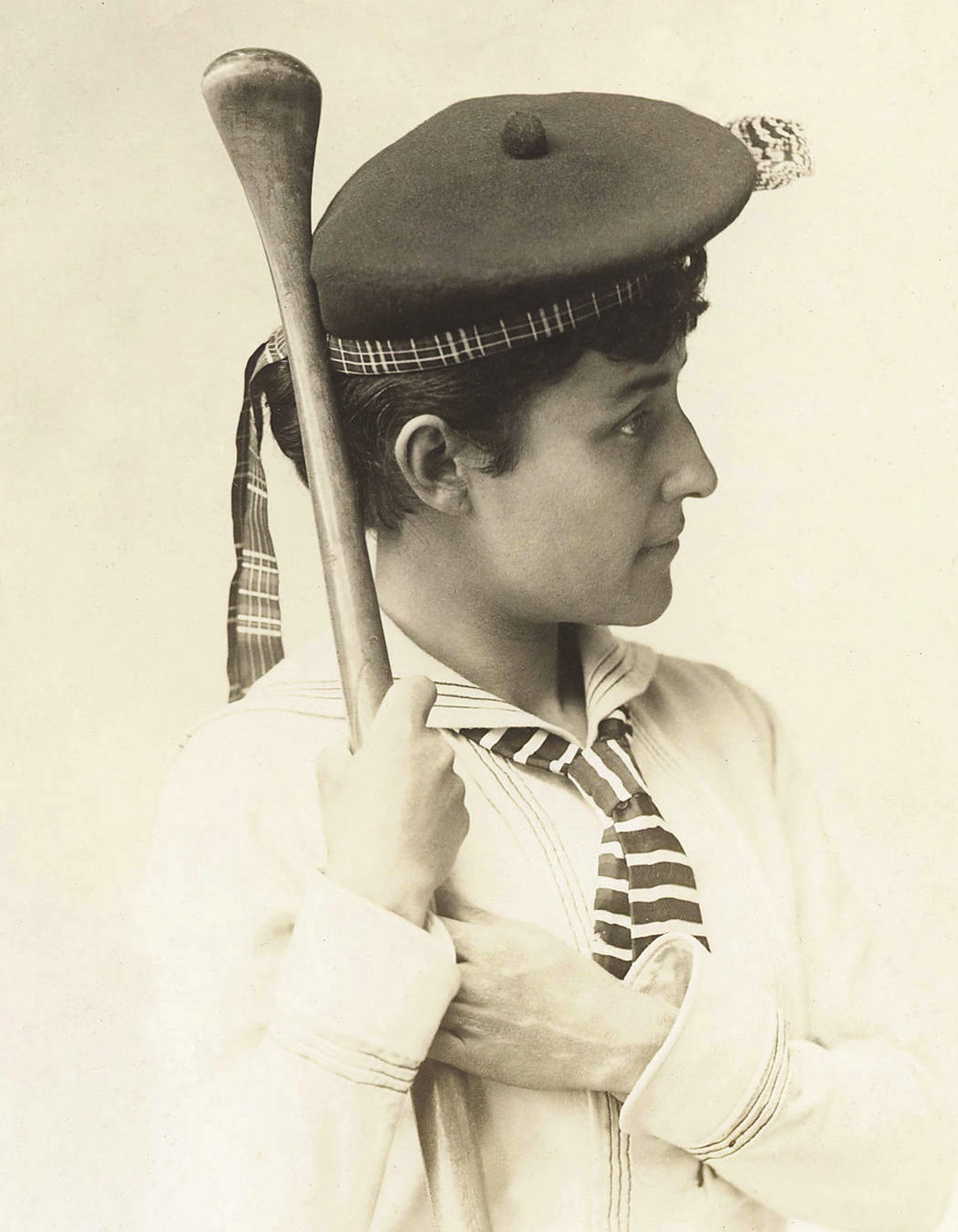
The archival photograph used here carries the same caution. It shows Johnson outfitted with a paddle and tam-o’-shanter; Studies in Canadian Literature reproduces it courtesy of Simon Fraser University Libraries but gives no date.[4] It documents how canoeing entered her photographed public image. It cannot, by itself, settle what every canoe in her writing means.
The lullaby changes hands
The passage ends by returning to the poem’s earliest image. At first, the wind rocks its cradle between the hills but refuses to propel the sail. The speaker then promises that the paddle will lull the wind to sleep. After the rapid, the rocking motion appears a third time: a fir tree is “rocking its lullaby,” and its emerald wings are “swelling the song” of the paddle.[1]
That final transfer completes the doubled verbs’ quiet argument. The speaker has successfully crossed the dangerous water, but the reward is not an image of solitary command. The last repeated action belongs to the tree: “Swings, swings.” Its movement enlarges a song that began in the paddler’s hands.
The voyage has not subdued the river, either. The craft races one rapid and moves on; the water continues through its bed. What has been achieved is coordination. When the wind fails, the speaker changes tools. When the current quickens, the stanza keeps its shape while its sounds grow violent. When the danger passes, paddle, canoe, bubbles, and fir return the rhythm to ease.
Johnson’s seven doubled verbs thus do more than imitate a blade entering water. They mark a sequence of attentions. The pleasure of the poem is feeling that sequence repeat; its intelligence is discovering, each time, where the motion has gone.
Sources
- E. Pauline Johnson, “The Song My Paddle Sings,” Representative Poetry Online, University of Toronto Libraries—line-numbered text from the 1921 seventh edition of Flint and Feather.
- E. Pauline Johnson, The White Wampum. John Lane, 1895; Project Gutenberg eBook no. 52988—first-collection text of the poem and its punctuation.
- Carole Gerson and Veronica Strong-Boag, “Johnson, Emily Pauline,” Dictionary of Canadian Biography, vol. 14—biography, Grand River canoeing, recital career, and publication history.
- Jeffrey Swenson, “‘A Scrap of the Savage’: E. Pauline Johnson’s Canoeing Journalism,” Studies in Canadian Literature 43, no. 1 (2018)—canoeing context, gendered and racialized self-presentation, and the archival photograph.
- William Ready Division of Archives and Research Collections, McMaster University Library, “E. Pauline Johnson fonds”—finding aid for manuscripts, photographs, performance material, and canoeing journalism clippings.