Alice Waythorn pours cognac into her husband's coffee. He does not take it that way. Earlier that day, he has watched her previous husband prepare precisely that drink in a restaurant. The mistake lasts a moment; the blush that follows makes it impossible to dismiss. An intimate gesture has arrived with a history.[1]
Edith Wharton's “The Other Two” first appeared in Collier's on 13 February 1904 and entered The Descent of Man and Other Stories that year.[2] Its comic situation is compact: Waythorn has married a twice-divorced woman, and circumstances keep bringing her former husbands into his company. Yet the most unsettling discovery is about something he thought he understood already. Alice's ease, the quality that makes marriage feel like a refuge, may be an accomplishment acquired through accommodating other people.
This essay discusses the complete story, including its ending.
The comfort of a clear face
In section I, Waythorn admires Alice's “perfectly balanced nerves.” Her daughter Lily is ill, but he expects Alice to emerge from the sickroom capable of enjoying dinner. He values her affection for the child; he also values the way that affection appears to leave his evening undisturbed.[1]
Wharton gives this admiration an uncomfortable intimacy. Who has not found another person's composure reassuring? The desire is recognizable before its demands become visible. Waythorn wants to live beside someone whose feelings will steady his own. The difficulty begins when reassurance becomes his measure of what she feels.
Scott Emmert's study of Wharton's early stories emphasizes how her restricted viewpoints involve readers in a character's flawed interpretations. Discussing this opening, he draws attention to the distance between Alice looking untroubled and Waythorn assuming her worries have disappeared.[4] That distinction changes the reading experience. We can hear the relief in his judgment while noticing how little evidence supports it.
The prose lets us inhabit a pleasant misapprehension. Alice smiles; Waythorn feels better; her inward life seems, briefly, to have been accounted for. Reading closely means resisting that last step. A face can offer comfort without reporting everything its owner knows.
The wrong drink, exactly prepared
The coffee episode in section II sharpens this problem through a repeated action. In the restaurant, Wharton slows down Varick's preparation of his drink. Later, Alice's hands reproduce the combination at home.[1] Because the reader has already seen its components assembled, recognition precedes explanation. The object does the work of an accusation before anyone makes one.
Notice what the scene does not establish. A remembered preference cannot tell us whether Alice still loves Varick, misses him, or thinks about him often. Habit can survive a feeling. The scene's precision makes its evidence powerful, but also limited: something learned in one marriage has entered another.
That is enough to disturb Waythorn because, just before the mistake, his pleasure has become a fantasy of possession. The narration repeats “his” as he contemplates Alice's body.[1] The possessive gathers her into the present marriage; the familiar movement of her hands quietly undoes its exclusiveness. He can marry the woman without becoming the origin of everything she does.
There is a further sting. The attentive service he enjoys depends on knowledge of another person's tastes. When such knowledge becomes visible as learned behavior, he finds it less flattering. He wants the benefits of experience to arrive with the freshness of a first discovery.
A necktie becomes a biography
Waythorn's encounters with Haskett, Alice's first husband and Lily's father, expose another weakness in his way of reading people. In section III, Haskett's ready-made tie sends him imagining the furnishings, outings, and aspirations of Alice's earlier life.[1]
The sequence is funny because the reconstruction is so lavish in proportion to its evidence. A small accessory becomes permission to furnish an entire household. Wharton makes class prejudice productive: it generates pictures, supplies missing scenes, and gives its owner the sensation of understanding.
Those pictures are Waythorn's inventions. Treating them as recovered facts about Alice would repeat his error. Their vividness tells us how practiced he is at recognizing social distinctions, and how easily that competence can impersonate knowledge of a marriage.
Haskett gradually supplies a different kind of evidence. His persistence concerns Lily's welfare; he has sacrificed a profitable business to live near her.[1] The contrast asks us to reconsider what deserves interpretive weight. Clothes make an immediate impression. Sustained care becomes visible over time. Wharton's story takes long enough for the second to embarrass the first.
This does not give Waythorn, or us, a complete account of why Alice left Haskett. A considerate father need not have been an ideal husband. The ethical gain lies in revising a judgment without pretending that revision grants access to everything previously hidden.
The daughter learning to please
Haskett's complaint about Lily's governess in section IV brings the story's quieter anxiety into focus. He fears the child is becoming “too anxious to please” and less truthful.[1] The phrase makes a disturbing companion to Waythorn's early praise of Alice. What looks like a wife's valuable tact may look, in a daughter, like a danger to be resisted.
The resemblance is an invitation to compare, rather than proof that mother and child are identical. Haskett is worried about a developing habit. Waythorn is enjoying the finished appearance of social fluency. Between those positions lies a question the adults never put together: what does a person learn to conceal while learning to keep everyone comfortable?
Alice's flexibility also exposes a contradiction in Waythorn's wishes. When she offers to follow his preference about speaking to Varick, her readiness to comply irritates him.[1] He wants deference to confirm his importance, then wants independent conviction to reassure him that the deference comes from a substantial self. The same response cannot reliably satisfy both demands.
Emmert reads the story's economic language as evidence that Waythorn continues to value Alice as a possession even when his opinion changes.[4] That argument is useful because it prevents us from confusing every new insight with greater generosity. A person can become better informed while retaining the habits that made the first judgment inadequate.
Room for a third cup
The ending gathers all three men into Waythorn's library. A plumbing problem has displaced the household tea service; Alice arrives and distributes the cups. Waythorn receives the “third cup” and takes it “with a laugh.”[1]
The ordinary inconvenience matters. Wharton gives the encounter the accidental awkwardness of domestic life. The men have arrived with separate purposes, and the room has failed to keep those purposes apart. Alice must make the shared space usable.
Her hospitality accomplishes something real. Whatever we think of her motives, she supplies a practical form for coexistence. A cup can be accepted before a complicated relationship has been explained. The gesture creates a little time in which nobody needs to win.
The story's reception registers the difficulty of deciding what that ease means. Library of America's account recalls an early critic's disgust at its treatment of divorce and Upton Sinclair's later contention that former spouses could simply meet with ordinary decency.[3] Sinclair's response catches the comic disproportion between the encounter and the men's distress. Still, the distribution of labor remains worth watching: Alice is the one making ordinary decency possible.
Waythorn's laugh allows a warmer reading of him. Perhaps he can now bear belonging to a history larger than his own marriage. But Wharton gives us an action, not a certificate of moral transformation. We cannot know how far his accommodation extends beyond this room.
At the coffee table, an old habit made him feel excluded from an intimacy he thought was his. At the tea table, he accepts a place among other people. The shift is small enough to be credible and large enough to change the atmosphere. Alice's practiced ease has room for him, once he can tolerate its having room for someone else.
Sources
- Edith Wharton, “The Other Two,” in The Descent of Man and Other Stories (1904), Project Gutenberg — sections I–V; primary text for the coffee episode, Haskett's visits, Lily's governess, and the final tea scene.
- The Edith Wharton Society, “Edith Wharton's Short Stories: Publication Information” — magazine date and first collection for “The Other Two.”
- Library of America, “Edith Wharton, ‘The Other Two’” (30 April 2021) — early critical objections and Upton Sinclair's 1922 response.
- Scott Emmert, “Drawing-Room Naturalism in Edith Wharton's Early Short Stories,” Journal of the Short Story in English 39 (Autumn 2002), pp. 57–71, reprinted in “Wharton, Edith: General Commentary” at Encyclopedia.com — limited viewpoint, social constraint, and Waythorn's economic language.
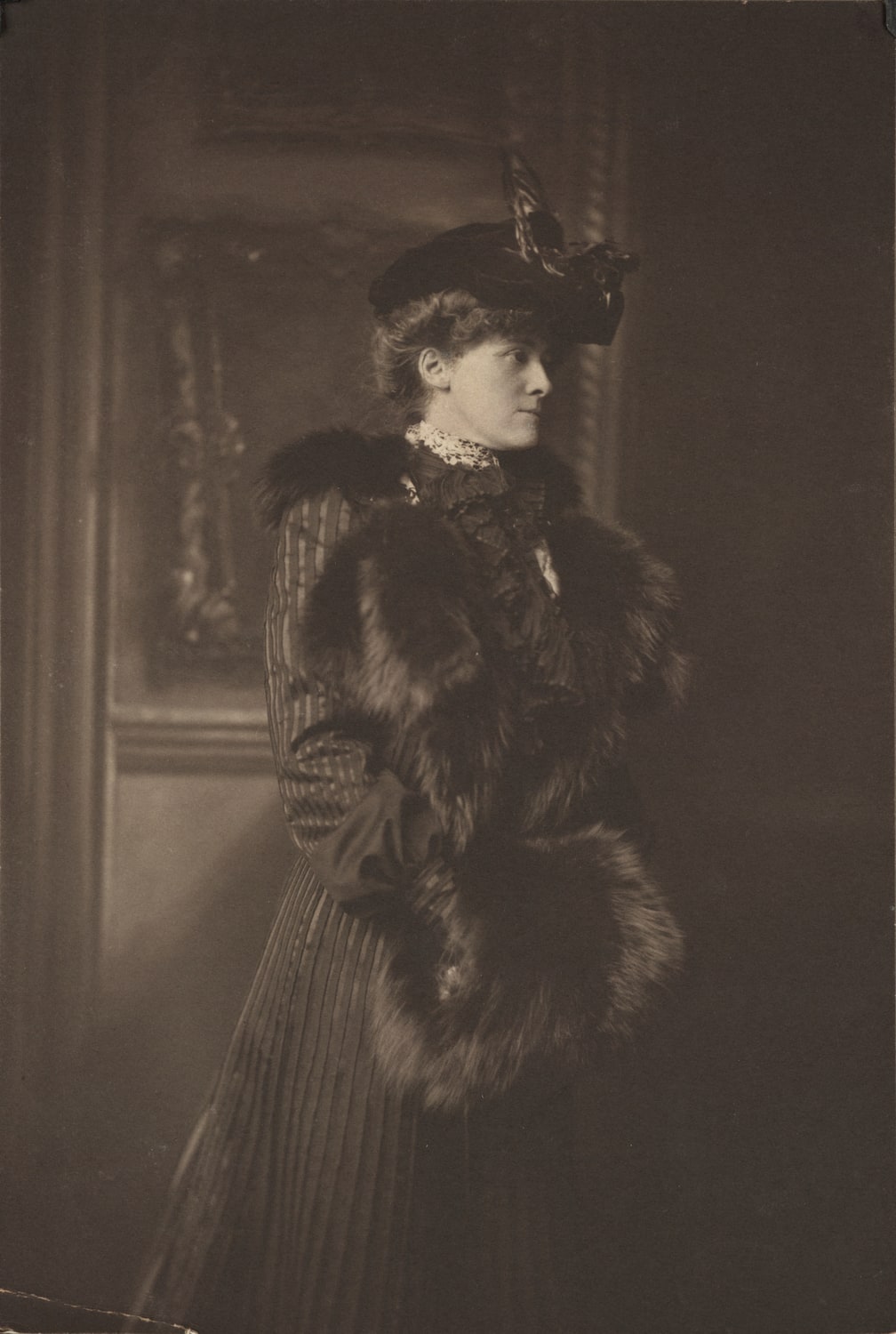
- Wikimedia Commons, “Edith Newbold Jones Wharton in hat with fur muff” — archival photograph dated 1907, credited to the Beinecke Rare Book & Manuscript Library, Yale University.