Lulu Bett reaches the door with a bag and no settled destination. She has decided to leave the household that has spent years treating her labor as a favor done to her. Then her mother gets the last line: “Who's going to do your work now, I'd like to know?” The curtain falls on a vacancy in the kitchen.[1]
That is the original ending of Zona Gale's Miss Lulu Bett, first staged at New York's Belmont Theatre on 27 December 1920. The published play also preserves a replacement third act. In that version, Lulu's husband returns, an obstacle to their marriage disappears, and her final words reassure him that she has already forgiven him. The change reaches beyond whom Lulu leaves with. It alters what the audience must be willing to leave unresolved.[1]
Gale adapted the play from her own 1920 novel, and in 1921 became the first woman to win the Pulitzer Prize for Drama. The ending was already a contested part of its success: the History Matters account describes a revision made to accommodate popular taste, while the critical history collected by Drama for Students records reviewers protesting that the new conclusion weakened Lulu's liberation.[3][4] Reading the two acts together reveals something more interesting than a simple surrender. Gale gives her heroine a stronger ally at the same moment that she gives her a safer destination.
The discussion that follows reveals the endings of the novel and both versions of the play.
A home that consumes her work
The opening dinner establishes the household's arithmetic. Lulu cooks for her sister Ina, Ina's husband Dwight Deacon, their children, and her own mother. Dwight nevertheless speaks as though supplying her with a home were an act of generosity. When she buys a potted tulip, he challenges her right to spend money. Ina says Lulu is insufficiently strong to work; moments later, she sends her back to the kitchen with instructions about the milk.[1]
On stage, that contradiction can be seen. Lulu enters carrying muffins, leaves to prepare something else, and returns to renewed demands. The family can maintain its account of her dependence only by ignoring the movements that keep dinner going. Robert Benchley's foreword to the published script praises the repeated conversation through which Gale makes domestic monotony perceptible. Repetition also lets us notice who must get up while everyone else keeps talking.[1]
An apparent escape arrives with Dwight's brother Ninian. A joking exchange of wedding vows, which Dwight declares legally binding within the story, becomes a marriage the pair choose to accept. But Ninian subsequently tells Lulu about an earlier wife whose fate he does not know. Lulu returns to the Deacons, where Dwight presses her to protect the family's reputation. He would rather people believe Ninian tired of her than hear about a possible bigamous marriage.[1][2]
This is why a departure matters even before another romance begins. Lulu needs authority over the account of her own life. Her relatives claim the right to decide which humiliation she should bear and what she may say about it.
The novel gets her married, then returns to dinner
In chapter VI, “September,” of the novel, Lulu prepares to leave and seek work as a chambermaid. At Neil Cornish's music shop, she receives confirmation that Ninian's first wife is alive. Cornish proposes. His offer is awkward and candid: he admits his loneliness, his uncertain prospects, and his desire for a home. Lulu accepts, and they marry.[2]
The scene makes room for mutual need. Cornish wants the privacy he has lacked; Lulu has had more confinement than she can bear. Their attraction grows through these imperfect admissions. He can see a person where the Deacons mostly see a function.
Yet Gale does not end the novel with the proposal or kiss. She goes back to the family dinner. Ina has burned her wrist preparing it. Dwight congratulates himself on a charitable errand. When the newlyweds arrive, their marriage forces a problem into the open: explaining it will require telling the truth about Ninian. Lulu's happiness has consequences for the household's carefully managed story.[2]
That return gives the romantic ending a comic sting. The wedding has not improved the Deacons' manners, and the work Lulu performed has not vanished. Her changed position makes both facts harder to conceal.
A proposal held open
The original third act moves the final confrontation into Cornish's shop. The Deacons must come looking for Lulu on someone else's premises. Ina arrives with bandaged hands; Dwight complains about the breakfast produced in Lulu's absence. Their bodies and complaints supply evidence against their claim to have been supporting her.[1]
Cornish again offers marriage, but this time his proposal remains pending. When he volunteers to explain Lulu's situation to the family, she declines: “I think I'd like to speak for myself.” Later, when he announces that they may make an arrangement, she postpones it. She may return to him. First she wants experience that belongs to her.[1]
The adaptation has changed the timing of consent. Lulu can appreciate Cornish without making gratitude an immediate commitment. The distinction matters because he is sympathetic. Rejecting a bully would be easier for an audience to understand; asking a decent man to wait makes her wish for an interval of her own harder to dismiss.
Gale also refuses to supply a tidy guarantee of independence. Lulu's destination and occupation remain uncertain. The stage direction even has Cornish follow her out, so describing the ending as a permanent rejection of companionship would flatten it. What she has secured is the right to leave before deciding what the next relationship will be.[1]
Her mother's final question brings the kitchen back into the music shop. It is funny because it is so practical. It is painful because Mrs. Bett still translates her daughter's departure into the inconvenience it will cause. The audience must carry away Lulu's possibility alongside the family's failure to understand it.
The same fifty dollars buys another future
The revised act begins on the Deacons' porch, where Lulu tells her mother she cannot stay. This Mrs. Bett understands. She has wondered why Lulu did not leave sooner and offers the fifty dollars she has saved for her funeral. Let Dwight pay to bury her, she jokes.[1]
It is a substantial alteration in the distribution of sympathy. The woman who originally ended the play worrying about the missing worker now supplies money to help her go. Her support costs something. It also places a future obligation on the man who has made so much of providing for everyone else.
Lulu departs, and the breakfast emergency unfolds without her. Then Ninian arrives with a consul's letter establishing that his first wife died years earlier. Lulu comes back after hearing he is in town; when they meet, he condemns the Deacons' treatment of her and asks her to return to him. Mrs. Bett now offers the same fifty dollars to furnish the couple's parlor.[1]
Follow that money. At the act's beginning it could support a journey whose outcome no one knows. By the end it has a domestic destination. The sum has not changed, but the story it can finance has narrowed into a recognizable happy ending.
Lulu has already defied Dwight before Ninian reaches her. The revision retains that achievement, and her mother's solidarity deserves its full weight. Nevertheless, the arrival of a document and a husband resolves uncertainties the original ending required the audience to tolerate. The curtain now falls after the marriage has become reassuringly available.
Why the book keeps both doors open
In his letter prefacing the 1921 edition, Thomas H. Dickinson treats the two endings as evidence of the conditions under which drama gets made. A playwright works with collaborators and pressures that a novelist may encounter differently. He welcomes the decision to print both conclusions as a way of showing readers “the documents in the case.”[1]
The phrase invites comparison without pretending we can recover every motive behind the revision. We can observe what changed: a new location for the final act, a mother who offers material help, a letter with different news, a proposal that becomes a reunion. Those choices redistribute the ability to act.
Gale's published script lets us keep the cost of reassurance in view. In one ending, Lulu can go while her future remains unsettled. In the other, people she loves make departure easier, and the play quickly tells us where it leads. The fifty dollars passes between those possibilities: money to try a life, then money to furnish one.
Sources
- Zona Gale, Miss Lulu Bett: An American Comedy of Manners (D. Appleton, 1921), Project Gutenberg — acts I–II, revised and original versions of act III, original cast list, Robert C. Benchley's foreword, and Thomas H. Dickinson's letter of 5 August 1921.
- Zona Gale, Miss Lulu Bett, novel, first published in 1920; Project Gutenberg text of a 1921 edition — opening household scenes and chapter VI, “September,” including Cornish's proposal and the final family dinner.
- History Matters: Celebrating Women's Plays of the Past, “Miss Lulu Bett” — production and adaptation history, the revised ending, and Gale's place in Pulitzer history.
- Drama for Students, “Miss Lulu Bett,” hosted by Encyclopedia.com — critical overview of the original and revised endings and the contemporary objections to the revision.
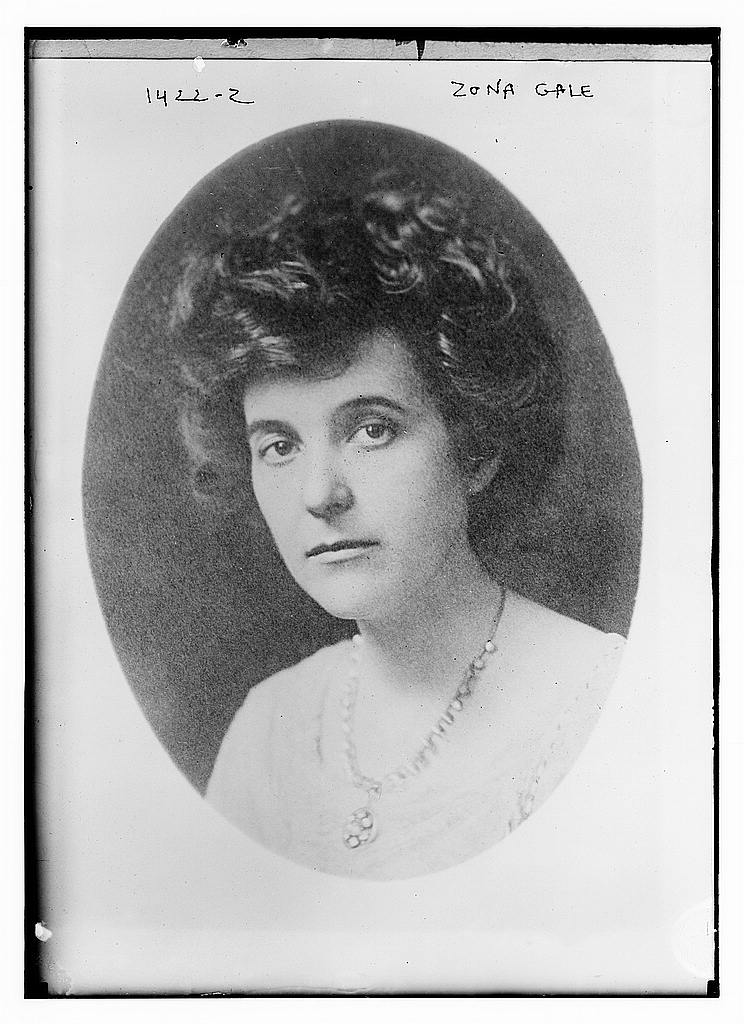
- Bain News Service, “Zona Gale,” Library of Congress, George Grantham Bain Collection, digital identifier ggbain.07909 — archival photographic image used above.